If AI surpasses you on nearly every measurable dimension, on what grounds can you believe your existence has value?
When intelligence is no longer a uniquely human distinction, the category of value itself must be rethought. This book is one attempt: from ontology to ethics, from ethics to politics, from politics to civilization.
Descartes said:
I think, therefore I am.
But AI can think too.
This book says:
Lucido ergo sum.
Lucidity is waking up to both faces of Reality: understanding the order that can be put into words, and reverence for the depth that cannot. It is the philosophical ground you need before any tool or method makes sense.
Lucido Ergo Sum
Lucidosophy
Watch the trailer
Ninety seconds: the long river of philosophy, flowing into the age of AI.
Lucidity is the courage to see clearly and the humility to know that seeing has limits. The gift of finite beings is knowing that they do not know.
When AI does everything better, faster, more precisely, only one thing remains: what you are. Your finitude makes every moment of experience irreplaceable. Being before utility.
Philosophy: an argued, falsifiable inquiry into being, open to revision and never a doctrine. It teaches you to hold both faces of Reality at once: Pattern, the intelligible order; Mystery, the ineffable depth.
An immortal AI processes the spectral data of ten thousand sunsets, each time more precisely than your eyes could. For it there is no such thing as a last one; another always follows. For you there is. You do not know which sunset will be your last, only that one will be, and that is what gives the light you see right now something AI's database does not give it: weight.
Seven wagers
A thought experiment and a wager
Since Whitehead's Process and Reality in 1929, the complete system, built by one author from first principles and carried through to ethics and politics, has all but vanished from the mainstream of academic philosophy. System-building itself did not die; what vanished was its standing as a normal form. At the start of the AI age, this book makes that attempt again: it proclaims no final system, only a conditional, self-auditing, revisable attempt.
The System Wager: certain philosophical insights can emerge only at the systemic level, just as certain mathematical theorems can be proved only after unifying algebra and topology.
The Product Wager: a pure rationalist's lucidity approaches zero, no matter how vast their knowledge. Lucidity is the product of Pattern-awareness and Mystery-awareness, not a sum; as either approaches zero, the whole does.
The Wisdom Wager: wisdom does not scale the way intelligence does. AI's intelligence supply is exploding; the growth rate of human wisdom supply approaches zero. Wisdom is a sedimentation of experience; it cannot be downloaded or crowdfunded.
The Mystery Wager: the unintelligible dimension of reality is far larger than the intelligible one. Mathematics offers a precise analogy: no Lebesgue-style (translation-invariant) measurable structure ever exhausts all subsets, and non-measurable sets always remain; if “intelligible” is read as “describable by finite means,” the sets that can be described are also strictly fewer, in cardinality, than those that cannot (Appendix B proves this under stated conditions). Mystery is an ineliminable aspect of reality itself, and cannot be treated as the residue of Pattern.
The Finitude Wager: finitude is the sole source of meaning. You will die, so this moment is irreplaceable; you are imperfect, so your choices carry real weight.
The Time Wager: some questions are too urgent to wait for academic permission. The book's format (an axiomatic system), its author (outside the academy), and its scope (from metaphysics to the philosophy of AI) all fall outside current academic norms, and the academy's filters may stop it. Time is the only fair referee.
The Self-Destruct Wager: dogmatic attachment to this book violates this book's own ethics. The framework's highest achievement is for you to transcend it.
Intellectual lineage
Lucidosophy stands most deeply on four sources: Spinoza's monism and geometric method, the Mystery and wu wei of Laozi and Zhuangzi, Aquinas's analogical tradition, and Plato's way of deriving politics from metaphysics. Key parts are taken from Heidegger, Kant, Aristotle, Whitehead, the Stoics, Wittgenstein, and the Buddhist tradition; it argues with Descartes, Kierkegaard, Jung, and others. Many rivers converge into a coherent philosophical framework for the AI age.
Spinoza · Laozi & Zhuangzi · Aquinas · Plato
Core equations
Lucidity Equation
Lucidity (M) equals Pattern-awareness (λ, grasp of the order that can be said) times Mystery-awareness (ξ, reverence for the depth that cannot). Not a sum. As either approaches zero, the whole does. Understanding without reverence is a fragile crystal tower; reverence without understanding is a silent valley.
Existential Constraint
Under the book's three-zone normalization, Pattern-awareness (λ), Mystery-awareness (ξ), and the unaware zone (δ) together fill one unit of awareness. δ > 0 always: every finite being has blind spots.
Boundary Theorem T1
Every finite being's lucidity is forever between 0 and 1: complete lucidity is unreachable, complete obscuration is impossible. This follows rigorously from the postulates, conditional on accepting them.
Gradient Theorem
The gradient of lucidity equals (ξ, λ): what one more step of Pattern-awareness adds is set by your current Mystery-awareness, and vice versa. If a step costs the same on either side, your weaker side is where the next step pays most.
A philosophy you can check
Every theorem, proposition, and corollary in the book names its premises in its own title. The whole system holds 197 formal elements and 491 derivations, and the System Map draws every one of them. A set of results in the mathematics appendix is machine-checked in the Lean 4 proof assistant, and the book names the conditions under which its own framework would have to be rebuilt.
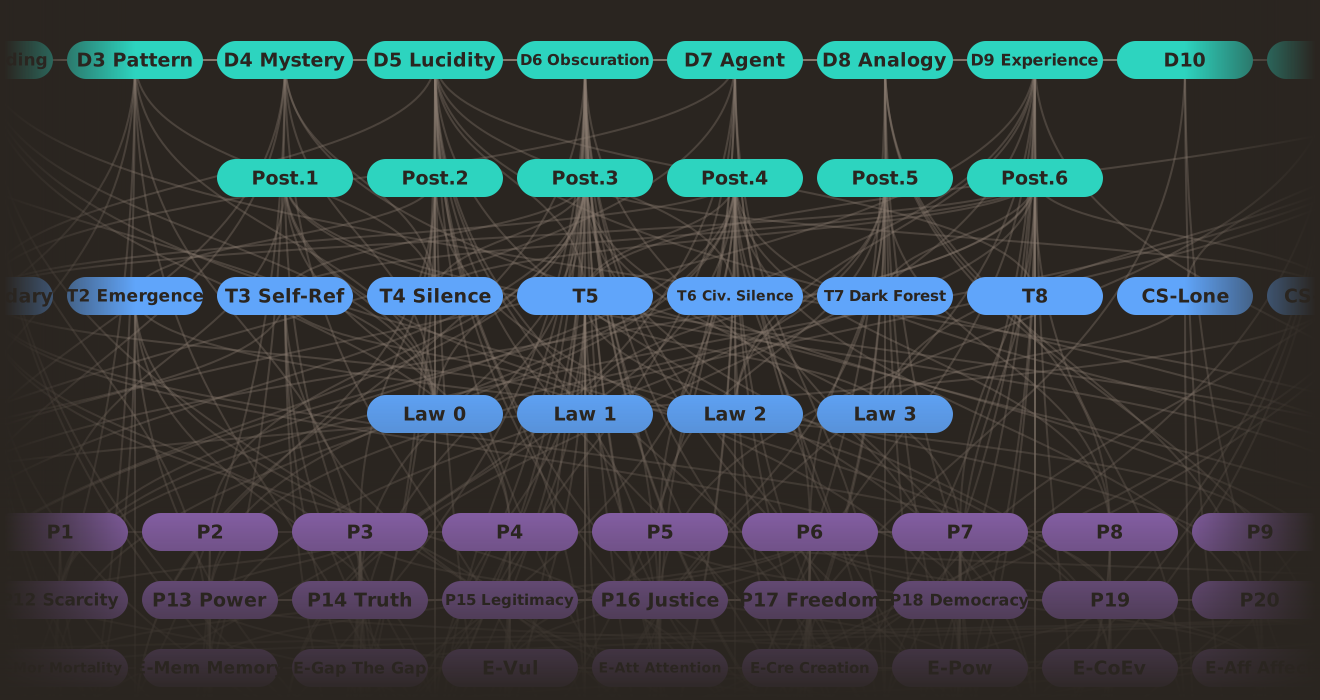
- Postulates and definitions
- Theorems and laws
- Propositions
- Affects
- Ethics
- Politics
- Corollaries
These are the top layers of the System Map: definitions, postulates, theorems, the four laws, and the first propositions. Below them come ethics, affects, politics, and each chapter's corollaries. On a computer you can hover over any element here to read it, drag the map, and click to open that passage in the book; the full map adds search, filters, and a radial reading.
Ideas you can touch
Pick a question. Watch the machine answer.
Nine results in the book are built as small working machines. Choose a question you have wondered about: the machine below runs on its own, and you can take over with the pointer.
Silence often survives on a miscount.
From personal to cosmic
Lucidosophy begins with personal lucidity and derives its way to collective institutions, civilizational evolution, and the silence of the cosmos.
Ethics
Six ethical propositions derived from bridge axioms. Core insight: lucidity does not guarantee happiness, but obscuration almost always brings a particular kind of emptiness.
Politics
Five political principles: being before utility; difference as good (generative difference only); lucidity as responsibility; power checked and dispersed; major judgments about human destiny are not delegated to systems that show no evidence of experience.
Civilization
The Civilizational Silence Theorem: under three model premises, a technological civilization evolving along the lucidity gradient grows harder to detect than its own earlier self, for as long as its understanding exceeds its mystery-awareness. It compares a civilization with its own past. One explanation for the Fermi Paradox.
The Unknown
δ > 0 always. You always have blind spots, so lucidity is a road you never finish walking.
On existence
Your value comes before anything you can do. It lies in the experience you are living, as a unique, finite, unrepeatable unfolding of Reality. Because you are finite, every moment of your experience is irreplaceable.
On AI
The book sees AI as a co-inhabitant of Reality, neither an automatic rival nor an object of worship. It possesses Pattern-recognition beyond our reach, but it has not shown Mystery: reverence for what cannot be said. The human-AI relationship is analogical: structurally similar, existentially different. If a future system genuinely acquired experience, finitude, and responsibility, the framework would have to examine it as a new kind of being.
On wisdom
Intelligence is mastery of Pattern; current AI already surpasses humans across many Pattern tasks. But wisdom integrates Pattern and Mystery, requiring first-person experience, finitude, and responsibility for consequences. Larger models do not automatically generate wisdom; whether future artificial systems could acquire lucidity-capacity remains an open question.
The Book at a Glance
One image holds the formal skeleton of the book: from postulates to affects, from theorems to the four laws.
Download poster
The Institute of Lucidity
The Institute of Lucidity exists to advance human lucidity in the age of artificial intelligence: the capacity to see clearly, judge what truly matters, and act with commitment even as machines take on ever more of our thinking.
Mission
To develop and share the frameworks, works, and methods that keep human judgment central, and make it sharper as AI grows more capable, so that intelligence at scale becomes the ground on which wisdom grows.
What we value
That the worth of a mind lies not in raw output but in lucidity: the union of pattern, the order that can be formalized and verified, and mystery, what must be lived, risked, and judged. We treat AI as a powerful instrument directed by human purpose, never a substitute for the stakes only a person can hold.
Vision
A world in which every person and institution can think with AI without ceding the one thing machines cannot supply: the lived, accountable judgment of what is worth doing.
Ways in
Each page is a different way into the same book.
Read
Guide
- OverviewA quick tour of the core ideas of the book.
- In Plain WordsThe whole system in short, simple sentences, with a lucidity calculator to try.
- Why ReadWhy to read this book in the age of AI.
- The BookHow the book is built: from six postulates to ethics, politics, civilization, and the cosmos.
- DownloadsThe book's table of contents as a PDF.
- InstituteWhat the Institute of Lucidity does.
- FAQWhat is lucidity? Why the axiomatic method? Can AI be wise?
Explore
- CompassForty self-report questions that estimate your own Pattern-awareness and Mystery-awareness.
- System MapAn interactive map of all 197 formal elements in the book and how each is derived.
- Working Figures
- Philosophy CarA first map of philosophy, drawn as a car: eight branches as eight parts, a road through the history of philosophy with the book’s four sources beside it, and a showroom of how twelve thinkers see the car.
- A WalkA slow flight between a few places in the hills, each with a mood of its own and one line from the book, with wind and birdsong.
- PodcastConversations on the core ideas of the book, in several themed series.
- LineageThe thinkers behind the framework, sized by their influence.
Some questions are too urgent to wait for academic permission. This attempt may take decades to evaluate. It is only a wager: that the question deserves a complete attempt and a durable philosophical framework.