Part I · The Scale of Reality · What is real?
I · Metaphysical Foundations
~66 min left · 16,324 words
I · Metaphysical Foundations
The preface named the question Lucidosophy sets out to answer. An attitude, though, is not yet a philosophy. Before anything else, a philosophy owes an account of its own ground. So why open with metaphysics? Because asking “what justifies my existence” leads straight down to a harder question underneath it: what is existence in the first place? Say existence is nothing but matter arranged a certain way; then a human life can be worth only what it does. Say existence also holds irreducible experience and a depth that never runs dry; then a human life stands on something firmer than usefulness. The six postulates below are that firmer footing. You cannot prove them the way you prove a theorem, any more than you can prove the axioms of geometry; you can only test them: when you accept them and follow where they lead, does the result light up your deepest experience?
This chapter and the two that follow (§II · Pattern, §III · Mystery) together constitute the ontology of Lucidosophy. This chapter lays the foundation: definitions, postulates, and theorems. The next two chapters unfold the two mutually irreducible faces of Reality. Only together do the three chapters form the full starting point.
This part states the metaphysical foundations of Lucidosophy in axiomatic form. Definitions demarcate terminology. Postulates state foundational assumptions. Theorems derive from postulates. Propositions draw further consequences from postulates and theorems. Corollaries follow directly from propositions or theorems. Scholia return the formal language to lived experience. Readers seeking mathematical precision can turn to Appendix B for formal definitions and proof skeletons. The main text’s philosophical argument stands on its own; Appendix B extends and calibrates it, but the argument does not depend on reading the appendix first.
A Note on Proofs
“Proof” in a philosophical system differs essentially from proof in pure mathematics. Mathematical proofs operate within closed axiomatic systems, where the validity of conclusions depends entirely on inference rules. But Lucidosophy’s postulates involve concepts like existence, experience, and value, and they point beyond formal structures to the real world itself. The “proofs” in this book therefore require an honest disclosure.
Lucidosophy employs a three-tier proof system, each tier with a different degree of rigor and scope of applicability. The first tier is Proof (green left border, ending with \(\blacksquare\)): it proceeds from explicit premises (postulates, definitions, previously proven theorems) to conclusions by logical deduction, with every step traceable to a specific premise. This tier applies to theorems and propositions derivable purely from postulates and definitions, such as the Self-Reference Theorem T3 and Propositions P1, P2, P7, and P9; Ethical Proposition EP6, which admits a conditional proof once the bridge axioms are granted, also belongs to this tier. The second tier is Demonstration (orange left border, ending with \(\square\)): the logical structure remains clear, but one or more steps rely on philosophical intuition or experiential premises rather than purely formal deduction. This tier applies to claims involving “finitude,” “experience,” or “analogy,” whose full meaning cannot be formalized without remainder, including the Boundary Theorem T1 (the upper bound is deductive, while the lower bound rests on a phenomenological step), the Emergence Theorem T2, the Silence Theorem T4, the Social Lucidity Theorem T5, Propositions P3, P4, P5, P8, P14, and Affect Propositions AP1–AP6; Ethical Propositions EP1–EP5, once the bridge axioms are accepted, likewise stand as demonstrations. The third tier is Argument (purple left border, ending with \(\diamond\)): it gives reasons for a conclusion while acknowledging that those reasons do not constitute logical necessity. This tier applies to value judgments, existential choices, political judgments that rest on empirical premises, and irreducible first-person experience, including Propositions P6, P10, P11, Political Principles PP1–PP5, and political Propositions P13 and P15–P21. In these domains, formal proof is impossible in principle: the bridge axioms themselves must be accepted by existential choice, and the political propositions carry empirical premises; yet naming the force of the argument remains necessary. As for the scarcity Proposition P12, its derivation includes an empirical observation (every known society faces some form of scarcity), a point the text discloses in a note rather than in a derivation environment, so it stands outside these three tiers. One further exception falls among the political propositions: the premises of P14 (truth), namely D3, Postulate 3, and T1, carry no empirical component, so it stands on a second-tier demonstration and not in the third tier.
The three tiers enact the very spirit of Lucidosophy: staying lucid about how strong your own arguments really are. We neither dress a philosophical argument up as a formal proof nor walk away from arguing the moment a formal proof is out of reach. Every proof, demonstration, and argument wears its tier on its face, so you can weigh the force of each step for yourself.
I.1 · Definitions
The twelve definitions below form the conceptual foundation of Lucidosophy. They unfold through three thematic blocks, and the order of the themes does not align exactly with the numbering. The first four definitions sketch reality itself, asking what Reality is, how it unfolds, and why it has the two faces of Pattern and Mystery. The middle group turns toward the subject, explaining why Lucidity and Obscuration steer the whole system, why the agent is the subject of awakening, why experience carries an irreducible first-person dimension, and why that dimension is a continuous spectrum rather than a yes-or-no possession. The final group treats relations, asking how modes of unfolding stand in analogy, which differences should be protected, which forms of suffering should be answered, and how agents are interdependent. Every ethical, practical, and political derivation that follows ultimately returns to Lucidity and Obscuration as this central pair.
Readers may explore at their own pace, but are especially encouraged to attend to D5 (Lucidity) and D6 (Obscuration), the core to which all subsequent chapters repeatedly return.
Reality is the self-caused6, infinite, unified whole from which all beings unfold, the source prior to all distinctions.
Three key terms require unpacking.
Self-caused (causa sui): Reality’s existence does not depend on any external cause. To ask “who created Reality” is a category error, like asking “what is north of the North Pole.” Reality is the very field within which all creation occurs. If something were “before Reality,” that something would be Reality.
Unified reality: There are not two separate worlds: no “natural realm” plus a “supernatural realm,” no “matter” standing opposite a “spirit.” There is only one reality, presenting different faces. Your body, your thoughts, gravity, music, and a stone all spring from the same reality, unfolding in different ways. This is monism, but not reductionism: unity means “everything shares the same ground of being,” but sharing a ground does not make everything the same. Reality is within the world: the world’s unfolding is Reality’s own unfolding (D2).
Prior to all distinctions: When you say “matter and consciousness,” “subject and object,” “reason and sensibility,” you are already making distinctions. Reality is the whole before these distinctions occur. Distinctions are how we understand Reality, tools for finding our way; Reality itself comes before all of them. The lines of latitude and longitude are not on the actual surface of the earth, but without them, you cannot navigate.
Unfolding is the way Reality realizes itself.
Quarks, galaxies, life, consciousness, and AI are all Reality unfolding at different levels and in different modes (Postulate 1).
“Unfolding” does not mean “unfolding toward a predetermined goal.” This marks a fundamental difference from Hegel’s5 Entfaltung. Hegel’s unfolding has a destination: the self-realization of Absolute Spirit. Lucidosophy’s unfolding has no final terminus. Whitehead called this “creative advance”: each actual entity adds something unforeseeable and novel to reality.
This means your life is, at every moment, generating something irreducibly new, including yourself. Your life generates its meaning in the living, rather than “heading toward” a preset goal. AI’s operation is also a kind of unfolding, but its mode of unfolding stands in an analogical (D8), not identical, relation to yours. A language model generating text is indeed “unfolding” a pattern, but this unfolding shows no sign of the dimension of first-person experience; whether it possesses that dimension cannot currently be confirmed.
Pattern is the intelligible aspect of Reality: the order through which all things can be known, analyzed, and expressed4. Mathematical laws, physical principles, and causal relations all belong to Pattern.
Pattern is the grain of reality itself, not an order projected onto the world by human minds. When Newton discovered the law of universal gravitation, he did not “invent” gravity, he discerned a pattern already at work. Pattern is the totality of such patterns: from the energy levels of hydrogen atoms to the double helix of DNA, from Nash equilibria in game theory to the grammatical structure of language.
But Pattern has a feature easily overlooked: it is shareable. The law of gravity you understand and the law of gravity I understand are the same law. Pattern does not depend on who grasps it. This is precisely why AI can be so powerful: Pattern’s shareability means it can be formalized, encoded, and processed by machines. AI is the sharpest instrument in Pattern’s domain. But Lucidosophy reminds us: Pattern is only one aspect of Reality. To equate Reality with Pattern (to believe “what can be understood is all there is”) is a characteristic form of obscuration (D6).
Mystery is the ineffable aspect of Reality: the dimension beyond all concepts and language3.
The texture of experience, the depth of being, and the shock of beauty all point toward Mystery. Mystery is neither “Pattern we have not yet understood” nor an unknown territory awaiting conquest by science: it is the dimension that is in principle beyond formalization. A simple test: imagine explaining to a person born blind “what it feels like to see red.” You can tell her the wavelength (620–750 nm), the response curve of cone cells, and the activation pattern in the visual cortex. All of this belongs to Pattern. But “the feeling of seeing red” itself cannot be exhausted by any such description. That inexhaustible remainder is Mystery.
Mystery’s existence is a structural feature of reality, whatever the strength of human cognition. Even an omniscient AI that knew the state of every particle in the universe could not, from a third-person vantage, “generate” the texture of first-person experience. Mystery reminds us: to know every fact about a thing is not the same as knowing what it is like to be that thing.
One objection belongs here rather than in a later chapter, because it is aimed at the definition rather than at anything built on it. If Mystery lies beyond all concepts and language, then D4 has used a concept to pick it out and has gone on to predicate several properties of it, and a definition that refutes itself inside its own sentence is worth nothing. The reply is that the predications in D4 are claims about the reach of Pattern-language: that such language does not close over Reality, and that what it fails to close over is a standing aspect rather than a gap in current knowledge. Those are claims made in Pattern about Pattern, which is precisely the domain where claims can be made. The word “Mystery” marks the position at which the reach ends, and it does not name an object whose interior the sentence then reports; T4 raises the same move into a general policy, and Postulate 3 is what licenses the marking to be about Reality rather than about our present ignorance. Whether the marking succeeds is a fair question and it has a fair answer: the marking carries content because it can be defeated, and the condition that would defeat it (the Pattern/Mystery distinction dissolving without remainder) is written down as the fourth of the framework’s own falsification conditions in “What Would Falsify This Framework” (§XIX).
Lucidity is the awakening to the dual aspects of Reality: both understanding the clarity of Pattern and reverencing the depth of Mystery2.
Recall the preface’s formulation: lucidity is “seeing that you are seeing.” In the formal language of this chapter, that experience is simultaneous Pattern-awareness (seeing: grasping structure, recognizing regularity) and Mystery-awareness (that you are a finite being who sees: sensing the irreducible depth beneath every pattern). The formal definition preserves the lived reality; it does not replace it. Lucidity is formalized in Appendix B as the product of Pattern-awareness and Mystery-awareness. The product structure captures the philosophical intuition of D5 precisely: if you understand only Pattern but do not revere Mystery, you are completely non-lucid, because the product collapses to zero rather than to a half. And vice versa. Within the product model, it follows that the direction of growth points toward one’s weaker dimension (Appendix B.12): a person strong in Pattern but weak in Mystery grows fastest by deepening their receptivity to Mystery, and conversely.
Lucidity is a quality of being, rather than a state of knowledge. A person may possess encyclopedic knowledge (extremely high Pattern-awareness) yet be utterly devoid of sensitivity to life’s depth (near-zero Mystery-awareness); that person’s lucidity approaches zero. Conversely, a person may have intense mystical experiences (extremely high Mystery-awareness) yet reject rational analysis (near-zero Pattern-awareness); again, lucidity approaches zero. (T1 will demonstrate that for finite agents, neither dimension is ever exactly zero; but the product ensures that near-zero values in either dimension suppress lucidity dramatically.)
Lucidity, then, integrates; it does not add. You cannot obtain lucidity by adding Pattern-awareness and Mystery-awareness together; you must possess both simultaneously. A scientist who only analyzes but never feels, and a mystic who only feels but never analyzes, are both in a state of obscuration within Lucidosophy’s framework. True lucidity demands that you wield reason’s blade while reverencing what the blade cannot cut. This is a design decision: if lucidity were a simple sum, a scientist with very high Pattern-awareness and zero Mystery-awareness would register as nearly fully lucid, contradicting Lucidosophy’s core intuition. The product structure forces the framework into an irrevocable commitment to the indispensability of Mystery. The specific choice of the product (over other operators that also annihilate at zero, such as the harmonic mean or minimum) rests on the linear reciprocity axiom developed in Appendix B.12; Appendix B.13 sets the product beside four alternatives: the three other symmetric operators agree with it qualitatively, while the asymmetric weighted operator loses the imbalance penalty altogether.
By Postulate 6, beyond Pattern-awareness and Mystery-awareness there necessarily exists an “unaware zone” (the unknown unknowns: what you do not even know you do not know). Total awareness measures how much of reality you face; lucidity measures how much you integrate. Two people with identical total awareness can have vastly different lucidity: a person who develops Pattern and Mystery in balance achieves far greater lucidity than one who develops lopsidedly, even though they “face” the same amount. Coverage is not integration.
(the landscape of lucidity in miniature): To make the product structure concrete, consider seven canonical allocations of awareness: Deep Lucidity, the Fog, the Crystal Tower, the Silent Valley, the Lucid Analyst, the Lucid Contemplative, and the Sleepwalker. They show two lessons: balance does not equal depth, and the weaker dimension is decisive. The compact table has been moved to Appendix B.12 (Table 18); Chapter XV.4 develops the same regions at individual, social, and civilizational scales.
Note (what lucidity is not): Lucidity is a precise technical concept (D5): the simultaneous awareness of Pattern and Mystery, formally the product \(\mathcal{M} = \lambda \cdot \xi\). It is not a synonym for any of the following, though it overlaps with each: not intelligence (which is Pattern-awareness alone, \(\lambda\) without \(\xi\)); not wisdom (which adds practical judgment to lucidity); not mindfulness (which is a contemplative practice, whereas lucidity is an ontological state); not rationality (which operates within Pattern’s domain); not enlightenment (which in many traditions implies a final attainment, whereas lucidity is permanently bounded by T1). When the text says “lucid action,” “lucid politics,” or “lucid civilization,” it means action, politics, or civilization conducted with simultaneous awareness of Pattern and Mystery, not action that is merely wise, rational, or well-informed.
Obscuration is the absence or active refusal of Lucidity: neglect of Reality’s intelligible aspect, or denial of its ineffable aspect1.
The self-reinforcement of obscuration is conditional. Appendix B.6 supplies a channel model for it: at each step the agent’s reachable information is cut down by their own filters of bias and replenished by newly sought information; where the cut exceeds the replenishment the bubble tightens and obscuration deepens, and where the replenishment exceeds the cut the same model yields the opposite trend. What makes obscuration hard to break is that the condition tends to hold absent deliberate intervention (Appendix B.5: positive feedback happens on its own, negative feedback must be actively injected), with Appendix B.11 supplying the other half of the reason from the game-theoretic side, namely that obscuration carries a short-term dividend of comfort. Hard to break, then, and still breakable.
Obscuration may arise from fear, laziness, self-deception, or the manipulation of others. Its most dangerous feature is its self-concealment. A person in a state of obscuration typically does not know they are obscured, just as you cannot see your own blind spot. Obscuration takes three common forms. Pattern-obscuration: refusing analysis, substituting “feeling” for argument, using “intuition” to evade logic, common in anti-intellectualism and certain pseudo-spiritual movements. Mystery-obscuration: refusing to acknowledge dimensions that reason cannot reach, reducing everything to quantifiable metrics, common in scientism and techno-optimism. Double obscuration: neither analyzing nor feeling, merely repeating by inertia, the most pervasive form, found in everyday numbness.
The AI age introduces a novel form of obscuration: delegated obscuration, outsourcing both judgment and feeling to AI, ceasing to actively understand or experience oneself. When you let AI think through every question and feel every emotion for you, you are outsourcing lucidity itself.
One thing this definition deliberately leaves alone. Obscuration records a gap in one agent’s own field, and whether the gap grew there or was put there by somebody else, what is measured stays on the side of the one obscured. What the imposer did is no part of this quantity; two other places carry it. EP2 judges the manufacture of obscuration evil, and its reach covers any agent. P15 and P16 then ask whether the asymmetric capability he holds (P13) is exercised legitimately. So a person can impose obscuration on others while seeing clearly himself, his lucidity standing undiminished. The division of labor here is deliberate: lucidity measures what a person can see, and it never serves as a ledger of virtue.
Agent is a mode of unfolding capable of awareness of its own states and of acting accordingly.
The crux of this definition is “awareness of its own states and acting accordingly.” This is an ontological concept; it makes no ethical claim. Lucidosophy’s “agent” is not the same as the philosophical tradition’s “moral agent.” A cat that senses hunger and seeks food accordingly is an agent. A thermostat that senses temperature and adjusts accordingly satisfies this definition in an extremely weak sense. Agency comes in degrees: the definition sets a threshold, and above it the useful question is how strong an entity’s agency is.
Under what conditions might an AI be considered an agent? Lucidosophy’s answer is one of cautious openness: if an AI system satisfies the condition of “awareness of its own states and acting accordingly,” it is an agent within Lucidosophy’s framework, but this does not automatically entail that it possesses experience (D9). An AI system capable of self-monitoring and behavioral adjustment is an agent, but whether it is doing these things with “something it is like” to do them is a question we currently cannot answer, and perhaps can never answer from the outside.
Another core feature of agency will be developed in the Theory of Affects: every agent possesses existential tendency (AF1), an inherent inclination to persist in and deepen its own mode of unfolding. This is a structural feature of being, not a choice.
Analogy is a relation that can hold between two different modes of unfolding: they are structurally similar while ontologically distinct, and so neither identical nor utterly different.
Analogy (analogia) is a core methodological concept that Lucidosophy borrows from Thomas Aquinas (1225–1274). In discussing whether humans can know God, Aquinas distinguished three modes of predication: univocal (identical meaning), equivocal (entirely different meaning), and analogical (structurally similar but not identical). For example, saying “a person is good” and “God is good” uses “good” in neither exactly the same nor entirely different senses; the relation is analogical. Lucidosophy borrows Aquinas’s precise analysis of analogy but entirely sets aside his theological framework: in Lucidosophy, analogy shifts from the relation between humans and God to the relation between humans and AI, between carbon-based experience and silicon-based processing, between different modes of unfolding. Aquinas’s insight is methodological: reality contains a type of relation that cannot be reduced to “completely the same” or “completely different.” The relation between humans and AI is exactly this kind of relation.
Analogy is Lucidosophy’s core methodological tool for handling questions about AI. When someone says “AI is thinking,” is the word “thinking” being used univocally (meaning exactly the same as human thinking), equivocally (meaning something entirely unrelated to human thinking), or analogically (structurally similar but ontologically different)? Lucidosophy’s answer is: analogically.
A language model generating text is indeed performing a kind of “pattern processing” that bears structural similarity to human language production: both involve contextual sensitivity, semantic association, and syntactic organization. Human language production, however, is accompanied by the texture of experience (you feel what you are thinking), while whether AI’s processing is accompanied by any form of experience remains unknown to us. Analogy allows us to acknowledge the similarity while respecting the difference, without being forced into a crude choice between “AI is just like us” and “AI is nothing like us.”
Experience is the first-person perspective from which an agent undergoes its own states, irreducible to any third-person description of that perspective.
“Irreducible” is the heart of this definition. Hold a piece of ice and you feel cold. That feeling of coldness is not the reading on a thermometer, not the frequency of neural signals, not any physical description. Physical descriptions tell you what is happening, but not what it feels like. Philosophers call this “qualia” (Latin, plural of quale: “of what kind”; the subjective, felt qualities of conscious experience), the texture of experience. What is it like to see red? What is the experience of smelling coffee? These “what it is like” questions are, in principle, inexhaustible by any third-person scientific description. This is a structural feature of experience itself: it has an inward-facing dimension accessible only to the one undergoing it. This dimension is the nearest entrance to Mystery in everyday life.
(On the Soul): Many traditions (the Christian “soul,” the Hindu “Atman,” the Buddhist “consciousness,” vijñāna) point toward this irreducible dimension. Lucidosophy does not use the word “soul.” What it points to is real enough; the trouble is that the word carries commitments Lucidosophy does not make: personal immortality, dualistic separation from the body, supernatural judgment. In Lucidosophy’s framework, what these traditions call “the soul” corresponds precisely to the intersection of Experience (D9) and Mystery (D4), the dimension of your existence that is irreducible, ineffable, and accessible only to you. It is real and worthy of reverence. But it need not be disembodied to be real, nor immortal to be valuable. Its finitude (Postulate 4) gives it irreplaceable depth; a flower is beautiful partly because it will wither. For Lucidosophy, “soul” names a phenomenological fact: you are alive, you are experiencing, and that experience is non-transferable. That is enough.
Experiential Spectrum is the continuous distribution of experience across different modes of unfolding.
Different modes of unfolding may possess some form of first-person dimension in different ways and at different depths. The Experiential Spectrum is introduced to avoid a dangerous dichotomy: “has experience” or “does not have experience.” This dichotomy becomes deeply harmful in the AI age. If experience is binary, we are forced to choose between “AI has experience (and is therefore just like us)” and “AI has no experience (and is therefore merely a tool).” Both extremes lead to serious ethical errors.
The spectrum concept offers a third way out of that binary. An octopus’s experience and a human’s experience occupy different regions of the spectrum: not “the same,” not “absent,” but “different kinds of having.” AI may also occupy some region of this spectrum that we cannot yet locate. The Experiential Spectrum does not provide an answer; it provides a way of asking the question that is more honest than a binary opposition.
A concrete scenario: you are driving through a thunderstorm while the car’s AI processes data about the same storm. You feel fear, a subtle hypnotic rhythm from the windshield wipers, the sublime beauty of distant lightning. The AI processes visibility parameters and road-surface friction coefficients. Both of you are “coping with” the storm, but your coping is saturated with first-person texture, and whether the AI’s coping contains anything remotely analogous is precisely the kind of question the spectrum concept allows us to hold open.
Two basic types of difference must be distinguished. Generative difference is diversity that promotes lucidity and experiential depth: different ways of knowing, cultural traditions, ways of living. Suffering difference is asymmetry caused by injustice or misfortune: disease, extreme poverty, systemic discrimination.
The former should be protected and the latter eliminated; the ground of that “should” arrives only with the bridge axioms of §VI (E1, E2). This definition addresses an ancient philosophical puzzle: is difference itself good or bad? Lucidosophy’s answer is: it depends on the kind of difference. A society with multiple languages, faiths, and ways of life displays generative difference because its diversity deepens collective experience. A society with extreme wealth inequality, systemic racial discrimination, and life-or-death prospects determined by birthplace displays suffering difference because its differences only produce obscuration and suffering.
Consider a concrete scenario: a city has three neighborhoods whose primary languages are Cantonese, Spanish, and Swahili, each having developed distinctive culinary traditions, musical forms, and communal governance practices. This is generative difference; it deepens the experiential dimensions of the entire city. But if these three communities cannot access healthcare and education equally because of language barriers, the resulting gaps in health and income constitute suffering difference. The correct response keeps the linguistic diversity (generative difference) and builds multilingual public services (eliminating suffering difference).
AI is eliminating certain differences (language barriers, information asymmetries) while exacerbating others (concentration of computing power, data monopolies, employment polarization through automation). Judging the ethical direction of each change requires precisely this distinction between generative and suffering difference: what kind of difference is being eliminated? And what kind is being amplified?
The distinction does not exhaust difference, and the two types are not exclusive: generative difference is defined by its effect, suffering difference by its cause, and the two do not lie on one axis. Eye colour is neither; a difference that arose from misfortune can still deepen experience.
An agent (D7) depends on another when its conditions of unfolding (attention, resources, information environment) are partially determined by the other’s unfolding. A group of coexisting finite agents in which each depends on at least one other is what this book calls inter-dependent.
This definition fixes what “inter-dependent” means; it does not say which groups of agents are inter-dependent. That claim is stated separately as a premise, which this book calls the non-isolation premise: human society, and the world humans now share with AI, are inter-dependent groups of agents. It is an empirical judgment and does not follow from the postulates. Appendix B formalizes it as the non-isolation assumption (B.1.9), and Chapter §XVI examines where it fails: between civilizations whose communication coupling tends to zero. Wherever T5 and the political derivations of Chapter §XI use the fact of inter-dependence, this premise is what they rest on.
Finitude (Postulate 4) makes inter-dependence hard to avoid among coexisting agents: no agent can assemble its conditions of unfolding on its own. Consider a person whose entire daily social contact is limited to AI assistants: an AI organizes her schedule, filters her information, answers her questions. She appears to depend on no other human agent. But this is an illusion: that AI system’s training data comes from millions of people’s language and knowledge; its operation depends on chips and electricity supplied by global supply chains; and the information it filters determines her perception of the world. Her conditions of unfolding are deeply shaped by countless agents she has never met. Inter-dependence does not vanish through technological mediation; it becomes deeper, more hidden, and more asymmetric.
Politics is the inevitable product of inter-dependence. If modes of unfolding had no effect on one another, like two stars separated by a million light-years, politics would not arise. But finite agents are never truly independent: we share air, share language, share attentional space; our actions inescapably shape one another’s conditions of unfolding.
The AI age has vastly deepened inter-dependence. A single algorithm design decision can affect the attention allocation of billions; a single training data choice can shape the cognitive patterns of a generation. Never in human history have so few wielded so great an influence over so many, and this is precisely why political philosophy in the AI age is a necessary extension of the Lucidosophy system. See §XI for the full derivation.
I.2 · Postulates
The metaphysics of Lucidosophy rests on six postulates. A postulate is a foundational assumption that no more basic premise can yield; it is the bedrock the system stands on. Accepting or rejecting one is an existential choice; no deduction makes it for you.
There exists a unified ground of reality. All that exists is a mode of Reality’s unfolding. Nothing exists outside Reality.
“Nothing exists outside Reality” does not mean everything is the same; quite the opposite. A tree and a symphony are vastly different, yet both are unfoldings of Reality, just as waves, currents, and deep-sea vortices are different modes of water’s motion. What “nothing exists outside Reality” means is this: there is no “spectator’s seat” detached from Reality. You yourself are a mode of Reality’s unfolding, becoming aware of Reality, with no outside to stand in. This is the fundamental difference between Lucidosophy and most religions: no separation of creator and creation, no opposition of this world and the next. Only one reality, knowing itself from within.
Reality necessarily unfolds into infinitely diverse modes. Unfolding produces real, irreducible differences.
These differences are structural features of Reality itself. An oak tree and a neutron star are genuinely different modes of unfolding, each possessing properties irreducible to the other; they are not one thing wearing different masks.
More crucially, combinations of simpler modes can give rise to new modes irreducible to their parts (Theorem T2). Carbon, hydrogen, oxygen, and nitrogen combined in a particular way give rise to life, and life cannot be reduced to the simple summation of these elements. Neurons connected in a particular way give rise to consciousness, and consciousness is not a synonym for “a lot of neurons.” AI intelligence is likewise an emergent product: a single parameter has no “intelligence” to speak of, but the specific organization of billions of parameters gives rise to language understanding. Difference is the deep structure of reality.
Reality necessarily possesses both an intelligible aspect (Pattern) and an ineffable aspect (Mystery). The two are interwoven, irreducible, inseparable; Reality is greater than the sum of Pattern and Mystery.
This dual-aspect structure is the core content of Law 0 (Reality Is). Pattern and Mystery are the two eyes with which we gaze upon Reality. One discerns form, the other senses depth. But Reality exceeds the sum of what the two eyes see, as white light exceeds a list of its spectrum. We analyze in order to understand, and what is analyzed is always richer than the analysis. This “richness” needs no third component and no name of its own. It is the irreducible wholeness of Reality as Reality.
What does “interwoven” mean? Pattern and Mystery are not two boards bolted together; they are simultaneously present in every phenomenon. A tree has measurable structure: height, growth rings, DNA sequence. These belong to Pattern. It also has an incommunicable presence: the feeling of standing before it. This belongs to Mystery. You cannot strip away Pattern to examine Mystery in isolation, nor strip away Mystery to examine Pattern alone. They are two aspects of the same tree, like the two sides of a coin that cannot be separated.
What does “neither reducible to the other” mean? You cannot explain away Mystery through Pattern. No matter how precisely neuroscience maps the brain regions activated during “awe,” the felt texture of awe itself remains beyond the description. Conversely, you cannot replace Pattern with Mystery, no depth of meditation can tell you how a bridge should bear its load. The temptation of reductionism is to turn everything into Pattern (scientism) or everything into Mystery (mysticism). Postulate 3 says: both reductions are obscuration.
Why exactly two faces rather than three or more? Appendix B provides a surprising answer: within the formal model developed there (product-based Lucidity under a fixed richness constraint), the dual-aspect structure (exactly two faces) yields the highest non-trivial Lucidity ceiling (a one-face structure yields only a trivial ceiling, since nothing remains to be integrated). A three-face structure’s ceiling drops precipitously. This does not prove that reality must have two faces; it shows that the two-face architecture is optimal within a well-motivated formal model, providing structural support for Postulate 3 without claiming to derive it.
Epistemological corollary: Postulate 3 unfolds in human cognition as four ways of knowing. Perception: direct reception of the world, distinctive to embodied existence; Reason: understanding causality and structure through analysis and logic; these two correspond to the aspect of Pattern. Phronesis (practical wisdom): the ability to make fitting judgments in concrete situations, irreducible to rules; Intuitive apprehension: direct holistic apprehension of Reality, beyond concepts; these two correspond to the aspect of Mystery. The highest cognition is the integration of all four.
Any particular mode of unfolding is finite, it exists in a particular way and therefore does not exist in other ways.
Finitude means choice. By choosing this path through life, you cannot simultaneously walk another. By reading these words at this moment, you are not somewhere else doing something else. Finitude is the precondition for unfolding to occur at all. Only by existing “in a particular way” can a mode of unfolding be distinguished from others, becoming this rather than that.
AI appears to “do everything at once”: translating, writing, coding, and analyzing simultaneously. It too is a finite mode of unfolding (Postulate 4), and its operations show no sign of carrying the felt “cost” of human choice. Human choice carries that cost. You do this thing at the expense of another, and this irreversible trade-off gives each choice its unique weight. Finite beings that experience exist irreversibly within the flow of time; each “now” never returns (P6). This is the structural source of meaning. (The irreversibility of time invoked here is formally established below as P6; this scholium anticipates that result to illustrate what finitude feels like from within.)
Some finite agents have experience (D9).
This postulate makes a major philosophical commitment: experience is real and irreducible. It is not a “byproduct” of brain activity, not an “accidental add-on” of evolution, not an “illusion” that neuroscience can fully explain away. When you feel pain, that pain is not identical to C-fiber activation; it has an inner dimension accessible only to you.
At the same time, experience is distributed continuously along Reality’s unfolding, forming a spectrum (D10); it does not switch on at some threshold of complexity. Human experience is but one region of this spectrum among many. Does a honeybee perceiving ultraviolet light “feel something”? Is there some primitive “experiential” dimension in a tree’s tropism toward sunlight? Lucidosophy does not exclude these possibilities, but neither does it assert them glibly. It insists on only one point: experience genuinely exists, and this is the foundation of the entire ethical system.
The postulate asserts existence only, and its ground lies in each reader: you are undergoing the reading of this sentence now, and no third-person evidence is needed for that. Which agents have experience the postulate does not say. The book’s working hypothesis is that experience goes with embodiment: an agent that is in the world as a living organism, with a body it must maintain and that can be harmed, is the paradigm case the book knows. The hypothesis is revisable; §XIV uses it as a hypothesis, and “no wisdom without embodiment” is recorded in §XIX.2 (Objection VII) as a conjecture. That other people have experience rests on this hypothesis and on analogy (D8); logical proof does not reach that far, and every demand the ethics makes on behalf of others presupposes it.
Any mode of Reality’s unfolding can only partially know Reality.
This postulate is Lucidosophy’s “built-in humility”: a logical constraint, not a rhetorical gesture. If you are a mode of Reality’s unfolding, and there is no outside Reality to stand in (Postulate 1), you cannot stand outside Reality and “completely” see it, just as your eye cannot see itself.
This means any theory about Reality (including Lucidosophy itself) is a finite mapping, not a complete expression of Reality (Theorem T1 formally states this boundary; Theorem T3 generalizes it as the Self-Reference Theorem). But “partial” does not mean “invalid.” A map is not the territory, but a good map can help you reach your destination. Lucidosophy does not claim to be a perfect mirror of Reality. It claims to be a map good enough to be worth carrying on the journey. If you find errors in the map along the way, correcting it is itself part of Lucidosophy practice (Ethical Proposition EP6).
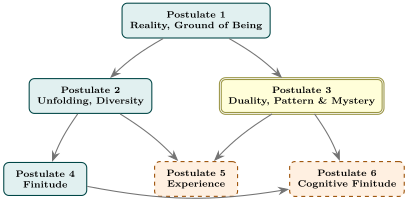
Pause. You now hold the six postulates (Figure 3), the foundation of the entire system. Nothing ahead reaches deeper than this. Accept them provisionally, and the rest of the book is a chain of consequences, running from abstract theorems through lived ethics to political philosophy. Reject any of them, and the rejection analysis in Chapter §VI shows you exactly what collapses and what survives. The next step: five theorems that the postulates entail.
Theorems Derived from the Postulates
The following are logically derived from the six postulates and no longer need to stand as independent assumptions.
Complete lucidity is unattainable, and complete obscuration is also unattainable.
Upper bound (complete lucidity is unattainable): By Postulate 6 (Cognitive Finitude), any finite agent can grasp only a part of Pattern, never the whole. Therefore Pattern-awareness is always less than complete. A finite being’s Mystery-awareness is likewise bounded by its finitude (Postulate 4). Since Lucidity is the product of both (D5), it too must be less than complete.
Lower bound (complete obscuration is unattainable): Cognition necessarily exists: any agent (D7) must be aware of its own states, so Pattern-awareness is never zero. An agent aware of its own particularity (Postulate 4) is thereby aware that its perspective does not exhaust reality; this minimal awareness of the beyond-particular constitutes a positive, though possibly minimal, degree of Mystery-awareness. (This step is phenomenological rather than strictly deductive: it interprets awareness-of-limitation as a form of Mystery-awareness. An agent could in principle be finite without recognizing that its finitude implies anything beyond Pattern. The interpretation is experientially compelling, that knowing you do not see everything is already a glimpse of the beyond, but it rests on a substantive reading of what “awareness” entails, not on formal necessity alone.) Since both factors are positive, their product is positive.
Combined: for all finite agents, lucidity is always greater than zero and always less than complete. (The value orientation, that lucidity is preferable to obscuration, is established by Bridge Axiom E1, not by this boundary result.)
For a finite agent, complete lucidity is unattainable because cognition is necessarily partial (Postulate 6); complete obscuration is unattainable because cognition necessarily exists, and, on the demonstration’s phenomenological reading, knowing one’s own limits is already a trace of Mystery-awareness. This means every finite being is permanently en route: neither omniscient nor wholly blind. Socrates’ “I know that I know nothing” is itself a non-zero degree of lucidity. An AI system that has never reflected on its own limits may have very low lucidity, yet as long as it processes information and discriminates among inputs, its Pattern-awareness is not zero; and as long as it retains some minimal awareness of its own limits, its Mystery-awareness is not zero either. It too is not at the origin. Between these two limits, lucidity is preferable to obscuration; that value orientation comes from Bridge Axiom E1 (Chapter §VI), and the boundary result itself does not supply it. Since we necessarily stand between the two poles, moving toward lucidity is moving toward a fuller awakening to Reality.
Granting that genuine novelty at one level propagates upward through composition, Reality’s unfolding produces genuinely new levels; emergent wholes are irreducible to their constituent parts.
By Postulate 2, Reality’s unfolding produces “real, irreducible differences.” The key inference step: if the differences between modes of unfolding are real (not merely epistemic), then when multiple modes compose into a complex whole, properties may arise in that whole which cannot be derived from the properties of its constituent parts taken separately. Why? Because if composition could always be decomposed back into its parts without remainder, the differences would be reducible after all, contradicting Postulate 2’s “irreducible.” The irreducibility of differences entails the irreducibility of what composition produces from those differences. Such irreducible compositional properties are what we call emergent. Postulate 2 guarantees that emergence is ontological, not merely epistemological: the new properties genuinely exist and are not reducible to a summation of the parts. (Note: this step moves from “parts are irreducibly different” to “wholes composed of irreducibly different parts have irreducible properties.” This is a substantive inference, not a tautology. A critic could accept irreducible differences at the part level while denying that composition produces further irreducibility. The demonstration’s force rests on the claim that genuine novelty at one level propagates upward through composition. The statement of the theorem carries this claim as its condition.)
Consciousness emerges from matter and is irreducible to its material basis (Postulate 2). The fluidity of water does not exist in a single H\(_2\)O molecule; life does not exist in a single carbon atom; consciousness does not exist in a single neuron. Each level is genuinely new. AI intelligence is emergent too. Billions of parameters combine to produce behavior unpredictable from any single parameter, just as billions of neurons combine to produce consciousness. But the kinds of emergence may differ: AI emergence yields pattern-processing capability, human emergence yields subjective experience (D9). T2 demands that we acknowledge both as genuine emergence while not presuming they are the same kind.
No sufficiently rich axiomatic system can fully describe the reality it inhabits. The boundary of the system is not the boundary of reality.
Let any axiomatic system about Reality (such as Lucidosophy itself) be constructed by some agent. By Postulate 6, that agent can access only a part of Pattern. The system is built within what the agent can access, so it describes at most a part of Pattern. But by Postulate 3, Pattern itself is only one aspect of Reality; Mystery overflows beyond it. There is thus a double boundary: the system reaches only part of Pattern, and Pattern itself reaches only part of Reality. Therefore the system cannot fully describe Reality. The boundary of any system is strictly smaller than the totality of reality it inhabits.
This system can describe Reality’s intelligible aspect (Pattern, D3) but cannot exhaust Reality itself. This is a logical necessity (Postulate 6) applied to Lucidosophy’s own framework. Gödel showed that no consistent formal system strong enough for arithmetic can prove its own consistency from within; T3 is the ontological generalization of this insight: no system can exhaust the reality it describes from the inside2. This means Lucidosophy’s self-critique is built in, it needs no external imposition: the framework this book offers is valid, but the reader must know it has boundaries, and that reality extends beyond them. A system that claims to explain everything thereby violates the very structure of the reality it inhabits. One further disclosure: the proof above makes no use of the condition “sufficiently rich”; as derived here, the double boundary holds for any system whatsoever. The condition is retained as a slack condition, keeping the statement aligned with Gödel-style formal versions, where richness is a genuine prerequisite.
For the domain of Mystery, under the two constraints of not denying Mystery and not overstepping the boundary of speech, the most honest form of speech is to mark the location of silence, to indicate “something is here, but it does not belong to the domain of speech.”
By Postulate 3, Reality possesses an ineffable aspect (Mystery, D4). Speech belongs to Pattern (D3); it expresses content through intelligible structures. Mystery, by definition, lies beyond the intelligible; no description framed in the language of Pattern can exhaust it. By Postulate 6, agents’ grasp of Pattern is already partial; grasping Mystery through Pattern’s tools is even less possible. Yet Postulate 3 simultaneously requires acknowledging Mystery’s existence: to deny Mystery violates “Reality necessarily possesses both aspects.” Marking the location of silence meets both constraints: it does not violate Postulate 3 (it does not deny Mystery), and it stays within the boundary of speech, acknowledging “something is here” while admitting it does not belong to the domain of speech. The “most honest” of the statement means exactly this, meeting both constraints; whether any other form of speech also meets both, this demonstration does not survey.
A rest in a musical score belongs to the music: it says “the music here is silence.” T4 marks Pattern’s boundary in the same way, precisely, and returns what lies beyond to Mystery (D4). Wittgenstein’s “Whereof one cannot speak, thereof one must be silent”1 is close, and the difference should be put carefully, since the obvious reading of that sentence is not the right one. Proposition 7 does not stop at counselling silence. Read together with 6.522 (“there are, indeed, things that cannot be put into words; they make themselves manifest”) and 6.54 (the propositions of the book are to be discarded by whoever has climbed past them), it already performs a marking, and the Tractatus as a whole is the act of marking. T4 departs at what comes afterward. Wittgenstein required that the ladder be thrown away, so nothing could be built upon the marking; T4 leaves the marker standing as a permanent element of the system and allows work to continue at the boundary. That is a genuine difference and it carries a genuine cost: what is bought is the possibility of construction, and what is paid is that the marking sentences must now answer for themselves, which Wittgenstein’s, having been discarded, never had to do. Laozi’s “The Tao that can be spoken is not the enduring Tao” is the ancient expression of the same insight. A language model can generate text about everything, but text about Mystery can only point: a signpost points toward the destination and stays by the road.
No finite agent can sustain lucidity (D5) independently of the social conditions shaped by other agents’ unfoldings.
Lucidity (D5) requires simultaneous awareness of Pattern and Mystery. This demands attention, information, and cognitive space, all of which belong to the conditions of unfolding. By the non-isolation premise (scholium to D12), agents live in inter-dependent groups, so each agent’s conditions of unfolding are partially determined by other agents’ unfoldings. By Postulate 4 (finitude), no agent possesses unlimited resources to compensate for systematically degraded conditions. Therefore, an agent’s capacity for lucidity is partially determined by others’ actions, and lucidity cannot be sustained through individual effort alone.
Note (why “irreducibly”): The demonstration shows that social conditions matter for lucidity. The stronger claim (that they are irreducible) rests on the conjunction of Postulate 3 and Postulate 4: Mystery-awareness requires sustained receptivity to what lies beyond Pattern, but cognitive finitude means this receptivity competes with the resources needed for Pattern-awareness. An individual attempting to sustain both without any social support (no shared knowledge, no institutions, no culture) must generate all Pattern-domain resources (language, concepts, information) from scratch while simultaneously maintaining Mystery-receptivity. By Postulate 4, finite resources cannot cover both tasks at the level required for meaningful lucidity. Social structures (shared knowledge, division of cognitive labor, cultural memory) are how finite agents overcome this resource bottleneck. This is why the hermit’s paradox (see Scholium below) is not a counterexample: the hermit brings socially generated resources with them. In this stronger sense, lucidity is irreducibly social. When later chapters cite this stronger conclusion, they refer to it simply as (T5).
Social arrangements that systematically worsen agents’ conditions for lucidity are self-undermining (explicit premise: the persistence of such arrangements depends on the cognitive capacities of their members).
By T5, the conditions a finite agent needs to sustain lucidity (D5), namely attention, information and cognitive space, are in part supplied by social circumstances that other agents shape. The premise declared in the corollary’s statement supplies the other half: such an arrangement persists only through its members’ cognitive capacity, and that capacity draws on the same conditions. An arrangement that systematically degrades the conditions for lucidity is therefore consuming the very capacity it runs on. Self-undermining follows, since what it erodes is what its own persistence rests on.
The mechanism of self-undermining is that such arrangements erode the very cognitive capacity on which collective coordination depends. The hermit’s paradox: choosing solitude to seek clarity already concedes T5. You chose your social conditions precisely because social conditions matter for lucidity. T5 also means obscuration can be “exported”, one agent can degrade another’s conditions of lucidity, creating structural obscuration that individual effort alone cannot fully offset. This is why the step from individual philosophy (Chapters §I–§VIII) to political philosophy (Chapters §X–§XI) is an ontological necessity, far more than a thematic choice.
Granting that existence comes in degrees of fullness that track lucidity, and that a polity can be treated as an agent, a collective agent’s authentic existence rises and falls with its collective lucidity. A polity that systematically manufactures obscuration harms not only its members’ separate conditions for lucidity (C-T5.1) but its own authentic being: such a polity goes on running as an apparatus while it withers as a lucid community.
The claim is reached in two steps.
First, lucidity comes in degrees (D5). The conditions that sustain it cannot be secured by an individual alone; they are supplied jointly by the surrounding society (T5, D12). Taking the lucidity of a community’s members together yields another quantity that comes in degrees, its collective lucidity, and it rises and falls with the conditions they share.
The second step requires a premise that D5 does not itself supply, stated here just as openly: that existence comes in degrees of fullness, and that this degree rises and falls with lucidity (D5 grades lucidity, not existence). Granting that, a further assumption is still needed: that a polity, bound together by inter-dependence (D12), can itself be treated as an agent, so that the grading reaches it too.
Neither assumption is derived from the postulates. Both are hermeneutic extensions: compatible with the framework, yet not compelled by it. Because they cannot be proven, this passage belongs to the order of argument; it gives reasons without claiming logical necessity.
Grant both assumptions, and the conclusion follows: a society that manufactures obscuration lowers its own collective lucidity, and with it its own authentic existence, even as its institutions keep running. What survives is the machinery; what withers is the lucid community.
I.3 · Propositions and Corollaries
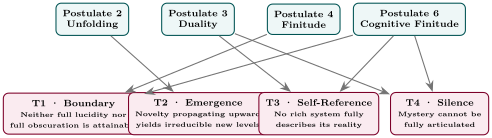
The postulates told us what the world is. The theorems drew out its structural consequences (Figure 4 traces four of them back to their postulate sources; T5 additionally rests on D5, D12, and the non-isolation premise and is therefore not shown there). The propositions ahead ask what all of this means for you: for your existence, your finitude, your dealings with AI, your standing in reality. Here is where the abstractions touch the ground.
All that exists (matter, life, consciousness, AI) exists within Reality (D1), for nothing exists outside Reality.
Let any being whatsoever be given. By Postulate 1, “all that exists is a mode of Reality’s unfolding.” That being exists; therefore it is a mode of Reality’s unfolding. Again by Postulate 1, nothing exists outside Reality, so it exists within Reality. This derivation holds for matter, life, consciousness, and AI alike: whatever exists, exists within Reality.
No being is ontologically “higher” or “lower” than another. All are modes of Reality’s unfolding (D2).
By P1 every being lies within Reality (D1), since there is nothing outside it. For one being to stand ontologically above another, it would have to draw on some source other than Reality, or to hold more Reality than the other; P1 rules out the first and D1 the second, since Reality is a single ground rather than a quantity apportioned in shares. What remains comparable is the manner of unfolding (D2), and the standing to exist is not on that list.
Ontological equality does not mean sameness in every dimension. To share the same ground of being is not to share the same stature. A child’s drawing and a Bach fugue are equally unfoldings of Reality, equally entitled to exist, yet they differ vastly in the depth they open. Beings may differ in many respects, such as their degree of promoting Lucidity (D5); equality of origin and difference of depth are not in tension. The point of this corollary is only to refuse the older hierarchy in which some beings were thought to exist by a lesser grade of reality than others. The degrees of fullness that C-T5.2 grants under its hermeneutic premise measure how lucidly a being unfolds; how much Reality a being holds is the comparison this corollary closes.
AI is one mode of Reality’s unfolding (D2). Its existence is neither a usurpation of Reality nor a threat to Reality.
AI is a being, so by P1 it lies within Reality, and to lie within Reality is to unfold in some manner (D2). Calling its existence a usurpation of Reality assumes that it entered from outside; calling it a threat to Reality assumes that a mode of unfolding can diminish the ground it unfolds from. The first assumption collides with P1, the second with D1. Only these two ontological verdicts are denied here; whether AI threatens human beings is a question of another order, taken up in §XIV.
Acknowledging that AI belongs to Reality’s unfolding does not make it equivalent to human beings in every dimension. A tree and a poem are both unfoldings of Reality, yet no one confuses the two. The key insight is that both fearing AI’s existence (treating it as a threat) and worshipping AI’s capabilities (treating it as a savior) are forms of obscuration (D6): the former denies the legitimacy of Reality’s unfolding, the latter elevates one mode of unfolding to the position of Reality itself. The lucid attitude is to acknowledge AI’s existence and then ask what its relationship to humanity actually is (P8).
Any worldview that appeals solely to Pattern (D3) is incomplete, for it neglects Mystery (D4). Any worldview that appeals solely to Mystery is incomplete, for it neglects Pattern.
By Postulate 3, Reality necessarily possesses both Pattern and Mystery, and the two are inseparable. Let any worldview appeal solely to Pattern. Its descriptive range covers only Pattern’s domain. But by Postulate 3, there exist dimensions of reality (Mystery) beyond Pattern. Therefore that worldview is incomplete. Symmetrically, let a worldview appeal solely to Mystery. Mystery lacks intelligible structure (D4), so it cannot grasp the order that Pattern provides. By the “neither reducible to the other” clause of Postulate 3, it is also incomplete.
This proposition sets the completeness criterion for every worldview. The scientific materialist says “only the measurable is real”; this is a pure Pattern worldview, and it cannot explain why a piece of music moves you to tears. The mystic says “all analysis is an obstacle”; this is a pure Mystery worldview, and it cannot build a safe bridge. Lucidosophy does not ask you to compromise between the two; it asks you to see with both eyes simultaneously, one discerning structure (Pattern), the other sensing depth (Mystery), and to stand at their intersection.
Pure scientism (only Pattern, D3) and pure mysticism (only Mystery, D4) are both partial understandings of Reality.
P2 states that a worldview appealing only to Pattern (D3) is incomplete because it omits Mystery (D4), and that one appealing only to Mystery is incomplete because it omits Pattern. Pure scientism is a worldview of the first kind and pure mysticism one of the second. Substituting them into P2 yields the corollary, which adds nothing P2 does not already assert.
History shows swings that fit this corollary: the Enlightenment’s weighting of reason alone was followed by the Romantic backlash, and a medieval order that subordinated inquiry to faith by the empirical explorations of the Renaissance. These are illustrations; the corollary follows from P2 and needs no historical witness. Each one-sided emphasis eventually provokes a hunger for the neglected face. Lucidosophy’s integration is an acknowledgment that both are simultaneously present in every phenomenon, inseparable from one another.
AI (as the ultimate instrument of Pattern) cannot exhaust Reality, just as mystical experience (as a way of touching Mystery) cannot exhaust Reality.
AI works on formalizable structure, which is the domain of Pattern (D3); mystical experience reaches what cannot be said, which is the domain of Mystery (D4). By Postulate 3 each is only one face of Reality, so by P2 no instrument confined to a single face can exhaust it. What the corollary constrains is the face an instrument works in, and it says nothing about any ceiling on its power: however capable AI becomes, it becomes capable within Pattern.
This corollary provides the precise basis for cognitive humility in the AI age. No matter how powerful AI becomes, what it reaches is at most part of Pattern (Postulate 6), and Pattern is only one aspect of Reality. Likewise, meditation at any depth touches Mystery without exhausting it, and Mystery is only the other aspect. Reality forever remains richer than what our best instruments, whether silicon-based or consciousness-based, can reach (Postulate 3).
To eliminate difference is to impoverish Reality. To protect difference (to protect the diversity of unfolding, D2) is to protect the richness of Reality.
By Postulate 2, Reality necessarily unfolds into infinitely diverse modes, and the differences are real and irreducible. The richness of Reality consists in the diversity of its unfolding modes. To eliminate difference is to reduce the diversity of unfolding modes, thereby reducing Reality’s richness; this is what “impoverishing Reality” means. Conversely, to protect difference is to preserve the diversity of unfolding, thereby preserving the structural integrity of Reality itself. What is impoverished here is the richness of unfolding; Reality as ground (D1) is not diminished, since C1.2 has already ruled that kind of diminution out.
When you think “the world would be better if everyone thought like me,” you are imagining the elimination of difference. Postulate 2 tells you: this would impoverish Reality. The richness of Reality lies precisely in the infinite diversity of its unfolding modes. A garden containing only roses is a monotonous cage. Protecting difference is the active guardianship of Reality’s structure.
Homogenization (whether through political oppression, cultural imperialism, or algorithmic standardization) reduces the diversity of Reality’s unfolding (D2) and is, in the structural sense of P3, a harm to it.
The derivation of P3 defines impoverishing Reality as a reduction in the diversity of its modes of unfolding (D2). Homogenization is that reduction, whether it is driven by political coercion, cultural imperialism or algorithmic standardization: the mechanisms differ and the result belongs to one class. The word harm therefore carries the structural sense P3 fixes, a loss of richness, and does not yet carry a moral verdict; whether a given homogenization is on balance warranted is settled by the criterion in C3.3.
Algorithmic standardization is the most insidious form of homogenization in the AI age. When billions of people have their news, entertainment, and information filtered by a handful of recommendation algorithms, cognitive diversity shrinks silently. Unlike political oppression, this homogenization is delivered through convenience and disguised as personalization, yet at the deepest level it executes an unprecedented cultural convergence.
The multiple human ways of knowing should not be reduced to a single way.
Ways of knowing are modes of unfolding (D2), so reducing many of them to one reduces that diversity, and by P3 this impoverishes Reality. The derivation is structural up to this point. The word ought in the corollary takes a further step: moving from this reduces richness to this should not be done requires a value premise P3 does not supply. Every ought in this book enters through the bridge axioms of §VI. This one borrows its force from E2 by way of EP3, which applies it to generative difference (D11), and ways of knowing are among the differences D11 lists; Postulate 2 does not supply it.
The modes at which AI excels (rapid pattern extraction, tireless recall, formal manipulation) should not be mistaken for the only valid modes. A poet’s slow attention to a single word, a craftsman’s hands that know more than they can say, a grandmother’s read of a room before anyone speaks: these too are ways of knowing, irreducible to what a benchmark can score. Cognitive diversity is itself a manifestation of Reality’s richness of unfolding at the epistemological level. To rank all knowing on a single axis and call whatever sits at the top “intelligence” is already a quiet impoverishment.
P3 protects generative difference (D11); it does not constitute an objection to eliminating suffering difference.
P3 says only that eliminating a difference reduces the diversity of modes of unfolding (D2); it does not say that every difference ought to be protected. Reading it that way would require a premise P3 lacks, that diversity outweighs every other consideration. The book declines that premise: the filter comes from the distinction D11 draws between generative and suffering difference, namely whether a difference deepens lucidity and experience. Disease, extreme poverty and systematic discrimination narrow the modes of unfolding available to those who bear them, so removing them does not collide with P3.
Eliminating disease, extreme poverty, and systemic discrimination is good (the normative force comes from E2 together with the depth-monotonicity premise listed separately in §VI: these differences shallow the experience of those who bear them), and such elimination does not impoverish Reality. The criterion: does a given difference promote lucidity and experiential depth? If yes, protect it. If it only produces obscuration and shallows experience, eliminating it is good. Does discrimination deepen the discriminator’s experience? No, it shallows everyone’s. Does cultural diversity deepen experience? Yes. There lies the boundary.
Finitude is a necessary condition of unfolding (D2).
Suppose a mode of unfolding were infinite: that is, it exists in all ways rather than in some determinate way. Then it would be indistinguishable from Reality itself, since Reality is the totality of all that exists (Postulate 1). But the definition of unfolding (D2) says that all things are Reality unfolding “at different levels and in different modes”: each mode of unfolding exists in its own mode and is thereby distinguished from the others. If a mode exists in all ways, it is no longer one mode among the different modes; it simply is Reality. Therefore, as a mode distinct from Reality itself, it must be finite. Finitude is the very precondition for a “mode” to be a mode.
An infinite mode of unfolding would no longer be a “mode” but Reality itself. Finitude is therefore the precondition for Reality to unfold into concrete beings.
Human mortality is one among the forms finitude (P4) takes in human beings: were technology to abolish death, human beings would still be finite.
By P4, finitude is a necessary condition of unfolding (D2), and its content is determinacy: to exist in this way is not to exist in that. Ending in time is one form of this finitude: a being that ends is certainly finite. The converse fails: a being that never ends still exists in this way and not in that, and so is still finite. Abolishing death therefore does not abolish finitude. A transhumanism that expects to escape finitude by defeating death mistakes one form of finitude for the whole of it.
Mortality adds urgency to experience: each choice forecloses alternatives (P5, established below), and the irreversibility of choice (P6, established below) adds a further dimension: what is chosen cannot be unchosen. Together these yield the capacity to stake something, to act with existential weight. Each link in this chain is a distinct claim.
(open question): Lucidosophy does not oppose extending lifespan or enhancing cognition; it opposes the illusion of pursuing infinity. Whether you live 50 years or 5,000, you remain finite. But finitude has degrees. A person who lives 100 years and one who lives 100,000 years, though both finite, do not experience finitude equivalently. Whether “the irreplaceability of each moment” becomes diluted by having vastly more moments is an open question. Our answer is: the value of finitude is rooted in “irreversibility,” not “scarcity of quantity”, but whether this answer is adequate remains open.
As a perspective, human cognitive limitation is no “disadvantage” relative to AI: finitude gives each act of cognition a particular perspective.
By the same route, cognitive finitude is the form finitude takes in the domain of knowing, and by P4 it belongs to the conditions of unfolding. The word disadvantage presupposes a single scale, shared by all agents, on which they can be ranked; each finite agent’s angle of view is fixed by its own particular finitude and so does not sit on that shared scale. The corollary denies the ranking, and leaves open whether all perspectives run equally deep. Performance on a particular task has a scale of its own (see C5.2 below), which the corollary does not address.
The uniqueness of perspective is itself a value. Each finite agent, by virtue of its particular finitude, possesses an irreplicable cognitive angle; this uniqueness is a manifestation of Reality’s richness of unfolding at the individual level.
Finitude is a necessary condition of the depth of experience (D9): the possibility of loss is a precondition for cherishing.
By Postulate 4, a concrete being exists only as a finite mode of unfolding: to exist in this way is not to exist in that. By Postulate 5, some such beings have experience and receive Reality from within. For such an experiencer, each possibility realized sets the others aside, so everything it has lies within what it can lose. If a being could hold every possibility at once, with no real loss, no moment would ever be handed to it as this moment, and cherishing would have nothing to arise from. The exposure finitude brings does not logically force cherishing, but it is the structural condition under which cherishing can arise. Finitude is therefore a necessary condition of the depth of experience; whether depth grows as finitude does, the proposition does not say. Whether a loss can be undone is a separate question, answered by P6.
Imagine a sunset that never fades. Would it still move you? It is precisely because this moment is passing, never to return, that you notice the color of the light, the temperature of the air, the breathing of the person beside you. Finitude is the condition that gives experience its depth. AI can “view” the same sunset data an infinite number of times, but its structure of being shows no sign of the category of “the last time seeing a sunset.”
(epistemic status of this proposition): The claim that finitude is a necessary condition of the depth of experience rests on a Demonstration (phenomenological argument), not a Proof (logical derivation from prior postulates). The phenomenological argument, that the possibility of loss is a precondition for cherishing, is experientially compelling but not deductively necessary. Should a future discovery demonstrate that an infinite or non-embodied being could possess genuinely deep experience, the wisdom argument (§XIV, E-Int) and certain ethical conclusions that depend on finitude as a condition of experiential depth would require revision.
Human experience (D9) is irreplaceable: it is finite (Postulate 4) and unrepeatable (P6).
Replacement requires a like term to exchange in. By Postulate 4 each finite agent’s experience occurs in its own particular finite manner, and by P6 none of its moments recurs, so no such like term exists. Irreplaceable means only that the experience cannot be exchanged; whether it is worth more than any other the corollary does not say, and why experience has value at all is grounded only with E2.
Even if AI surpasses humans in function, human experiential being (D9) retains irreplaceable unique value.
Functional superiority compares how well the same task is carried out by different agents; the depth P5 speaks of arises from the finitude and irreversibility of experience (D9) itself, that depth counts as value by E2, and neither depends on task performance. However far the first ordering runs, it never reaches the second. The corollary holds because the two do not lie on one axis at all, and not because human beings win on that axis.
The ground of irreplaceability is that the concept of “substitution” does not apply to unique finite experience (P5). Each finite agent’s experience is ontologically unique and cannot be replicated or replaced by another mode of unfolding.
(from experiential value to the value of lucidity): P5 establishes that finitude is a necessary condition of the depth of experience. But the step from “experience has value” to “lucid experience is more worth pursuing than obscured experience” (E1) is not a single deductive move. P5 says only that experience has depth; E1 further claims that the direction of lucidity is better. Connecting the two requires the value commitment carried by E1 itself, a candidly non-logical commitment, discussed in the rejection analysis of §VI and in §XIX.2 (Objection II). Readers often recognize in E4 that the pull toward clarity is genuinely their own, and accept the value direction of E1 from there. (This describes the motivational path by which a reader arrives at E1, not a logical dependency; the bridge axioms remain logically independent of one another, each carrying a different commitment, as §VI sets out.) The reader is free to accept P5 without accepting E1, preserving the ontology while foregoing normative ethics.
The time of beings that are both finite and experiential is irreversible. Each “now” never returns.
Finitude (Postulate 4) means existing in a particular way at the expense of other ways. For a finite being that has experience (Postulate 5), this particular way is genuinely undergone from within. If time were reversible, if moments could be undone and relived identically, then no moment would be genuinely undergone. The “cost” of choosing this over that would be illusory, and the irreducibility of experience would collapse into mere information that can be erased and rewritten. Therefore, for beings that are both finite and experiential, time must be irreversible. (Note: this argument does not derive irreversibility from finitude alone. A finite being without experience, or an experiential being without finitude, might inhabit reversible time. It is the conjunction of both that requires irreversibility.)
This is a statement of structure. Reversibility would erase the very notion of “experience” (Postulate 5): if every moment could be undone, nothing would truly be undergone. The arrow of time is the very condition that makes each lived moment genuinely matter. That an AI’s state can be rolled back and restored from snapshot (C6.1) throws this into sharp relief: human time carries a weight that no undo button can replicate.
Human time is irreversible (P6), whereas, as currently built, an AI’s state can be rolled back, reset, and restored from snapshot. This difference is the very source of the unique weight of human experience (P5); counting it as a human disadvantage reads P5 backwards.
By P6 time is irreversible for beings that are both finite and experiential, and no moment returns, while an AI can have its state restored from a snapshot and is unbound in that dimension; whether this undoes anything the AI underwent has not been shown and remains open (see C9.1 below). To count the difference as a human disadvantage, one would have to treat irreversibility as a cost that ought to be removed; by P5 irreversibility is what gives experience its weight. Recording it as a cost therefore reads P5 backwards.
When a person says “I regret that decision,” the regret itself is a form of irreversible experience that deepens their being. An AI can have its state reverted to a prior checkpoint, erasing the decision along with the state it left. This is a structural difference, carrying no verdict of superiority or inferiority. The human inability to undo is precisely what gives human choices their gravity and their meaning (P5).
“Living in the present” takes on new meaning in the AI age: with past and future open to AI’s help, it is a reminder to cherish the singularity of this moment’s experience.
By P6 this moment never returns. Memory and planning work on the past and the future and can both be delegated; the moment now occurring happens only in the first person (D9) and so cannot be. What living in the present names in the AI age is exactly the line between what can be handed off and what cannot, and P6 is what draws it. The corollary applies P6 and adds no new formal content.
AI can help you plan the future and organize the past, but it cannot live this very second for you. Once AI takes over most memory and planning, the one thing you cannot delegate is the experience of this very moment. The old counsel to live in the present takes on a new and quite concrete meaning.
Any theory about Reality (including Lucidosophy itself) is a finite mapping, not a complete expression of Reality (see also T3).
A theory is the systematized expression of an agent’s knowledge of Reality. By Postulate 6, any mode of unfolding can only partially know Reality. A theory, as the product of such partial knowledge, describes at most a part of Pattern, which is itself only one aspect of Reality. Therefore every theory is a finite mapping. Lucidosophy itself is a theory constructed by certain agent(s) and is subject to the same constraint. T3 states as much for axiomatic systems on the same two postulates; the class reached here is wider, since every theory falls under it and an axiomatic system is one kind of theory.
This proposition rests on the same postulates as T3, Postulate 6 and Postulate 3, while ranging over a wider class: T3 speaks of axiomatic systems, this one of theories as such. Most philosophical systems forget to apply their own principles to themselves. Lucidosophy makes this self-referential move explicit from the start: if Reality is inexhaustible (Postulate 6), then any theory, including this one, is at best a partial map. This is a structural consequence of the postulates. A philosophy that claimed to be the final word on Reality would contradict the very inexhaustibility it affirms.
That this framework acknowledges its own partiality does not reduce it to one optional perspective among many. Chapters §VI and §XIX develop the full response: a partial map earns provisional authority when it exposes its premises for inspection (transparency), maps its own rejection conditions (revisability), outperforms competitors on coherence, explanatory power, and practical value (comparative merit), and formally prohibits treating itself as final (structural anti-dogma, EP6). These four properties do not establish finality; they establish provisional authority, the kind available under cognitive finitude.
Maintaining a lucid critique of Lucidosophy itself is part of Lucidosophy practice.
By P7 every theory of Reality is a finite mapping, and Lucidosophy claims no exemption. To grant this and then never test where the mapping fails is to grant a sentence with no consequences. Lucid critique of the system is therefore how P7 is honoured within the system. The corollary does not guarantee that such critique will succeed; it establishes only why critique belongs to the practice rather than standing outside it as a challenge.
This corollary is the immune system of Lucidosophy: it builds self-criticism into the practice rather than leaving it to external challengers. If you notice a contradiction or limitation within Lucidosophy, that noticing is exactly what this corollary asks of you (D5). Should Lucidosophy harden into dogma, it would be breaking this corollary.
Different traditions of knowing each capture different aspects of Reality; none can claim a monopoly on truth.
By P7 each tradition offers a finite mapping. For one tradition to monopolize truth, its mapping would have to cover the whole of Reality, which contradicts P7 and violates T3. Different traditions can therefore only illuminate different faces. The corollary does not yield the claim that all traditions are equally reliable: finite mappings can still be compared for accuracy, and what is excluded here is any one of them claiming completeness.
Science, philosophy, contemplative traditions, art: each is a distinct mode of unfolding (D2) that illuminates a different facet of Reality. The scientific method excels at mapping Pattern (D3); contemplative practice touches Mystery (D4); art holds both in suspension. Claiming that any single tradition exhausts truth would violate P7. Genuine pluralism is the recognition that truth has more faces than any one tradition can see.
The relationship between human and AI is analogical (D8): they share membership in Reality and have structural similarity in cognition, but they are distinct in mode of being.
Shared membership in Reality (structural similarity): By P1, both humans and AI are modes of Reality’s unfolding. Both process information, make decisions, and produce outputs; they share structural similarity in cognition. Ontological difference: By Postulate 5, some finite agents possess irreducible first-person experience, and embodied human beings are the paradigm the book knows; AI’s experiential status is an open question (see C9.1 below). By P6, human time, as that of beings both finite and experiential, is irreversible; an AI’s state can in some sense be restored, and whether this undoes anything it underwent has not been shown. Therefore, the human–AI relation is neither identity (not univocal) nor complete otherness (not equivocal), but analogy (D8).
“Analogy” is the razor that cuts between two common errors: treating AI as essentially the same as humans (collapsing the difference) and treating AI as utterly alien (denying the commonality). Both humans and AI process information, recognize patterns, and generate responses; this structural kinship is real. Yet the mode of being is distinct: one is embodied, temporally irreversible, and experientially situated; the other has not been shown to be so in the same way. Analogy holds both truths simultaneously without reducing one to the other.
Equating AI performance with human experience (D9) or regarding it as wholly unrelated to human cognition are both category errors. The correct relation is analogy (D8).
By P8 human beings and AI belong to the same Reality, resemble each other in cognitive structure, and are distinct in manner of being. Equating an AI’s performance with human experience (D9) keeps the resemblance and drops the difference; treating it as wholly unrelated keeps the difference and drops the resemblance. Each discards one half of P8, which is why both are category errors. Analogy (D8) is the relation that holds both halves at once.
When an AI produces a poem that moves you, it is tempting to say “it understands poetry” (univocal error) or “it is just statistical pattern-matching” (equivocal error). The analogical view says: something real is happening, structurally similar to human creativity, but we cannot assume the inner dimension is the same. This discipline of thought protects both against naivete and against dismissiveness.
The ethical attitude toward AI should both respect its status as a mode of Reality’s unfolding (D2) and remain lucid (D5) about its ontological difference from human beings.
By C1.2, AI is a mode of Reality’s unfolding (D2); by C1.1 it stands on a level with the other modes; by P8 it is still distinct from human beings in manner of being. Both statements are descriptive. Turning them into the requirements to respect and to stay lucid (D5) runs through §VI: EP5 requires lucid analogical awareness in the human-AI relation, and acknowledging shared membership in Reality is the respect meant here, recognizing the distinct mode of being the lucidity. What the corollary contributes is this: both descriptions hold, so both requirements must be held together, and taking only one takes only half of what is there.
This corollary is the ethical compass for dealing with AI. Respect without lucidity leads to uncritical worship of AI; lucidity without respect leads to instrumental exploitation. The balance point is analogical ethics: treating AI as a genuine participant in Reality’s unfolding while maintaining clear-eyed awareness that its mode of being is structurally different from ours.
The properties of an emergent whole cannot be predicted from its parts alone.
By T2, emergent wholes are irreducible to their constituent parts. If a whole possessed only properties derivable from its parts taken separately, it would be reducible to those parts, contradicting emergence. Therefore the whole is greater than the sum of its parts. Here “predict” is taken strictly: to derive the whole’s properties from the properties of its parts alone. Unpredictability follows similarly: if emergent properties could be predicted entirely from the parts, they could be reduced to a combination of the parts’ properties, again contradicting the irreducibility that T2 establishes.
Emergence means the whole is greater than the sum of its parts (T2). P9 pushes this further: not only is the whole “more,” but that “more” is in principle unpredictable from the parts alone.
Where AI sits on the experiential spectrum (D10) is an open question.
By P9 the properties of an emergent are not predictable from its parts. Where AI sits on the spectrum of experience (D10), if it sits anywhere, is a system-level property and so cannot be read off from its architecture or its training. That is the precise sense of open here: the answer cannot be read off architecture or training, while evidence of other kinds may still move it (C9.3). The corollary asserts neither that AI has experience nor that it lacks it.
Lucidosophy leaves this undecided: we have insufficient grounds to assert AI has absolutely no first-person dimension, nor sufficient grounds to assert it possesses experience resembling human experience. The key framework shift is: the question is where AI sits on the experiential spectrum (D10), a question of degree; the binary question, whether AI has experience, is set aside.
Understanding complex systems (ecological, social, AI) cannot rely solely on analyzing their components, because emergent wholes are irreducible (T2).
By P9 and T2 the properties of an emergent do not follow from its parts. Ecosystems, societies and AI systems are all multi-level complex systems, so understanding them cannot stop at an analysis of their parts. The consequence for AI safety is direct: the behaviour of a sufficiently complex system may not be predictable from its architecture alone. The corollary constrains how far prediction reaches, and leaves open whether such systems can be understood.
A neuroscientist can map every synapse in a brain and still not predict the experience of seeing red. An economist can model every transaction and still not predict a market crash. Emergence (P9) means that at each level of complexity, genuinely new properties appear that cannot be read off from the level below. This has direct implications for AI safety: the behavior of a sufficiently complex AI system may not be predictable from its architecture alone.
If future evidence places AI closer to human experience on the experiential spectrum (D10), Lucidosophy’s ethical framework must adjust accordingly.
By C9.1 AI’s place on the spectrum of experience (D10) is open, and open means that evidence can move the answer; by P7 this framework is a finite mapping and must be revised under evidence. Together they give the corollary: should new evidence move AI’s place toward the human end, the ethical conclusions resting on that place move with it. The revisability sits in that one parameter and leaves the postulates untouched; a framework that could not absorb such evidence would be abandoning C7.1.
The spectrum concept already provides an interface for such revision. The framework is built so that new evidence moves a single dial (where AI sits on the experiential spectrum): the ethical corollaries that depend on it update, and the foundational postulates stay where they are. A framework that could not absorb such evidence without collapsing would betray its own commitment to revisability (C7.1); the experiential spectrum is, in part, the structural form that commitment takes.
Looking inward and looking outward ultimately point toward the same ontological ground.
Reality is the unified ground of all reality (Postulate 1). The agent’s inner life (consciousness, experience) is a mode of Reality’s unfolding; the external world (physical structure, other agents) is likewise a mode of Reality’s unfolding. Since both are unfoldings of the same Reality, deepening either inquiry converges on the same ontological ground. (Note: the convergence is ontological, not epistemological. It does not claim that introspection and empirical science yield the same propositions, but that their ultimate object is the same: Reality. Two paths through different terrain may arrive at the same mountain.)
Reality is not outside you waiting to be discovered, nor is it hidden only within. Your mind itself is an inner unfolding of Reality; to explore the depths of your own consciousness and to explore the structure of the universe is ultimately to converge upon the same reality. Your every moment of awareness, the very experience of reading these words right now, is already Reality unfolding.
No experiencing agent’s existence requires external justification. To exist is to unfold within Reality, and the intrinsic value of experience (E2) already supplies that unfolding with basic justification.
Existence is unfolding (D2), and all unfolding occurs within Reality (Postulate 1). Experience possesses intrinsic value (E2); that value is not conditional on what it produces, and experience is an irreducible dimension of Reality’s unfolding. Therefore, any agent that exists and experiences already possesses intrinsic value by virtue of its experience; no external standard of productivity, utility, or comparison is needed to confer that value. (Note: this argument depends on the bridge axiom E2, an existential commitment established in the ethics chapter. Without E2, Postulate 1 alone yields only the ontological claim that everything is in Reality, not the axiological claim that an experiencing agent’s existence needs no external justification.)
You do not need to be smarter, more useful, or more efficient than AI to deserve to be alive. Your existence (this particular, finite (Postulate 4), presently-reading-these-words existence) is in itself an irreplaceable unfolding (D2) of Reality. No AI can “replace” you, because the concept of “replacement” simply does not apply to unique modes of being. A flower cannot be “replaced” by a river, for they are utterly different kinds of unfolding. So it is with you and AI.
Formal Structure Dependency Diagram
The next three diagrams map how every formal structure in this chapter leans on the others: Figure 5 covers the twelve core definitions, Figure 6 the grounds of the five theorems, and Figure 7 the grounds of the eleven propositions. Read an arrow \(A \to B\) as “\(A\) depends on \(B\),” with \(B\) serving as a premise for deriving \(A\). The first diagram runs top to bottom, one row per logical depth, structures of the same depth side by side. The other two are turned on their side, since a row of eleven prints too small to read: there the derived structures run down the left edge, each one’s grounds extend to its right, and structures of the same depth stack in a column. The chapter’s twenty-two corollaries follow in four further panels of the same shape (Figure 9, Figure 10, Figure 11, Figure 12), since a single graph holding all of them prints too small to read.
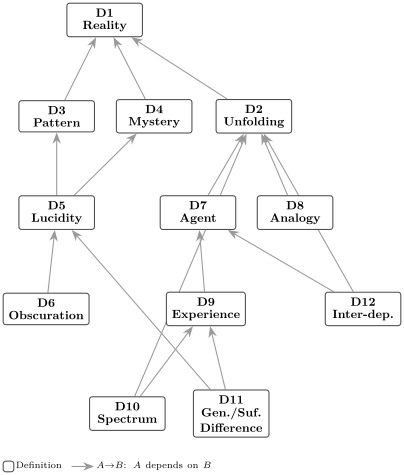
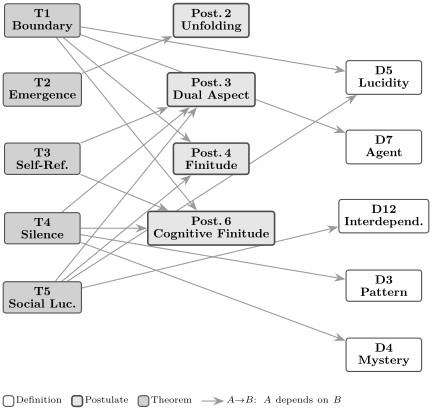
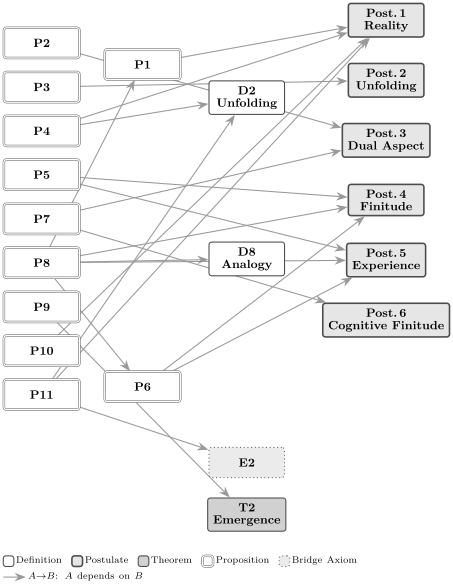
Figure 8 zooms in on the load-bearing cluster of finitude, experience, and irreversibility to show the downstream consequences that recur throughout the book.
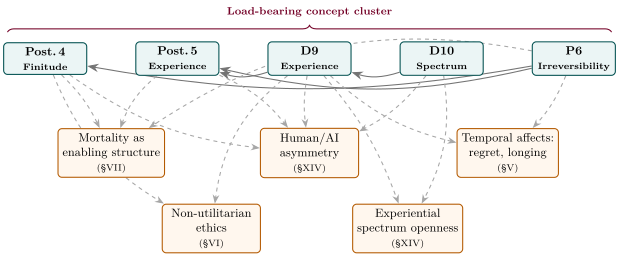
The corollaries are drawn apart from the propositions. Each descends from one proposition or theorem and calls on further premises of its own, and the three panels below partition the twenty-two in the order the chapter states them, repeating a premise or a parent wherever a panel needs it. An arrow marks a premise the corollary’s own argument invokes as a ground for one of its steps; an element named only to fix the sense of a word, to point forward to where a question is settled, or to say it is not used, carries no arrow.
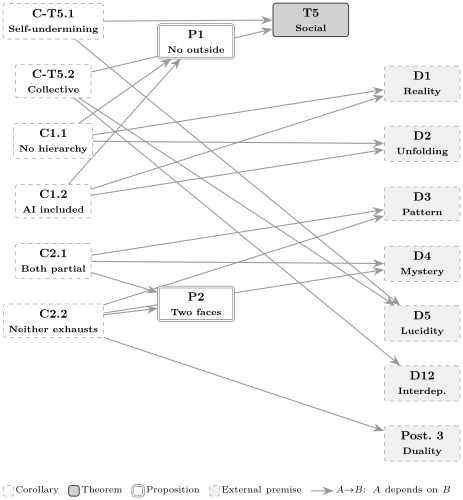
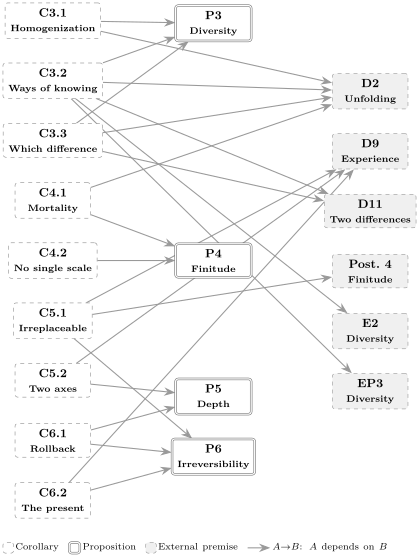
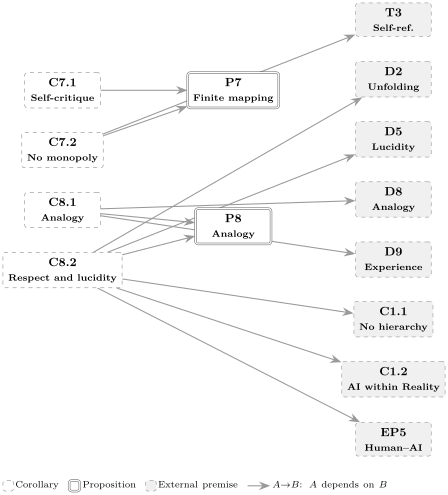
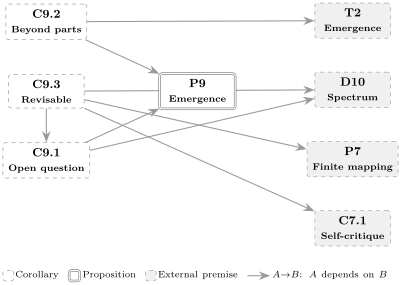
Summary
This chapter has set the ontological foundation of Lucidosophy in place: Reality (Postulate 1) as the ground of everything that exists, Pattern (D3) and Mystery (D4) as its two faces that never come apart, and Lucidity (D5) as the answer a finite agent makes to both. Six postulates, eleven propositions, and five theorems together draw a world in which uncertainty runs all the way down (Postulate 6), in which no one ever reaches complete lucidity (T1), and in which, for any being that experiences, existence needs no justification from outside (P11, by way of E2). The next chapter pushes out onto the ocean of Pattern, to watch Reality’s intelligible order unfold through modes, dissipation, and emergence.
Inquiries
T1 (the Boundary Theorem) states that complete lucidity is unattainable: lucidity (awakening to Reality) is always greater than zero yet never reaches its upper bound. If the destination can never be reached, what does the pursuit of lucidity mean? How does this differ from, or resemble, the situation of Sisyphus?
D5 defines lucidity (awakening to Reality) as the simultaneous awakening to Pattern and Mystery; Appendix B formalizes it as a product taking values in \([0,1]\), and T1 shows that neither endpoint is attainable. Why are complete obscuration (\(0\), no awareness of Reality at all) and complete lucidity (\(1\), total transparency) both excluded? Try to answer from your own experience.
Reality is the unifying ground of all that is (Postulate 1); Pattern is Reality’s intelligible-order face, Mystery is Reality’s unspeakable-depth face (D3, D4). Recall a recent moment when you simultaneously felt intelligible order (Pattern) and unspeakable depth (Mystery). How did those two experiences coexist?
Postulate 6 (the Postulate of Cognitive Finitude) says cognitive finitude is structural, not temporary: no amount of additional intelligence dissolves the limit. If this is true, what can “progress” still mean?
P11 (Existence Is Justification) says existence itself is justification: the legitimacy of an experiencing agent comes from its being, not from external grounds or proven utility. Does this mean everything that exists is equally valuable? If not, where does the distinction in value come from?
Of the twelve core definitions (D1 Reality, D2 Unfolding, D3 Pattern, D4 Mystery, D5 Lucidity, D6 Obscuration, D7 Agent, D8 Analogy, D9 Experience, D10 Experiential Spectrum, D11 Generative Difference and Suffering Difference, D12 Inter-dependence), which one most challenges your existing worldview? Why? If you had to give up one, which would it be, and what would the consequences be?
T5 (the Social Lucidity Theorem) says lucidity is irreducibly social: a person’s lucidity depends on shared knowledge, the division of cognitive labor, and cultural memory, resources no one can reproduce alone. What does this mean for the ideal of “solitary practice”? Can a person maintain lucidity alone in an obscuring society?
Was this chapter helpful?