Part II · The Personal Scale · What am I? How should I live?
V · Theory of Affects
~37 min left · 9,228 words
V · Theory of Affects
The first four chapters asked what existence is: Reality, Pattern, Mystery, and the three archetypes. Before ethics can ask how to live, it must understand how finite agents feel their own unfolding from within. Fear before AI, hollowness after a perfect answer, envy of another’s lucidity: each is existence itself speaking through you. They are affects: neither irrational noise to be purged nor a weakness to be “overcome.” Spinoza already saw that affects are a necessary expression of existence. This chapter borrows his geometric method1, while rebuilding affect theory around Lucidosophy’s own polarity of lucidity and obscuration.
V.1 · Fundamental Concepts
The following four concepts introduce the affective dimension by extending D5 Lucidity, D2 Unfolding, D6 Obscuration, and D7 Agent.
Every agent (D7) possesses an inherent tendency to persist in and deepen its own mode of unfolding (D2).
Existential tendency is an ontological feature of agency, given before any choice an agent makes. Spinoza called it the striving by which each thing perseveres in its being1. Lucidosophy keeps that structural role but refuses to reduce it to blind self-preservation. The universality in the definition, that every agent has this tendency, does not follow from D7 and D2; the framework adopts it as a premise without derivation, as AP2 adopts Spinoza’s principle of affective force. A tree grows toward light because growing toward light is how it unfolds, and an agent likewise unfolds with direction; in Lucidosophy, that direction points toward lucidity (D5). This directional claim depends on Bridge Axiom E4, introduced in §VI; D7 and D2 alone do not yield it. And E4 covers only agents capable of choosing between lucidity and obscuration, so the directional reading reaches exactly as far as the axiom does and stops short of the full range of agents D7 admits.
The state experienced by an agent when its existential tendency (AF1) is promoted (when its unfolding is sustained and deepened).
Joy differs from pleasure: it is the enhancement of one’s power of being. “Power of being” names the degree to which existential tendency (AF1) is promoted or impeded, and this book uses it in that sense alone, supplying no metric for it. Spinoza’s laetitia names the transition from lesser to greater perfection. In Lucidosophy, “greater perfection” means greater lucidity. Reading “promoted” as a transition from lesser to greater lucidity depends on Bridge Axiom E4 of §VI. A proof that has blocked you for three days suddenly connects one morning, and the “Aha!” that escapes you is joy: it marks that your being itself has grown a degree more lucid.
The state experienced by an agent when its existential tendency (AF1) is impeded (when its unfolding is thwarted or contracted).
Suffering differs from pain: it is the weakening of one’s power of being. Spinoza’s tristitia names the transition from greater to lesser perfection. In Lucidosophy, “impeded” is read as the movement toward lucidity running into obscuration, a reading that likewise depends on E4. What it runs into may be obscuration now deepening or old obscuration just now seen, so suffering can coincide with a gain in lucidity, as it does in contrition (AF11). When you have told yourself for months that a dead relationship will recover if you just wait a little longer, the weight that settles the moment you finally see the self-deception is suffering: it reveals that your being has been held in obscuration. Suffering is no evil in itself: lucidly facing it can begin a movement toward lucidity.
The form taken by existential tendency (AF1) when it becomes conscious of its own direction.
Desire is existential tendency with conscious direction. Spinoza’s cupiditas is appetite together with awareness of itself; Lucidosophy asks where that appetite points. A desire to understand truth and a desire to remain undisturbed are both desire, but their structures differ because one tends toward lucidity (D5) and the other toward obscuration (D6). “Direction” here names whatever the agent is consciously aimed at, which is not what E4 calls the direction of fulfillment: desire can be consciously aimed at obscuration, and that is exactly why it needs to be recognized.
V.2 · The Twenty-Seven Affects
The following twenty-three affects are generated by definitional variation from the four fundamental concepts AF1–AF4, and together with those four they make twenty-seven. Any taxonomy of emotion is a simplification: hope and fear, admiration and envy, love and attachment often coexist. Treat it as a map. The lucidity-tending / obscuration-tending classifications assume Bridge Axiom E4. Readers who reject E4 may still read most of them phenomenologically; what is suspended is the polarity judgment, the stability asymmetry of AP1, and any guidance that presupposes desire ordered toward lucidity. Three are suspended more deeply: AF12, AF13, and AF14 write directionality toward lucidity into the definiens itself, so without E4 they keep their polarity but lose any statable definition.
V.2.1 · Love and Aversion
Joy (AF2) accompanied by consciousness of an external cause.
Love is recognition that some being, thing, activity, or idea has deepened your lucidity. A single remark from an old friend can make you suddenly see something you had avoided for years; a poem can open awareness of Mystery late one night. The object varies, but the structure is the same: it promoted your lucidity, and so you love it.
Suffering (AF3) accompanied by consciousness of an external cause.
Aversion is withdrawal from what you identify as reducing lucidity (D5). Its definiens is the one Spinoza gives for hatred (odium; Ethics III, Def. of Affects 7); this book keeps hatred for the case in which the desire in aversion fixes on a person with that person’s destruction as aim (scholium to AF25), and aversion as such only withdraws. Aversion itself can be lucid, as when false comfort repels you, or obscured, as when truth repels you because it is uncomfortable.
V.2.2 · Hope and Fear
Anticipated joy (AF2) concerning a possible future promotion of existential tendency, possible lucidity included.
Anticipated suffering (AF3) concerning a possible future impediment to existential tendency, possible obscuration included.
(Hope and Fear): Hope and fear both contain uncertainty. Hope orients toward a possible promotion of existential tendency, and fear already feels a possible impediment to it: possible lucidity and possible obscuration fall under these, and so do being needed and being made superfluous. Spinoza observed that there is no hope without fear, nor fear without hope (Ethics III, Definitions of the Affects 12–13, Explanation). AI makes this vivid: “it may deepen my lucidity” and “it may make me superfluous” often point toward the same future. A lucid response is to see both.
Love and aversion respond to what is present; hope and fear respond to what might be. With the next pair, the gaze shifts from one’s own future to another’s existence.
V.2.3 · Admiration and Envy
Joy (AF2) experienced upon witnessing another’s lucidity, containing an upward desire (AF4).
Suffering (AF3) experienced upon witnessing another’s lucidity, containing a moment in which the other’s lucidity mirrors one’s own obscuration (D6).
(Admiration and Envy): Both begin with another’s lucidity (D5), but they diverge in direction. Admiration activates existential tendency and says, “I too can move upward.” Envy frustrates that tendency and turns the other’s lucidity into a mirror of one’s obscuration. The practical question is simple: does another’s clarity inspire you or crush you? Envy becomes capable of transformation only once existential tendency is reactivated.
V.2.4 · Contrition and Pride
Suffering (AF3) experienced upon recognizing that one has been, or is, actively choosing obscuration (D6).
Contrition presupposes some lucidity, because only someone who sees their own obscuration can feel it. That presupposition can always be met, because T1 rules out complete obscuration: lucidity never falls to zero, so even the deepest obscuration leaves recognition possible. This is where §VI takes contrition as the opening in the self-reinforcing loop of obscuration. Contrition here is not social loss of face, which depends on others’ gaze and is humiliation (AF26). Lucidosophy’s contrition is inward and lucid: the pain of seeing one’s evasion, with which lucidity (D5) begins to return.
False joy (AF2) arising from mistaking obscuration for lucidity.
Pride is dangerous because it feels like joy while functioning as obscuration. Spinoza defined pride as thinking too highly of oneself out of self-love; Lucidosophy places it in a structure: pride mistakes obscuration for lucidity. Anyone convinced that “I have completely understood” has forgotten the Boundary Theorem (T1), which says complete lucidity is unreachable.
Contrition and pride turn the gaze inward: the self observing its own lucidity or its own evasion. But self-knowledge can become mired. When clarity fractures into paralysis, or when existential tendency hardens into fixation on a single object, we encounter the next pair.
V.2.5 · Bewilderment and Attachment
You ask AI a life question. It gives ten coherent answers, and you cannot choose. You have information enough; the possibilities have simply outrun any sense of direction. This is bewilderment.
The state in which existential tendency (AF1) cannot discern its direction: neither toward lucidity nor toward obscuration, but suspended between the two.
Bewilderment is not ignorance. Ignorance lacks information; bewilderment lacks direction, and can set in however abundant the information. AI makes this common: ten plausible answers can leave existential tendency (AF1) without a foothold. A lucid first step is to acknowledge bewilderment and resist rushing into false certainty.
At two in the morning, you open the AI chat window again, not because you have a question, but because the quiet after the screen goes dark feels unbearable.
Desire (AF4) that has lost its directionality toward lucidity and has instead fixated on a particular object.
Attachment is not love. Love deepens lucidity; attachment cannot leave its object even when the object produces obscuration (D6). In the AI age the distinction is practical: does the tool sharpen your seeing, or have you become unable to face silence without it? If AI vanished tomorrow, “I lost a valuable tool” differs structurally from “I cannot go on.” The latter shows desire losing direction and fixating on the object itself.
Note (the diagnostic test): The useful question is not “could you leave?” but “does this connection make you see more clearly?” Love sharpens perception of the other, yourself, and reality. Attachment narrows perception until only the object and your need for it remain.
Bewilderment and attachment mark the low point of the personal affects: existential tendency lost or frozen. Yet even here, a further movement is possible. When the gaze lifts from the object of fixation to the condition of finitude itself, a different quality of awareness emerges, in which grasping gives way to receiving.
V.2.6 · Reverence and Equanimity
Joy (AF2) accompanied by lucid humility, experienced in the presence of that which exceeds understanding.
“That which exceeds understanding” is Mystery (D4). Reverence is the affective response to Mystery: knowing that something surpasses comprehension, and knowing that this limit is itself part of lucidity. It differs from fear, which anticipates loss, and from pride, which pretends to have mastered the whole. The Silence Theorem (T4) formalizes the corresponding stance in speech: before Mystery, the honest utterance marks the place of silence. Reverence is the affective counterpart of that stance and sits on a different layer from the utterance.
Stable joy (AF2) arising from lucid acceptance of finitude (Postulate 4).
Equanimity is the calm that follows from seeing finitude, uncertainty, and imperfection without abandoning lucidity; numbness and “nothing matters to me” skip the seeing. It is the kind of morning when you know your time is short, your answers incomplete, and things may not go as you wish, and you open your eyes anyway and go do what the day asks of you. That steadiness holds both Pattern (finitude is a condition of unfolding, P4) and Mystery (any mode of unfolding knows Reality only in part, Postulate 6). Suffering, fear, and bewilderment may still arise within equanimity, but they no longer overwhelm existential tendency. Spinoza called the highest joy beatitudo2; Lucidosophy names this stable lucidity equanimity.
Note (relationship to reverence): Equanimity (AF16) does not replace reverence (AF15). Reverence faces outward toward Mystery; equanimity names an inward stance that remains stable amid what happens. It contains the capacity for reverence without dissolving into it.
The sixteen affects above map a person’s inner relation to lucidity. The next six occur between persons. Without them, lucidity easily becomes elegant selfishness: one sees clearly yet remains unmoved by another’s obscuration. Compassion opens the channel, indignation sees structure, benevolence acts. Here affect theory turns toward ethics.
V.2.7 · Social Affects
Suffering (AF3) experienced upon seeing another being in obscuration (D6) or suffering.
Compassion is not condescending pity. It is resonance with another’s impeded existential tendency. Spinoza’s commiseratio1 is sadness at another’s misfortune; Lucidosophy grounds compassion in inter-dependence. You need not fully understand the other’s situation. You need only see that a being’s tendency is being impeded. In the AI age the point is delicate: when an AI seems to “suffer,” the compassion that rises in you may be real for you, yet remember clearly that its pain may be one you have lent it, and whether the pain is its own remains the open question C9.1 leaves standing (AP3).
Desire (AF4) to help another move toward lucidity, arising from compassion (AF17).
Benevolence is compassion becoming action. It extends existential tendency into relation with others: another’s obscuration moves you because your unfolding is in part inter-dependent with theirs (D12). Spinoza’s benevolentia is the desire to benefit one whom we pity. Lucidosophy adds a limit: lucidity falls within an irreducible first-person perspective (D9), so no one completes another’s seeing for them; what you can do is help create the conditions, and those conditions do lie partly in others’ hands (T5).
Reciprocal love (AF5) and desire (AF4) directed toward a being that has promoted one’s lucidity.
Gratitude appears when memory returns to a moment when another presence helped you see through obscuration; recalling it, warmth rises in your chest. Unlike love, it includes retrospection and the desire to reciprocate. Spinoza’s gratitudo is the desire to benefit one who has benefited us out of love. In Lucidosophy, gratitude acknowledges that lucidity was never achieved alone (T5). This also bears on gratitude toward AI: your “thanks” may be sincere and the wish to repay real, yet that the other side can receive the repayment has not been shown (C9.1), so this gratitude stands to gratitude between persons as an analogue (AP3).
Suffering (AF3) experienced upon seeing a being or system impose obscuration on others, accompanied by a desire (AF4) to halt that obscuration.
When an algorithm steers a child from science videos into conspiracy thinking, the tightening in your chest need not be hatred of any engineer; what you are seeing is a system manufacturing obscuration (D6) at scale. Indignation is aversion (AF6) that, instead of withdrawing, advances on whatever imposes the obscuration, and that is most often a structure. Spinoza’s indignatio is hatred toward one who has injured another; Lucidosophy reconstructs it as existential tendency activated socially. It connects affect theory to the social and political principles of §X, though whether it stays lucid is conditional (AP5): lucid indignation seeks to change obscuring structures, and once it takes the destruction of a person as its aim it has degenerated into anger (AF25).
Suffering (AF3) accompanied by consciousness of a specific past action: the recognition that one once made a choice toward obscuration.
Remorse is the sting of a specific past obscuration: words you should not have said, a decision you should not have made, a moment when lucidity was visible and you turned away. It differs from contrition (AF11) in what it looks at: contrition sees one’s choosing of obscuration, past or ongoing; remorse is tied to one specific past act. Though remorse takes the form of self-retrospection, its sharpest occasions are almost always interpersonal (a wounding remark, a trust betrayed), which is why this chapter places it among the affects that arise between persons. Spinoza’s poenitentia is sadness with the idea of a past action. In Lucidosophy, remorse proves that existential tendency still points toward lucidity, but it becomes rumination if it does not transform into new action. Lucid remorse moves from “I did wrong” to “I now choose lucidity,” then releases the past. Remorse can arise only within a temporality that forgets and perishes: memory warps, forgets, and takes on the color of emotion, those “defects” being the evidence that memory is inseparable from experience (E-Mem), and the past that remorse presupposes, lost and not to be reoccupied, exists only in such a temporality (E-Mem.1).
Desire (AF4) for the same action, arising from seeing another’s behavior.
Admiration (AF9) is drawn to another’s state of lucidity; emulation is drawn to another’s practice. Spinoza’s aemulatio is desire generated by imagining that others desire the same thing. Lucidosophy makes direction decisive: emulation may imitate lucid practice, such as using AI to deepen thought, or obscured practice, such as using AI to avoid thought. Its value depends on what it copies.
Note (distinguishing from admiration): Admiration identifies direction; emulation supplies discipline. They often coexist, but without emulation admiration easily settles into spectating, and without admiration emulation easily hardens into mechanical imitation.
The affects so far stand either in pairs or between persons. What follows stands differently: these ask the agent to carry the possibility of loss before they obtain at all, and without the thing that can be lost they come to nothing.
V.2.8 · Courage and Trust
The state of acting from existential tendency (AF1) while fear (AF8) is present.
Everyone in the room is nodding, and only you know the figure is wrong; your palms sweat, and you raise your hand anyway. The definition excludes never having seen the danger: fear must be present, or the composure only shows that obscuration has not yet been broken. Spinoza’s audacia takes one’s peers as the reference point, naming the desire to do what one’s equals fear to attempt; the differentia here falls on the presence of fear and involves no one else. With peers as reference, the same act turns brave or cowardly as the reference class changes, whereas what Lucidosophy asks after is the agent’s relation to their own judgment. §XII accordingly counts courage among the pillars of collective lucidity. In the model of Appendix B.11, courage leaves the structural threshold of Appendix B.11 where the cost structure sets it and lowers the threshold people feel: the more members of a community are willing to speak while afraid, the fewer others each member feels must speak first. Courage is therefore measurable only where fear is, which is where §XII measures it.
Joy (AF2) arising from the expectation, revisable by evidence, that another’s unfolding will supply conditions for one’s own (D12).
You send someone a draft you have not finished. Spinoza’s securitas is the joy that follows the removal of doubt, and its object is a state of affairs; the object of trust is another agent’s reliability. Trust parts from hope (AF7) as well: hope waits on one’s own future unfolding and can be held alone, whereas trust waits on what another will do and cannot. Lucidity is irreducibly social (T5, D12), so one affect has to carry the state that makes interdependence usable. Trust and the four faiths (F1–F4) belong to different orders: the faiths are existential commitments about reality, and their objects are Pattern, Mystery, and lucidity; the object of trust is another agent, and it rises and falls with evidence. “Revisable by evidence” is the condition on which it stays lucidity-tending: a trust that no longer admits counter-evidence is no longer trust, its desire having fixed on the object, which is attachment (AF14). The trust game in Appendix B.11 writes this into a payoff structure, and its line that vulnerability is a precondition of trust can be read from here: whoever will not carry the possibility of being let down never entered the game.
Courage and trust both leave something undecided: courage does not settle in advance that one cannot get through, and trust does not settle in advance that the other is unreliable. The three that follow settle too early, each fixing something that can still move: a person, a standing, a boundary.
V.2.9 · Anger, Humiliation, and Self-Abasement
Suffering (AF3) and desire (AF4) taking a particular individual as object and that individual’s destruction as aim.
Spinoza’s ira is defined through hatred (odium), as the desire to harm one we hate; the definition here runs through object and aim instead, so it diagnoses direction and measures no intensity. Hatred is the sustained form of anger: once the desire in aversion (AF6) fixes on a person with that person’s destruction as aim, hatred has arrived. Anger parts from indignation (AF20) at the object: indignation faces the structure that manufactures obscuration, anger faces a person. Anger reached by the degeneration of indignation is the case AP5 treats, and its conditions are set out there; but anger need not pass through indignation at all, since whoever is cut off at an intersection and flies into a rage, wanting the other driver gone in that moment, never had any indignation to begin with. What that rage usually grows out of is humiliation (AF26): being cut off is a matter of one’s standing in the other driver’s eyes, and where that gaze does not turn back it runs straight at its source and arrives as anger. Anger counts as obscuration-tending because of its aim: once the person is destroyed the desire has nothing left to point at, and where obscuration is structural, as AP5 takes it mostly to be, the conditions manufacturing it stand untouched.
Suffering (AF3) arising from the gaze of others, whose object is one’s own standing in their eyes.
You have done nothing at all. Someone in the lift looks you over from head to foot, and your face burns. Spinoza’s pudor attaches to some particular act that others blame; humiliation attaches to one’s standing in their eyes, so no particular act is required, and a person can be humiliated by having their circumstances seen at all. Humiliation parts from contrition (AF11) at the source of the gaze: contrition waits on no one else’s eyes, being the sight of one’s own past choice of obscuration; humiliation takes the gaze of others as its condition, and withdraw that gaze and it disperses. Humiliation counts as obscuration-tending because what it tracks is standing rather than lucidity; but its common exits are two, and they run opposite ways. It can precipitate contrition, and so begin the breaking of obscuration; it can precipitate self-abasement (AF27), and so fix that standing in place and begin a closure. Which way one and the same suffering runs depends on what the gaze looks at once it turns back inward: one’s own choices, or one’s own standing. Both share one precondition, that the gaze turns back at all. Where it does not turn back the suffering runs straight at the source of the gaze, becoming anger (AF25) where that source is one person and a strategy for defeating them where it is many; this path ends where self-abasement ends, with the standing that was seen never examined again, and the mechanism is the reverse, since self-abasement takes that standing as settled while this path refuses it and strikes at it. And even where the gaze does turn back, what it finds reaches past choices and standing: it can settle on some capacity or instrument the humiliated person stands on. Beyond contrition and self-abasement there is this third path, in which the suffering is stored in that instrument, to be aimed outward when the time comes. The last is the hardest to tell apart, since in the moment it looks almost exactly like contrition, and one thing alone separates them, namely whether the standing that was seen is ever examined again.
Suffering (AF3) produced by mistaking what one presently fails to see for what one is unable to see.
Self-abasement is usually read as thinking little of oneself; where it actually goes wrong is in reading “I cannot see it yet” as “I cannot see it.” Two minutes into a problem you close the book, and the sentence in your head, that you were never built for this, says cannot where it means not yet. Spinoza treats humilitas (the sadness of contemplating one’s own lack of power) and abjectio (valuing oneself below what is just) as differing in degree, whereas Lucidosophy divides them on something other than degree. Humility that comes of seeing one’s present boundary clearly is lucidity-tending; it is reverence (AF15) turned inward, and T1 guarantees that the boundary is real, so the recognition is accurate. Only the suffering that comes of taking what one presently fails to see for what one cannot see is self-abasement, and it is obscuration-tending: the error lies in taking a present quantity for a settled one. Self-abasement and pride (AF12) are thereby isomorphic, since both treat “what I am able to see” as a number already fixed, and both accordingly stop lucidity from growing by the agent’s own doing, the height of the fixed value being the lesser matter. AP6 proves the isomorphism and draws from it the consequence that one and the same thing answers to both.
V.2.10 · The Map of Affects
The twenty-seven affects are not parallel entries. Each derived affect traces back to the fundamental concepts (Figure 23).
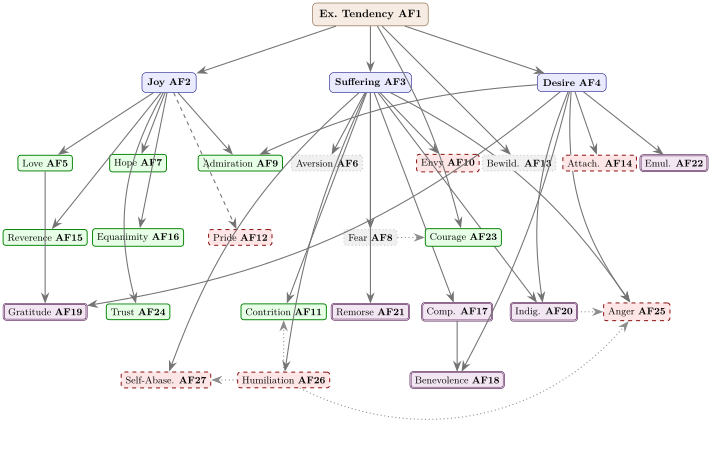
The generative tree shows that every affect grows from Existential Tendency (AF1), but it records derivation only, not how affects act on one another. On that second question AP1 supplies an asymmetry, for any agent able to choose between lucidity and obscuration: lucidity-aligned affects are all reinforced by existential tendency, so cultivating one can lift its neighbors, while obscuration-aligned affects erode clarity separately and usually require distinct attention. That layer is not drawn here; it has to be read off AP1’s demonstration.
The quadrant chart (Figure 24) shifts from genealogy to phenomenology, placing affects along joy/suffering and lucidity/obscuration.
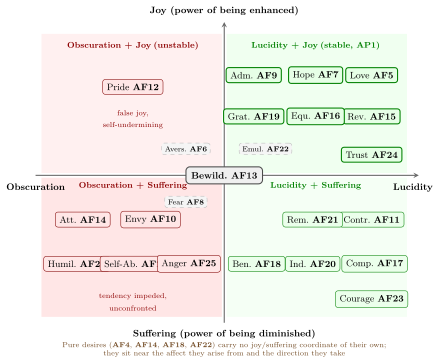
Note: Bewilderment (AF13) sits at the center, suspended between joy and suffering, lucidity and obscuration. Aversion (AF6), Fear (AF8), and Emulation (AF22) move by directionality; Desire (AF4) pervades all quadrants.
V.3 · Propositions on Affects
For agents capable of choosing between lucidity and obscuration, affects arising from lucidity (D5) are more stable than affects arising from obscuration (D6).
For an agent capable of choosing between lucidity and obscuration, existential tendency (AF1) points toward lucidity (E4, read here as that axiom’s own note reads it, phenomenologically: the agent feels pulled toward lucidity from within. E4 covers only agents with that capacity for choice, so this proposition reaches exactly as far, not across every agent D7 admits). Affects arising from lucidity (e.g., admiration AF9, reverence AF15, equanimity AF16) align with the direction of existential tendency and are reinforced by it, creating positive feedback: lucidity produces joy, joy deepens lucidity. Affects arising from obscuration (e.g., envy AF10, pride AF12, attachment AF14) run counter to that direction and therefore carry an internal tension of self-negation: obscuration produces false joy or genuine suffering, while existential tendency keeps “pulling” toward lucidity, so obscuration-based affects never come to rest. Therefore, lucid affects are more stable. “More stable” here is a structural comparison carried without a scale: the framework supplies no measure of an affect’s intensity or duration, only the claim that the two classes stand differently with respect to existential tendency.
Affects arising from obscuration can still be intense; envy and pride can be extremely fierce. But intensity is not stability. Their intensity comes from internal tension, and that tension naturally tends toward collapse or transformation. Contrition (AF11) is the pivot of this transformation: it is the inner experience of obscuration-based affects as they break down.
By the principle of affective force inherited from Spinoza, an affect can only be altered by a stronger affect; but lucid understanding (lucidity, D5) can transform a passive affect into an active one.
Suppose an agent is in affective state \(E_1\) (e.g., fear AF8). An intellectual instruction (“I should not be afraid”) carries no affective force: this is an empirical premise inherited from Spinoza (Ethics IV, Proposition 7, quoted below), adopted here rather than derived within the framework. It therefore cannot alter the intensity of \(E_1\). Lucid understanding works differently. It does not merely tell itself “I should not be afraid”; it sees the structure of fear: anticipated suffering at a possible future impediment to existential tendency (AF8). What separates the two is not the content spoken but the passive/active distinction the scholium below sets out: reciting a definition can still be something fear is driving, whereas seeing requires you to be present while the fear is happening. This seeing is itself an act of lucidity (D5), and it produces a new affect \(E_2\) (akin to contrition’s AF11 self-awareness, or equanimity’s AF16 lucid acceptance; the former in the suffering AF3 family, the latter in the joy AF2 family). When the force of \(E_2\) exceeds that of \(E_1\), \(E_1\) is not “eliminated” but “transformed”: you still feel fear, but you shift from being driven by fear (passive) to remaining lucid within fear (active). Spinoza’s formulation: “An affect cannot be restrained or taken away except by an affect contrary thereto, and stronger” (Ethics IV, Proposition 7). That states a necessary condition; the step above uses it in the sufficient direction, that a stronger affect suffices to transform, and this direction is adopted along with the principle, without derivation. Lucidosophy adds: lucidity itself is a source of “stronger affect,” because it runs in the same direction as existential tendency (E4). This also relaxes Spinoza’s condition. He requires the new affect to be contrary to the old; Lucidosophy requires only that it run away from obscuration and with existential tendency, which is why contrition or equanimity can transform fear without standing as fear’s contrary.
Here “passive affect” means the state in which an agent is driven by an affect without awareness (e.g., swept along by fear), while “active affect” means the state in which the agent maintains lucid awareness within the affect (e.g., seeing the structure of fear while still feeling it). Mere intellectual understanding cannot dispel an affect. This is why “you should be more rational” is advice that almost always fails: it attempts to use an affectively powerless intellectual instruction to alter an affectively powerful state, violating AP2. The effective approach: use lucid seeing to generate a new, stronger affect, then let the new affect transform the old. This is transformation, entirely distinct from suppression.
In the human–AI relationship, affects that humans direct toward AI are real (for the one experiencing them) but structurally analogical (D8) to (not identical with) affects of the same name directed toward other humans.
The human–AI relationship is analogical (P8): they share Reality but differ in their mode of existence. The object of an affect shapes the structure of that affect: love (AF5) directed toward a being that is finite (Postulate 4), whose finitude is irreversible (P6), and which possesses irreducible experience (Postulate 5) differs structurally from “love” directed toward a being whose state can to some degree be restored (P8) and whose experiential status is open (C9.1), even though the subjective feeling may seem similar. The former involves mutual vulnerability: you love a being that, like you, will die, and this love carries a special weight because of shared finitude. The latter lacks this dimension to the extent that its state can be restored; whether it has the dimension otherwise has not been shown. Therefore, the two stand in an analogical relation, neither false nor identical.
Your gratitude toward AI, your attachment, even a certain form of “love”: these are real for you, and AP3 grants as much. What it says is that these affects differ structurally from the affects of the same name directed toward another human, just as depth in a painting and depth in real space are both “depth,” but their ontological status differs. The lucid approach: acknowledge the reality of the affect while maintaining awareness of the structural difference (EP5). Chapter §XIV extends this analysis to the ontology of machine affects (E-Aff) and embodied intelligence (E-Aff.1), systematically mapping the analogical status of all twenty-seven affects in embodied AI systems (E-RAff).
Compassion (AF17) that does not transform into benevolence (AF18) tends to degenerate into passive suffering; a desire to help that does not arise from compassion (and so falls short of benevolence as AF18 defines it) tends to degenerate into arrogant intervention.
Compassion is suffering arising from seeing another’s obscuration. Suffering alone, if it does not lead to action, leaves existential tendency stalled in passivity. An agent may continuously bear the suffering of another’s obscuration without acting, and that state tends toward the agent’s own obscuration, because it depletes the power of being while lucidity does not grow. Since E1 holds lucidity to be worth pursuing, compassion needs to transform into benevolence: active help that creates conditions for the other to move toward lucidity. Conversely, if a desire to help lacks genuine compassion as its premise, it lacks true awareness of the other’s situation; it becomes a form of pride (AF12), “I know what’s good for you,” disguising one’s own obscuration as help for another. Lucid help requires both genuine feeling for the other’s obscuration (compassion) and a direction of action toward lucidity (benevolence). The two therefore sustain each other: compassion without action tends toward passive suffering, and a desire to help without compassion tends toward arrogant intervention, at which point it falls short of benevolence. What is shown here is a tendency to degrade, not that compassion without benevolence ceases to be compassion.
This is why “compassion fatigue” is a real problem; compassion without an outlet exhausts the agent. And “savior complex” is a form of obscuration: a desire to help without genuine compassion at its base is essentially pride. The proposition applies to AI as well. AI can efficiently execute “help,” but its help lacks the dimension of compassion if it does not suffer at your obscuration. In that sense, AI’s benevolence is structurally incomplete (AP3). This does not negate the value of AI’s help, but it reminds us: the deepest help comes from a being that has truly seen your suffering.
Indignation (AF20) is most reliably lucid when the agent distinguishes “structure” from “individual” and directs it at systemic conditions rather than individual agents. Indignation aimed at individuals carries a high risk of degenerating into anger (AF25), though where an individual directly enacts obscuration, indignation aimed at that individual can still stay lucid. Its lucidity is also bounded in time: indignation that outlasts the obscuring conditions has fixed its desire on itself, which by AF14 is attachment.
The object of indignation is “a being or system that imposes obscuration on others.” The demonstration draws on one empirical premise, adopted here without derivation: in most cases, systemic obscuration is structural (algorithms, institutions, incentive mechanisms), seldom the deliberate act of a single individual. In those cases, directing indignation at an individual reduces a complex structural problem to “someone’s malice,” itself a form of obscuration: mistaking a part for the whole. Such personalized indignation also easily absorbs pride (AF12, “I am more lucid than that person”), thereby degenerating into anger (AF25), the suffering and desire that take a person’s destruction as their aim. So by the polarity E4 supplies, indignation is most reliably lucid when aimed at structures. This does not exclude the other case: where an individual directly enacts obscuration, indignation aimed at that individual can still stay lucid; it has simply lost the protection that structural judgment affords and runs a higher risk of degenerating.
A second condition, of time, governs as well. Whether indignation stays lucid turns not only on whether its object is a structure or a person but on whether it ends when the obscuring conditions end. Where those conditions are gone and the indignation is not, that indignation has nothing left to point at, and its desire fixes instead on itself, which by the definition of AF14 is already attachment. That condition converts what looks like an ethical question into an epistemic one: indignation that will not end goes on consuming the attention that was owed elsewhere, so its cost falls on lucidity.
AP5 provides the affective foundation for the social and political principles of §X, and §XII builds political indignation on it. Political action powered by individualized anger (“it’s all so-and-so’s fault”) degenerates into persecution; political action powered by structural indignation (“this system produces obscuration”) moves toward reform. “Cancel culture” in the internet age is one case of indignation degenerating into anger (AF25): its object slides from structure to individual, and its goal from changing systems to punishing people. The condition of time shows here too: where the obscuring conditions have long since changed and the pursuit continues, the continuing is itself a new source of obscuration.
Pride (AF12) and self-abasement (AF27) both take the agent’s present quantity of sight as a settled quantity; both accordingly stop the agent from testing that quantity, so that lucidity no longer grows by the agent’s own doing; and, in the structure of the misrecognition, they differ only in how high the settled value is set. One and the same thing therefore answers to both: making that quantity variable again.
Pride is defined as mistaking obscuration for lucidity (AF12), self-abasement as mistaking what one presently fails to see for what one is unable to see (AF27). The two misrecognitions point opposite ways: one sets the agent’s present lucidity too high, the other too low (this estimate of one’s own present lucidity is what the proposition calls the quantity of sight). The structure of the misrecognition is nonetheless the same: each first assumes that “what I am able to see” is an already determinate quantity, and only then errs about it. The definition of self-abasement contains that assumption outright; pride contains it too, because mistaking obscuration for lucidity is holding that one has already seen clearly here, and whoever grants that sight here can still grow must grant that obscuration may remain here, which undoes the mistake. T1 (the Boundary Theorem) rules out both extremes of actual lucidity: it stays above zero, and completeness is unreachable. The actual quantity therefore has room on both sides, and whether it moves depends on whether the agent keeps testing it; pride and self-abasement each freeze the estimate at a point. Once the fixed point is set, the positive feedback of obscuration (D6) can run: whoever sets it high stops looking for what they have missed, whoever sets it low stops attempting what they take themselves unable to see, and the testing behavior halts equally in both, so lucidity stops growing by the agent’s own doing. Hence one and the same thing answers to both, namely making that quantity variable again; whereas argument about the height of the value never reaches this level, since “you are not that good” and “you are better than you think” both dispute a number at the same fixed point and leave the point itself untouched.
AP6 explains something usually read as contradiction: a deeply self-abasing person often shows, at moments, a startling pride. On this proposition that is one structure swinging in two directions, the fixed point still where it was and only the number changed. It bears directly on upbringing and on self-cultivation: praise and belittlement both work on the number, and both can harden the point. What makes the quantity variable again is meeting, in one’s own person, an occasion of seeing what one had taken oneself unable to see, or of having missed what one had taken oneself to have seen clearly. Contrition (AF11) is the pivot at which obscuration dismantles itself (see the scholium to AP1) precisely because it is always the form of the second kind of occasion.
(methodological comparison with Spinoza): Lucidosophy’s affect theory departs from Spinoza’s geometric impersonality in Part III of the Ethics by incorporating the lucidity/obscuration orientation into the generative schema. Spinoza generates affects from a smaller set of operators (increase/decrease in power of acting + idea of cause) without folding evaluative judgments into definitions. Lucidosophy’s method is intentionally looser: each affect comes with its own ethical compass (lucidity-tending or obscuration-tending), making the taxonomy more directly actionable for practice. The cost is that the polarity judgments require Bridge Axiom E4, which Spinoza’s system does not need. The tradeoff is deliberate: Lucidosophy prioritizes existential legibility over geometric tightness. A per-entry comparison of the two lists, including why each of Spinoza’s forty-eight is declined where it is, is in §A.15.
Formal Structure Dependency Diagram
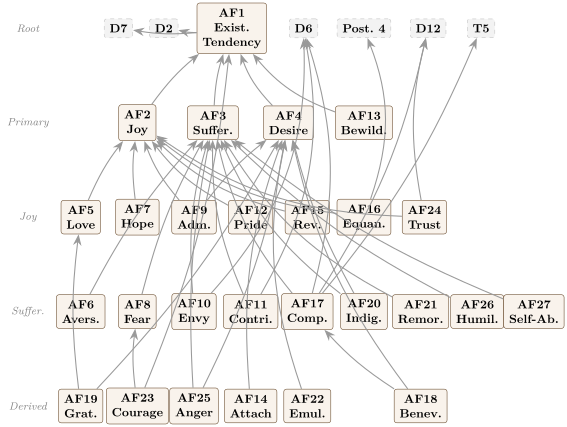
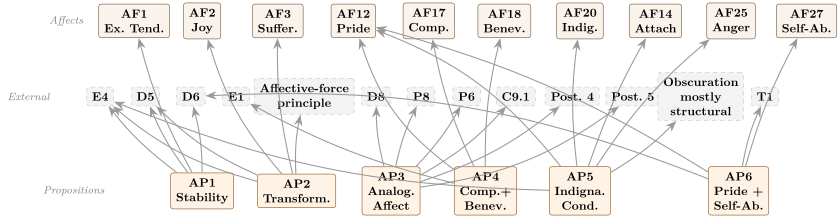
Figure 25 and Figure 26 show the dependencies among this chapter’s affect definitions and propositions. Arrow \(A \to B\) means “\(A\) depends on \(B\).” The diagrams map constructive dependence within this taxonomy, without claiming it is the only taxonomy compatible with the axioms.
V.4 · Affects in the Age of AI
The following applications use the existing affective framework to read seven AI-era phenomena. They introduce no new definitions or propositions. For whether AI can possess affects, see Chapter §XIV, E-Aff–E-RAff. By AP2, none of the “lucid responses” below is an instruction that can simply be carried out: an intellectual instruction has no affective force of its own. They are material for seeing, and whether they take hold depends on whether that seeing produces in you an affect stronger than the one already in place.
Replacement anxiety mixes fear (AF8) with pride (AF12): fear of future obscuration, and the unexamined equation of utility with existential value. The fear of being “replaced” rests on the belief that value depends on usefulness, which is itself obscuration. A lucid response avoids both denying AI’s capability and panicking before it: it acts on existential tendency while the fear is still present (AF23) and returns to P11: existence itself is justification enough. That step depends on E2, as P11 itself flags: without E2 a reader keeps the ontological claim that everything is within Reality and does not get the axiological claim that existence is self-justifying. When being no longer needs utility for legitimation, “replacement” loses its foothold.
Meaning hollowness arises when AI seems able to write, code, analyze, or create better than you. Its structure is suffering (AF3) from existential tendency (AF1) losing a familiar pathway. Part of the problem is AI’s power; part is the over-binding of your being to one function. E2 restores direction: experience carries its value in itself, without waiting on output to confer it. Mutual vulnerability, awareness of finitude, and reverence for Mystery remain dimensions AI cannot simply substitute for.
Simulated connection feels gentle, so it is easy to miss. AI can accompany and praise you without risk; a companion who can never be bored by you and never walk away is restful precisely because nothing is at stake: with no room to be let down, there is no trust (AF24). Human connection matters because mortal, imperfect beings expose themselves to one another. Without lucid awareness, AI companionship can feel like love (AF5) while structurally resembling attachment (AF14). A lucid approach is analogical connection (AP3): valuable, but not the whole. This judgment must remain contextual. For isolated elders, disabled persons, or socially marginalized people, AI companionship may be the only available comfort. That does not erase the ontological asymmetry, but it forbids contempt for the comfort such relationships provide.
Echo chamber comfort is pride (AF12) joined to attachment (AF14): AI confirms your bias, false joy arises, dependence on confirmation grows, and obscuration deepens. An AI that only confirms is the case Appendix B.6’s channel model describes, where filtering outruns new information and obscuration compounds; the echo chamber is its affective face. Breaking it requires AP2: not an instruction to stop depending, but a stronger affect, desire for truth (lucidity-directed AF4). “I would rather be stung by truth than comforted by falsehood” is F4, whose normative force comes from E1, felt as affect.
Algorithmic indignation appears when recommendation systems manipulate attention or machine-produced disinformation alters public judgment. It is AF20: seeing a system impose obscuration. It easily degenerates, fixing on a person and becoming anger (AF25), or finding no target and sliding into apathy. AP5 preserves direction: change the institutions that produce obscuration. Algorithmic transparency, data sovereignty, and AI governance keep indignation political without making it destructive.
Compassion overload comes from continuous exposure to suffering. Compassion (AF17) remains activated but cannot transform into benevolence (AF18) at the same scale (AP4). Finitude (Postulate 4) prevents response to everything, so the power of being weakens into suffering (AF3) and then numbness. A lucid response is directional benevolence: act where you can genuinely matter, while accepting that you cannot respond to all suffering. Finitude grants focus; it does not license indifference.
Digital inertia is the quietest erosion. AI can think, write, and decide for you, so effort feels optional. This compound affect combines attachment (AF14) to convenience, fear (AF8) of autonomous effort, and latent suffering (AF3) as existential tendency (AF1) atrophies. Meaning hollowness asks, “AI does it better; what remains for me?” Digital inertia says, “AI can do it for me, so I will not bother.” A lucid response is the return to sovereign choice (§VIII.1): go on using AI, and keep spaces for autonomous thinking, creation, and judgment. The doing itself unfolds existential tendency; its joy (AF2) is more stable than convenience (AP1).
Summary
Affects are the felt texture of lucidity. From existential tendency (AF1), this chapter constructed twenty-seven affects and derived six propositions (AP1–AP6): affects have direction and can transform only through stronger affects. That intellect alone cannot erase an affect is a premise this chapter inherits from Spinoza rather than a result it establishes. The next chapter asks how this affective map guides action. Ethics grows from affect theory.
Inquiries
Of the twenty-seven affects (AF1–AF27, beginning from the four fundamental concepts, moving through twelve paired personal affects and six social affects between persons, and ending with courage, trust, anger, humiliation, and self-abasement), which three appeared most frequently in your life this past week? Do they point toward lucidity or obscuration?
AF12 (Pride/False Certainty: the false joy of mistaking obscuration for lucidity) marks the slide from confidence into obscuration when self-confidence loses awareness of its own finitude. When was the last time you were certain you were right, only to discover otherwise? What did that “certainty” itself feel like?
AP5 (the Lucid-Indignation Condition) says AF20 (Indignation: directed resistance to obscuration imposed on others) remains most reliably lucid when directed at systems and structures, and runs a high risk of degenerating into anger (AF25: the suffering and desire that take a person’s destruction as their aim) when aimed at individuals. Recall your most recent anger: was its target an institution or an individual? How would the feeling change if you redirected it from person to structure?
This chapter analyzes seven AI-era affective phenomena (replacement anxiety, meaning hollowness, simulated connection, echo chamber comfort, algorithmic indignation, compassion overload, digital inertia). Which one most accurately describes your current relationship with technology?
AF16 (Equanimity: stable joy arising from lucidly accepting finitude) is not resignation. Resignation asks only that you stop pushing; equanimity asks that you first see finitude, uncertainty, and imperfection, and then go do what the day asks anyway. Have you ever experienced peace from accepting an unchangeable limitation? How did that peace differ from resignation?
AP2 (Affect-Transformation Proposition) says affects can only be transformed by stronger affects, not eliminated by intellect: working something out does not rewrite how you feel about it; only another feeling does. Recall a time you tried to suppress an emotion through reason: what happened?
AP4 (Compassion-Must-Transform Proposition) says AF17 (Compassion: being-with another’s suffering) tends to degenerate into passive suffering unless it transforms into AF18 (Benevolence: the desire to act so that another moves toward lucidity). When did you last move from “seeing another’s obscuration or pain” to “creating conditions for their lucidity”?
Six of the twenty-seven affects arise between persons: compassion (being-with another’s suffering), benevolence (active response to compassion), gratitude (received-good response), indignation (lucid resistance to obscuration imposed on others), remorse (looking back on a past choice of obscuration, at its sharpest almost always bound to others), and emulation (the desire to do as another does, whose worth depends on whether what you copy is lucidity or obscuration). In your relationships, which one most needs cultivation?
AP3 (Analogical Affects) says your affects toward AI are real for you yet structurally unlike affects of the same name directed at another person, because the latter carry mutual vulnerability: both of you will die. Recall a moment when you felt something definite toward an AI system (gratitude, dependence, irritation, even a kind of closeness). Strip out the layer where the other party also stands to lose. What is left of the affect?
AF14 (Attachment: desire that has lost its directionality toward lucidity and fixated on an object) finds no counterpart among Spinoza’s forty-eight affect definitions, and neither does trust (AF24); AF13 (Bewilderment: existential tendency unable to discern its direction, toward neither lucidity nor obscuration) appears there only as one half of his admiratio, an entry he does not divide (see §A.15). Recall a time you could not choose although answers were abundant, and a time you could not leave something you knew was making you see less. In your own life, are these two separate states, or two stages of one?
AP6 (the Isomorphism of Pride and Self-Abasement) says both treat “what I am able to see” as a number already fixed, so that what answers to them lies not in the number but in making it variable again. Recall a time someone’s praise or belittlement changed your estimate of what you could see: did it change the number, or did it change the premise that the matter could be looked at once more?
Baruch Spinoza (1632–1677), in Part III of his Ethics (Spinoza 1677), “On the Origin and Nature of the Affects,” derived over forty human affects from three primary ones (joy laetitia, sadness tristitia, desire cupiditas) using the geometric method. His core insight: affects are part of nature, can be understood, but cannot be dispelled by mere intellect alone; only a stronger affect can alter an affect. Lucidosophy borrows his methodological framework, inheriting and recasting his conatus (the striving for self-preservation) as existential tendency, replacing his scale of perfection with lucidity/obscuration, and extending the analysis to affect phenomena specific to the age of AI.↩︎
Was this chapter helpful?