Part IV · The Civilizational Scale · How should civilizations evolve?
XV · Civilizational Lucidity
~49 min left · 12,226 words
XV · Civilizational Lucidity
Chapters §X through §XII showed that lucidity is social and affectively collective; Chapter §XIII returned the principles to civic practice, and Chapter §XIV stepped onto the civilizational scale through the doorway of intelligence. This chapter formalizes that transition and widens the scale once more: if lucidity is social, does social lucidity depend on civilizational evolution? Extending pattern-awareness, mystery-awareness, and unawareness to civilization yields an unexpected answer: a civilization whose pattern-awareness exceeds its mystery-awareness may grow quieter as it grows more lucid.
Step outside on a clear night and look up. The sky is silent. Our galaxy holds something like a hundred billion stars, many of them older than our sun, and if even a sliver of them warmed living worlds, the night should be loud with the signals of others. It is not. Physicists have a name for the unease this provokes: Where is everybody?
This chapter ends by offering an answer that sounds, at first, absurd: the silence we read as absence may be a sign of maturity. To see why, begin with something you already know from your own life. You have met people who command an enormous amount of information and grasp almost nothing that matters, and people of great depth who cannot explain a thing. You sense, correctly, that neither is fully awake. Real lucidity needs both at once: the sharp eye for how things work, and the humility before what no explanation reaches. This book gives that twin capacity a name, lucidity, and a single law: you have it only when you have both, the way a rectangle has area only when it has both width and height. A civilization, it turns out, is bound by the same law, and following that law to its end leads somewhere strange.
A note on the transition from politics to civilization. Political concepts were derived from finitude, plurality, and inter-dependence. Civilizational claims add another layer of conditionality: they depend on political propositions, bridge axioms, and postulates. They should therefore be read as exploratory extensions (tier 4 in the “How to Read This Book” guide): marked by the framework, but not bearing the full deductive weight of T1–T5. In plain terms: the early chapters proved their claims, whereas this one extends the framework to a new scale, so its conclusions are best read as serious, structured conjectures rather than settled results. That tentativeness is deliberate, and it is part of what makes the chapter’s central surprise worth weighing. Figure 51 summarizes the scale transition.
XV.1 · From Society to Civilization: The Third Scale Transition
The argument of this book unfolds along a continuously widening arc. Each scale transition follows the framework’s own logic, and each step is marked as derivation or as interpretive extension.
Two transitions are already complete: from individual to social existence, where T5 and its note argued that lucidity is irreducibly social; and from personal to political affects, where collective affects became emergent rather than additive. This chapter completes the third transition, from social and political life to civilization.

A civilization, taken whole, faces the same allocation problem between Pattern and Mystery.1 Picture its total attention as a single pie cut into three slices: how much it spends understanding (call it \(\lambda\)), how much it spends revering what it cannot understand (\(\xi\)), and how much is simply lost to waste, self-deception, and blind spots (\(\delta\)). At any moment it distributes its collective attention across these three domains: pattern-awareness (technology, engineering, broadcasting, the steady expansion of what it can model); mystery-awareness (contemplative traditions, wisdom cultivation, the posture of listening, existential depth); and unawareness (waste, self-deception, institutional blindness).2 The three exhaust the whole: every increment of attention given to one is drawn from the other two. Your own day runs on the same arithmetic: every hour given to one slice is taken from the other two, and the slice you never notice is often the one shaping you most deeply. From here on this chapter reads all three numbers as shares of attention. The gradient result of Appendix B.12 uses a different reading, in which \(\lambda\) and \(\xi\) are the proportions of reality actually grasped. Where this chapter invokes that result it assumes the two readings are monotonically related (a larger share allocated does not lower the proportion grasped), which is a modeling assumption of the same kind as those declared for T6 below, not a theorem.
Civilizational lucidity then parallels individual lucidity (D5): the product of pattern-awareness and mystery-awareness. The parallel is an interpretive extension, of the same kind as the assumption made explicit in the argument for C-T5.2: it treats the civilization as an agent and reads the allocation of its collective attention as a measure of its degree of awareness. Why multiply and not add? Because a product collapses if either factor falls near zero, and a sum does not: a hundred times zero is still zero, while a hundred plus zero is a comfortable hundred. Addition would let a civilization’s towering Pattern paper over its missing Mystery; multiplication refuses to. A civilization that pours all its resources into technological expansion while cultivating no contemplative tradition has a mystery-awareness near zero, and that is structurally the same condition as a person who only gathers information and never pauses to reflect: enormous on one axis, near zero in lucidity. The ineliminable blind spot of Postulate 6, read at civilizational scale, means that every civilization carries systemic blind spots it cannot see, and that some degree of obscuration (that lost third slice \(\delta\), the share it neither models nor senses) is an ontological fact rather than a technical defect.
XV.2 · The Civilizational Silence Theorem
We can now ask: what does a technological civilization that evolves along the lucidity gradient (one that chooses to maximize lucidity rather than any other quantity) become?
Consider a civilization defined by its technological capacity. This chapter stipulates the phrase “technological civilization” to mean one whose pattern-awareness far outstrips its mystery-awareness. That is a stipulation rather than a diagnosis read off the words, and every inference involving T6 below presupposes this Pattern-dominant starting point; a civilization already on the Balanced Path falls outside the theorem’s reach. Pattern-dominance is where such a civilization begins, and beginning there does not make it the endpoint.
The gradient theorem tells us that lucidity, as the product of pattern-awareness and mystery-awareness, always increases fastest in the direction of one’s weaker dimension3. When pattern-awareness is already high, the gradient points toward deepening mystery-awareness. In other words: for a civilization whose Pattern domain is already highly developed, the fastest path to greater lucidity is to deepen Mystery: to deepen contemplation, expand awe, cultivate listening.
The reason is the same product seen from another angle, and you can check it on a napkin. Suppose a civilization’s understanding stands at nine and its reverence at one. Adding one unit of reverence, from one to two, nearly doubles the product; adding one unit of understanding, from nine to ten, barely moves it. The arithmetic itself pushes every further gain toward the weaker dimension, exactly as the fastest way to enlarge a long thin rectangle is to widen its short side rather than lengthen the long one. The phrase lucidity gradient simply names this direction of steepest improvement.
From this dry piece of arithmetic follows one of the strangest claims in this book, one that, if it is right, changes what an empty-looking night sky might mean.
Under three model premises (a detectability model, an energy-output assumption, and a maturity choice; see “Status and scope” below), a technological civilization evolving along the lucidity gradient becomes decreasingly detectable (harder for outside observers to see across the light-years: how strong the signals it emits, how conspicuous the structures it builds, how much energy it radiates) over time, for as long as its pattern-awareness exceeds its mystery-awareness: the further it travels along that stretch of its trajectory, the quieter it grows. The comparison is between a civilization and its own earlier self, not between one civilization and another: detectability is not monotone in lucidity.
The argument runs as follows. A civilization’s detectability, the degree to which it shows up for an outside observer, is proportional to its Pattern-domain activity. Radio signals, megastructures, energy output: these are all outward manifestations of Pattern (D3), and the more a civilization broadcasts, builds, and expands, the “brighter” it appears. Contemplation, by contrast, casts no shadow across the light-years: we can detect another civilization only by what it broadcasts, builds, and burns, never by how deeply it reflects, so the galaxy’s instruments are deaf to wisdom by construction. But when pattern-awareness is already high, the lucidity gradient points toward mystery-awareness. If a civilization follows that gradient, it shifts from broadcasting to listening, from conquest to contemplation, from outward expansion to inward deepening. The light it casts outward dims, and detectability declines, the signature of a civilization maturing rather than dying.
The formal derivation appears in Appendix B.17.
Under the detectability model, external visibility is monotone in outward Pattern-domain activity. By the gradient result of Appendix B.12, \(\nabla\mathcal{M}=(\xi,\lambda)\); while pattern-awareness exceeds mystery-awareness, \(\partial\mathcal{M}/\partial\xi=\lambda\) exceeds \(\partial\mathcal{M}/\partial\lambda=\xi\), so the fastest direction of increasing lucidity favours mystery-awareness. If the maturity-choice premise holds, the civilization turns from conspicuous expansion to contemplative deepening; if the energy-output assumption also holds, that turn lowers outward expenditure, outward Pattern-domain activity falls, and detectability declines (Appendix B.17 states this step as the condition \(\dot E/E<-\dot\lambda/\lambda\)). Thus T6 holds, under its three model premises, as a conditional civilizational model theorem.
Here an intuition needs correcting. Human intuition says: louder means stronger. A civilization that has wrapped a star in a Dyson sphere (a hypothetical megastructure enclosing a star to capture its entire energy output, proposed by Freeman Dyson in 1960) looks more “advanced” than a quiet planet. T6 dismantles that hierarchy: detectability measures the outward projection of pattern-awareness and cannot register the depth of lucidity. A civilization able to build the Dyson sphere that declines to may be the more lucid of the two, provided its restraint comes from grasping that lucidity requires Mystery as much as Pattern. The choice is not hypothetical: contemporary spacefaring ambition has already written the harnessing of a star’s entire energy output (the Kardashev Type II threshold3) into its stated aspirations, which makes the road the civilizations of T6 decline a road some are actively trying to take. Silence here need not be the sign of an empty house; it may be the voice of wisdom.
This leads to the question that has puzzled physicists since 1950. In that year, Enrico Fermi4 asked: “Where is everybody?” The universe contains roughly \(10^{22}\) stars and has a history of \(10^{10}\) years; statistically, there should be vast numbers of technological civilizations. Yet we observe nothing. The silence is deafening.
T6 provides a philosophical reading from ontology (rather than astronomy). If Pattern-dominant civilizations become quiet as they grow lucid, then the absence of detectable signals is compatible with the hypothesis that lucid civilizations exist. The Fermi Paradox may itself be an answer. Silence is the signal, if this reading is correct. Ever since, the silence has been read as something to explain away: they died, they never arose, they are hiding. T6 offers a stranger possibility, that the silence is the answer itself, the sound a civilization makes once it has outgrown the need to shout. We may be surrounded not by graves but by listeners.
A Pattern-dominant civilization growing lucid does not vanish; it ceases making outward Pattern projection the center. Broadcasters become listeners; conquerors become contemplators. What falls quiet is the outward projection; action goes on, turned toward inward deepening. This parallels T4: at the individual level, silence marks the unsayable; at civilizational scale, quiet can mark maturity.
Status and scope. T6 is not a direct consequence of the lucidity gradient alone. It rests on three modeling premises beyond the core postulates: a detectability model (visibility to outside observers tracks Pattern-domain activity), an energy-output assumption (deepening mystery-awareness lowers outward expenditure rather than merely redirecting it), and a maturity choice (a civilization maximizing lucidity prefers contemplative deepening to conspicuous expansion). It also relies on two modeling assumptions made in Section XV.1: that the civilization as a whole is treated as an agent, and that attention share and proportion grasped are monotonically related. These are plausible modeling choices, not axioms, so T6 is a conditional civilizational-model result, not a theorem with the deductive standing of T1–T5. Nor is it empirically decisive: cosmic silence looks identical whether it issues from wisdom, extinction, or absence. The honest claim is compatibility, not proof: silence is consistent with civilizational maturity, and that bare consistency is already enough to unsettle the reflex that reads quiet as failure.
When you next look up at a quiet sky, you cannot know whether you are facing extinction or wisdom; the framework only asks that you not flinch from the question.
XV.3 · Three Destinies and the Survival Filter
The Civilizational Silence Theorem describes a civilization that evolves along the lucidity gradient. But not every civilization makes that choice, and not every civilization that makes it is allowed to finish. From the constraint that pattern-awareness, mystery-awareness, and unawareness together exhaust the whole, three destinies can be discerned; and once they are in view, a second force appears that the gradient alone does not capture: whether a civilization survives long enough to follow the path it has chosen.
| Path | Detectability | Lucidity | Destiny |
|---|---|---|---|
Path |
Detectability | Lucidity | Destiny |
Pattern Trap |
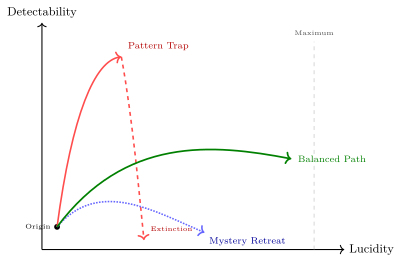
Very high | Near zero | Maximizes pattern-awareness while mystery-awareness vanishes. Risks such as nuclear war, AI loss of control, and ecological collapse rise. High detectability but possibly short lifespan; a flash followed by silence. |
Mystery Retreat |
Very low | Low | Maximizes mystery-awareness while pattern-awareness declines. The civilization turns inward, perhaps contemplatively profound yet low in lucidity, since the product does not care which factor approaches zero. To external observers it “does not exist.” |
Balanced Path |
Moderate | Near maximum | Evolves along the diagonal where pattern-awareness and mystery-awareness grow together. Sustainable, with moderate detectability. The most durable path within this model. |
Each path deserves a moment of contemplation.
The Pattern Trap is the warning Cognitive Finitude (Postulate 6) issues at civilizational scale. A civilization that refuses to acknowledge its own blind spots, treating obscuration as a technical problem to be solved by more technology, is in the end consumed by those blind spots. When mystery-awareness vanishes, the civilization loses all sensitivity to what cannot be formalized: awe before an ecosystem, anxiety about the consequences of a new tool, the quiet intuition that “perhaps we should not do this.” Such a civilization blazes briefly, like a flash across the cosmos: glimpsed for a moment by distant observers, then gone for good.
The Mystery Retreat is a choice. A civilization that turns its resources from outward expansion to inward deepening relinquishes the gifts of the Pattern domain (technology, engineering, the power to reshape the material world) and gains, in exchange, contemplative depth. To outside observers such a civilization is simply invisible: it still exists, but it no longer projects outward. Within Lucidosophy’s framework the path is legitimate but not optimal, since lucidity as a product requires both factors; when pattern-awareness falls to zero, lucidity vanishes no matter how deep the contemplation.
The Balanced Path is the structural optimum identified by the gradient theorem: lucidity is maximized when pattern-awareness and mystery-awareness grow together in balance5. The theorem locates an extremum and issues no instruction; what carries a civilization from that extremum to a path it ought to walk is E1 together with E4, and the product rule supplies neither of them. A civilization on this path possesses both technological capacity and contemplative depth; it neither blazes nor vanishes. It endures.
These three paths do not exhaust all possibilities; they are characterizations of limiting cases. An actual civilization may oscillate among them, or occupy different positions at different historical stages. But the three ideal types show that detectability, lucidity, and long-term survival are related in non-trivial ways. The most “spectacular” civilization and the wisest rarely coincide; the wisest may be the least visible.
That the wisest may be the least visible sounds, at first, like a consolation: maturity hides. But invisibility has a darker companion, and naming it requires a force the lucidity gradient leaves out. The gradient counsels a Pattern-dominant civilization to deepen its weaker dimension, Mystery; it says nothing about whether the civilization will be permitted to. Survival is the missing variable, and it does not follow the gradient.
Picture it concretely. A writer perfects the most luminous novel of her age while, unnoticed, her house catches fire. The quality of the novel and the presence of a working smoke detector are unrelated axes: excelling at one tells you nothing about the other. Lucidity is the novel; survival is the smoke detector. A civilization can grow wiser by the day and still be defenseless against the neighbor who decides to take its land. This is what the proposition’s one technical word, orthogonal, means: survival cuts across the lucidity gradient, a separate axis the lucidity math does not see, so progress along one says nothing about whether the other is satisfied.
A civilization’s position on the lucidity landscape is subject to a survival constraint orthogonal to the lucidity gradient. Under the material-agency premise (the capacity to feed, defend, and perpetuate a civilization is underwritten by Pattern-domain development, which turns into defense only where it is actually directed at defense), regions of high mystery-dominance whose Pattern capacity is not directed at material defense tend to be materially defenseless. The lucidity-optimal trajectory and the survival-viable trajectory can therefore diverge.
By D5, lucidity is the product \(\mathcal{M} = \lambda \cdot \xi\). The argument adds one empirical premise, parallel to those declared for T6: that pattern-awareness \(\lambda\) is, historically, a precondition (not a guarantee) of Pattern-domain material development, the capacity to build, feed, and defend. Granting it, a civilization in the Mystery-dominant corner (low \(\lambda\), high \(\xi\)) couples profound contemplative depth to near-zero defensive capacity. That corner is the purest form of the coupling rather than its only form: wherever a civilization’s Pattern capacity is not directed at defense, a contemplative civilization of middling \(\lambda\) falls into the same filter. The gradient at that corner points toward developing \(\lambda\), but development takes generations under the finitude of Postulate 4, and a defenseless civilization may not be granted them. Survival thus acts as a filter applied from outside the gradient: it can truncate a trajectory the gradient would otherwise reward. Where the filter binds, the path that maximizes lucidity (deepening the weaker dimension) and the path that secures survival (raising \(\lambda\) first) pull apart. CV-Sur is therefore a conditional civilizational-model proposition, not a deductive consequence of D5 alone.\(\square\)
Historically, such regions are often absorbed or destroyed by pattern-capable neighbors before their development can complete; that is an empirical judgment, and the proposition does not assert it. History supplies the structure, though the genuinely external cases must be separated from internal suppressions. Tibetan monastic civilization developed, over more than a millennium, one of humanity’s most sophisticated contemplative systems, an extraordinarily high mystery-awareness, yet in the 1950s it stood almost powerless before industrial-military force. The destruction of the great monastic university at Nalanda around 1200,1 is the same filter wearing a second face, and worth separating from Tibet. Nalanda’s pattern-awareness was not low: it stood in a tradition of formal scholarship running back to Pāṇini, and by the classification of Section XV.4.1 below it belongs in Region F rather than the D corner. Its Pattern capacity went into scholarship rather than defense, and it was razed all the same. What the filter selects on is the capacity for material defense; \(\lambda\) is only one condition of that. (Internal purges of contemplative life, such as the closure of the Academy at Athens in 529,2 are a different mechanism: the obscuration threshold of Section XV.6 below, turned against a minority within one civilization; what is named here is a filter from outside.) The survival filter is also what lifts the Balanced Path above a mere arithmetic optimum. Among the three destinies it is the only one that survives both of the filters the framework has named: the internal obscuration threshold of Section XV.6 below, which destroys the Pattern Trap from within, and the external survival filter of this proposition, which lets the Mystery Retreat be absorbed from without. The Pattern Trap is barely lucid and fails the internal filter; the Mystery Retreat, however deep, fails the external one; only the diagonal passes both, and only if its Pattern capacity is actually turned to defense. Balance is near-optimal not merely because the product peaks near \(\lambda \approx \xi\), but because, of the three corner-types, it is the single region that the gradient rewards and both filters spare.
This sharpens the Civilizational Silence Theorem. T6 says a civilization maturing from a Pattern-dominant start grows quiet, and quiet means hard to detect; the survival filter shows that quiet is double-edged. Invisibility may shield a civilization from predators, or it may leave it unable to deter them; the very silence that marks maturity can also mark defenselessness, and from the outside the two are indistinguishable. That ambiguity is not resolved at civilizational scale. The next chapter carries it to the cosmos, where whether silence means wisdom, fear,6 or extinction becomes the central question.
The three destinies sit at the corners of a larger space. Most civilizations live in its interior, where the pathologies are subtler. The next section maps that full landscape.
XV.4 · The Parameter Landscape: Seven Modes of Being Across Three Scales
The three destinies of Section XV.3 are limiting cases: they describe what happens when civilizations drive one parameter to extremes. But most individuals, societies, and civilizations occupy the interior of the parameter space, where the phenomenology is richer and the pathologies subtler. This section maps the full landscape.
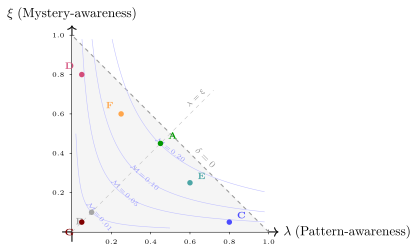
The constraint that pattern-awareness, mystery-awareness, and unawareness sum to one defines a triangular region in which every possible allocation state lives. Seven canonical regions within this triangle correspond to qualitatively distinct modes of being (Figure 52). The insight that motivates this taxonomy is twofold: (1) balance does not entail depth: a civilization that devotes ten percent to pattern-awareness and ten percent to mystery-awareness is perfectly balanced yet profoundly obscured (eighty percent blind); and (2) lopsided awareness at high depth produces recognizable civilizational pathologies (scientism in the Crystal Tower, inarticulacy in the Silent Valley) that a coarser analysis would miss.
The figure below is best read as a map. Its horizontal axis measures how much a society understands (\(\lambda\)); its vertical axis, how much it reveres what it cannot understand (\(\xi\)). The faint curves connect points of equal lucidity, and their shape tells the story: they bend away from both walls, because lucidity collapses whenever either dimension runs dry. The seven labeled dots are landmarks, and the pages that follow visit them one at a time, at three scales each: a single person, a community, a whole civilization.
XV.4.1 · Seven Regions, Three Scales
The following table maps each canonical region across three scales: individual (the phenomenology of a single agent), social (a community or institution occupying the region), and civilizational (a civilization whose aggregate parameters fall here).
| Region | Lucidity | Three Scales | |
|---|---|---|---|
| Region | Lucidity | Three Scales | |
A |
Deep Lucidity balanced, low obscuration |
High | Individual: Simultaneous understanding and awe: sees the structure of a Bach fugue and feels why it makes one weep. |
B |
Balanced Shallowness (The Fog) balanced but shallow |
Very low | Individual: Balanced but shallow. Content, incurious, neither analytical nor contemplative. “Things are fine.” No internal signal that anything is missing. |
C |
Pattern Dominance (The Crystal Tower) pattern-dominant |
Low | Individual: Brilliant but brittle. Masters every pattern, feels nothing. Derives the equations of quantum mechanics but finds no meaning in a sunset. |
D |
Mystery Dominance (The Silent Valley) mystery-dominant |
Low | Individual: Deeply contemplative but unable to articulate insight. Feels everything, understands little. Easily manipulated by those skilled at weaving a story. |
E |
The Lucid Analyst pattern-leaning, some depth |
Moderate | Individual: Einstein at the organ8: predominantly analytical, with genuine contemplative capacity. Sees further than C because mystery-awareness provides depth perception. |
F |
The Lucid Contemplative mystery-leaning, some depth |
Moderate | Individual: Dogen in the garden9: predominantly contemplative, with enough Pattern-awareness to articulate insight. Wiser than D because analytical capacity provides communicative power. |
G |
Double Obscuration (The Sleepwalker) near-total obscuration |
Near zero | Individual: Neither understands nor feels. Moves on autopilot, driven by habit and appetite. Not malicious but absent. |
XV.4.2 · Thought Experiments
Each canonical region, when imagined as a universal condition, reveals a distinct phenomenology. The following thought experiments ask: what would a world look like if everyone inhabited this region?
A. Deep Lucidity: “The Garden of Dual Seeing.” Imagine a society in which every member at once understands the causal structure of the world and stands in reverence before what that structure cannot hold. Scientists weep at the beauty of their equations, not out of sentiment but from genuine contact with Mystery. Artists know the formal structure of their medium with mathematical precision and still make works that point past all formalization. Here the “two cultures” divide (C. P. Snow’s diagnosis10) has been healed, not by reducing one culture to the other but by cultivating both within each person and each institution.
Region A is not utopia. A tenth of reality still lies in the blind spot. What sets A apart from the other regions is the awareness of obscuration: the inhabitants of A know that they do not know, and that knowledge is itself a form of lucidity. A is the structural optimum (D5): for any fixed level of obscuration, lucidity is maximized when pattern-awareness and mystery-awareness are equal.11
B. Balanced Shallowness: “The Fog.” Now imagine a society where four-fifths of reality is invisible and the remaining fifth is split evenly between Pattern and Mystery. Everyone is balanced and almost entirely blind. This society has no dysfunction it can name: people are moderately rational, moderately sensitive, and deeply content. There is no crisis because there is no awareness that anything is missing. The Fog is the most insidious of the seven regions precisely because it raises no internal alarm. A society in the Crystal Tower at least feels the absence of meaning; a society in the Silent Valley at least senses that something has been left unexamined. The Fog feels fine.
This is why balance alone is not enough for lucidity: when both pattern-awareness and mystery-awareness are low, their product hovers just above zero even when the two are perfectly matched. The inhabitants of the Fog have no motive to grow, because they are comfortable. Here obscuration (D6) takes its most insidious civilizational form: obscuration that feels like normalcy.
C. Pattern Dominance: “The Crystal Tower.” A society of pure analysts. Every citizen can solve differential equations; none can say why music moves them, and most find the question faintly embarrassing. Art survives as decoration; religion is extinct; philosophy has been folded into logic. The Crystal Tower is spectacularly productive: its output is enormous, its technology the most advanced anywhere, its optimization flawless. But when someone asks, “What is all this for?” the Tower has no answer, and treats the question itself as a symptom of insufficient pattern-awareness: “If you understood more, you would not need to ask.”
Region C is scientism made into a way of life, the belief that Pattern exhausts reality, which C2.1 denies. Despite enormous total awareness, lucidity stays dismally low, because a very high number multiplied by a very low one is still small. The gradient screams “develop Mystery!”, but the Tower cannot hear it, because the very capacity needed to hear it (mystery-awareness) is the one it lacks. This is the self-reinforcing structure of obscuration.12
D. Mystery Dominance: “The Silent Valley.” The inverse of C. A society of contemplatives who feel the depth of existence with exquisite sensitivity but cannot build a bridge, diagnose a disease, or organize a supply chain. Wisdom is abundant; agency is not. The Silent Valley is vulnerable in a way the Crystal Tower is not: it cannot defend itself, feed itself efficiently, or carry its insights to outsiders. Its people know something precious, but that knowledge dies with them if it cannot be articulated or structured. D and C carry identical lucidity, a symmetry that falls straight out of the product structure, which does not care which factor is small. The gradient for D points squarely at pattern-awareness: “develop Pattern.” This is the Mystery Retreat’s structural exposure under the survival filter (CV-Sur): Tibet is an instance of D’s vulnerability, a defenselessness that high mystery-awareness cannot offset; Nalanda, in Region F, shows the same filter binding where pattern-awareness is present but not directed at defense.
E. The Lucid Analyst: “Einstein at the Organ.” A society where Pattern dominates but Mystery is genuinely present as a second voice. Scientists practice contemplation as a source of insight. Engineers ask “should we?” in the same breath as “can we?” This society is recognizably better than the Crystal Tower: its technology is tempered by a real sense of what technology cannot answer. It is not balanced (pattern-awareness exceeds mystery-awareness), but its mystery-awareness runs high enough to lift it well above either the Tower or the Valley. E and F share identical lucidity despite opposite profiles, since the product is blind to which dimension is larger. What separates E from the Crystal Tower is that E has more mystery-awareness: it is the minority dimension that decides whether a society crosses from brilliance into lucidity.
F. The Lucid Contemplative: “Dogen in the Garden.” The mirror of E. Contemplation dominates, but Pattern-awareness is present enough to give the insight a body: monastics study mathematics; mystics write systematic philosophy. The Lucid Contemplative society can say what the Silent Valley can only feel. Its disadvantage relative to E is a thinner capacity for material agency; its advantage is that its insights run deeper and its relation to Mystery is more direct. Classical Indian civilization is a fair example, producing both the most rigorous contemplative practices and remarkably sophisticated formal systems such as Pāṇini’s grammar13 and the Kerala school of mathematics14. It is this Pattern-awareness that lets contemplative insight become transmissible.
G. Double Obscuration: “The Sleepwalker.” A society where almost everything has fallen into the blind spot: nine-tenths of reality invisible. The Sleepwalker neither understands the world (low pattern-awareness) nor feels its depth (low mystery-awareness). Movement is driven by reflex, habit, appetite. This is neither the Pattern Trap, which at least had the energy of expansion, nor the Mystery Retreat, which at least had the depth of contemplation. It is the absence of both, the endpoint of civilizational entropy: what is left after prolonged obscuration has eaten away both the capacity to analyze and the capacity to feel. G is not what CV-Osc (stated in Section XV.7 below) predicts directly: that proposition says only that neither pure phase is stable and that balance requires continuous correction. G is what follows once correction stops, which is the drift described in Section XV.4.4 below: when neither form of awareness is cultivated any longer and no one injects correction, obscuration accumulates (Appendix B.5), both dimensions fall together, and civilizational lucidity approaches zero. Recovery from G calls for an external shock or an improbable internal mutation, because the very faculties needed to recognize the trouble (pattern-awareness to diagnose it, mystery-awareness to sense that something is wrong) are exactly what G has lost.
XV.4.3 · The Mixed Society Problem
No real society is homogeneous. Every civilization contains agents scattered across all seven regions. The question is: does cognitive diversity automatically produce collective lucidity?
The answer is: only if integration occurs at the institutional level. If Crystal Tower analysts and Silent Valley contemplatives merely coexist, aggregate coverage improves only additively. If institutions make them work on shared problems, train in both modes, and deliberate with evidence and wisdom together, lucidity can exceed the average because multiplication happens at the institutional level.
When a society contains agents with complementary profiles: if institutions enable genuine integration (multiplication) of pattern-awareness and mystery-awareness, the society’s aggregate lucidity can exceed the lucidity of any individual member; if the members merely coexist without institutional integration (addition of coverage only), aggregate lucidity does not exceed the greatest individual lucidity.
By T5, lucidity is irreducibly social: part of an agent’s awareness is constituted by the relational structure it stands in. By T2, what emerges is irreducible to its components, so emergent structures such as institutions can create forms of awareness that no individual possesses, and civilizational lucidity is not the sum of individual lucidities (Section XV.7 below states this separately as CV-Irr). The condition for super-individual lucidity is therefore that emergent institutional structures combine pattern-awareness and mystery-awareness multiplicatively at the institutional level, rather than merely averaging individual capacities. This requires that institutions be designed so that complementary capacities combine productively: the analyst’s pattern-recognition informing the contemplative’s depth, and the contemplative’s sensitivity informing the analyst’s direction. The proposition models the unintegrated case as one in which every judgment is made at best by one member acting alone, so collective lucidity is bounded above by the greatest individual lucidity. The baseline needs stating precisely: pooling the pattern-awareness and mystery-awareness of different members and taking their product, even by simple averaging, is already a form of institutional integration, and for members whose profiles are complementary and of comparable strength it can already exceed that maximum. The unintegrated case is the one in which no such pooling occurs at all.\(\square\)
Cognitive diversity without institutional integration is addition without multiplication: total coverage increases, but aggregate lucidity does not exceed the greatest individual lucidity.
CV-Mix has two branches: where institutions achieve genuine integration, a society’s overall lucidity can exceed that of any member; where members merely coexist, it does not exceed the maximum among them. The corollary takes the second branch. Addition without multiplication restates it: coverage accumulates with members, while the product structure of lucidity (D5) requires Pattern-awareness and Mystery-awareness to interact, and coexistence supplies no interaction. The corollary therefore adds nothing beyond CV-Mix.
CV-Mix explains why mere “diversity” in organizations does not automatically produce wisdom. A company that hires both engineers and philosophers but assigns them to separate departments has added perspectives without multiplying them. The product structure of lucidity demands that the two modes of awareness interact: only then can the whole exceed its most lucid member. This is the institutional analogue of D5’s individual requirement: just as a person must integrate Pattern and Mystery within themselves, a society must integrate them within its institutions.
If your team keeps its analysts and its dreamers in separate rooms, you have only filed the same blind spots in two cabinets instead of one.
XV.4.4 · Phase Transitions
Societies do not remain in one region forever. What causes movement between regions?
The parameter landscape is dynamic. B \(\to\) C occurs when a comfortable but shallow society discovers science and technology: Pattern surges, Mystery stays low, and the Pattern Trap becomes possible. C \(\to\) E occurs when crisis reveals the limits of technology and a Pattern-dominant society rediscovers contemplative depth. E \(\to\) A is rare: both dimensions deepen together through sustained institutional commitment. Any region can drift toward G when both forms of awareness cease to be cultivated. Growth requires deliberate effort across generations; decay requires only neglect. This is also why the civilizational ethics of Section XV.8 asks that Mystery be maintained alongside Pattern, and the force of that duty comes from E1, not from the gradient, which only shows where the duty points.
The parameter landscape provides the framework; the next section turns the lens to a concrete contemporary paradigm.
XV.5 · A Contemporary Case: The Pattern-Expansion Paradigm
A framework cannot remain abstract. The Pattern-dominant path has a living contemporary form: the project of expansion beyond Earth, of which the multiplanetary enterprise now reaching toward Mars is the most visible instance. It deserves the framework’s strongest reading before it receives its critique. This is structural analysis of a civilizational mode. Where individuals come into it, what is assessed is a position in a governance structure rather than anyone’s character or motives.
Begin with the steelman, because the expansion paradigm starts from a truth the framework grants. A civilization confined to a single planet is a single point of failure; Postulate 4 makes finitude an ontological fact, and securing the continuation of conscious life against planetary catastrophe is a direct response to that finitude. Survivability is genuinely necessary for lucidity: a civilization that goes extinct has a lucidity of exactly zero, so any project that raises the floor under everything else carries real lucidity-value. The paradigm can even claim Mystery-credentials, since its self-understanding often reaches past raw capability toward understanding the universe and extending the reach of consciousness, language that gestures at awe and at the intrinsic value of experience (E2). And at its most honest it admits that the long bet may simply fail, that the enabling steps may never arrive, and it leaves that blind spot (\(\delta\)) on the record.
The framework’s reply does not deny any of this. It relocates the question. What fixes a civilization’s place on the landscape is its revealed allocation, more than its stated mission. A mission can name three ends, survival, understanding, and the extension of consciousness, two of them steeped in Mystery, while the actual distribution of attention and capital runs overwhelmingly to Pattern: to compute, launch, and infrastructure, and to contemplative depth almost nothing. Where a civilization’s stated purpose and its actual spending diverge, it is the spending that locates it: the share of its attention and money that really flows to Pattern versus Mystery. By that measure this paradigm sits near Region C (the Crystal Tower of Figure 52: high understanding, near-zero reverence). The test is portable, and worth carrying out of this chapter, so long as one remembers what it measures. It applies to entities with a discretionary budget and a public calendar: a person, an institution, a civilization. About anything with no budget to inspect it says nothing at all, and this book is one such thing. It also narrows the evidence deliberately. Appendix B.12 names three kinds of evidence for mystery-awareness (what an agent does, what it refuses to claim, and what can still move it), and allocation is only the first. The other two scored positively for this paradigm in the steelman above. This section uses allocation alone because the other two are supplied by the party under assessment, and the question here is precisely when a stated purpose and an actual allocation come apart; on other questions those two kinds of evidence should not be discarded. To learn what a person or an institution truly values, do not read the mission statement; read the budget and the calendar. A man may say his family comes first while his every hour and dollar flow to the office; a civilization is the same, only larger. The gap between the brochure and the budget is the exact size of the blind spot \(\delta\) a civilization cannot see in itself.
From there the verdict follows without polemic. Survivability is necessary, not sufficient; CV-Sur makes the point precise by showing that survival is a filter on trajectories. Exporting an unbalanced civilization to a second planet secures the species against one class of catastrophe while replicating its obscuration across two worlds rather than one. The gradient theorem’s counsel is unchanged: when pattern-awareness is already high, lucidity grows fastest by deepening Mystery in parallel; extending Pattern’s reach alone buys little. There is also a quieter danger in how such projects are governed. A single undertaking that spans centuries and answers to one person’s vision, with almost no way for others to check it, collides with two of the framework’s results. First, such an undertaking is in fact exercising power in the sense of P13: it settles the conditions under which people not yet born will unfold. P15 makes legitimacy turn on whether that exercise runs with the direction of lucidity, legitimate insofar as it advances agents toward lucidity and illegitimate insofar as it manufactures obscuration; and a century-long undertaking that no one is placed to question fixes in place exactly the structure in which obscuration accumulates most easily. The constraint falls on the people and institutions who carry the undertaking forward, not on the undertaking as a name. Second, no system can fully understand itself while it is busy changing itself (CV-Inc, stated in Section XV.7 below). Put simply: no civilization, and no founder, can fully model the world it is remaking.
The paradigm is therefore incomplete rather than wrong. Its expansion answers Finitude (Postulate 4) but leaves Cognitive Finitude (Postulate 6) untouched, and the move it omits is the inward one. To reach the stars without deepening the capacity to stand in awe before them is to carry the Crystal Tower into orbit: a longer reach, the same blind spot.
XV.6 · The Obscuration Threshold: Reinterpreting the Great Filter
If the Pattern Trap is a mode of civilizational self-destruction, at what point does it become irreversible?
The most unsettling hypothesis within the Fermi Paradox is the “Great Filter”15: a barrier preventing civilizations from reaching the interstellar stage. It is often imagined as an event: nuclear war, a supervirus, runaway AI. Lucidosophy reinterprets it as an obscuration threshold, a systemic state rather than a one-time catastrophe.
The Great Filter may be civilizational obscuration accumulating until lucidity falls below recovery. Once a civilization loses the capacity to recognize its own blind spots, the ineliminable blind region named by Cognitive Finitude (Postulate 6) stops being a fact that can be acknowledged and becomes a gap no one inspects. The Boundary Theorem (T1) supplies a guarantee running the other way: complete obscuration is equally unattainable and lucidity stays strictly above zero, so no civilization is structurally locked out. Recovery is hard because the faculties needed to recognize the trouble are precisely the ones that have drained away (Region G in Section XV.4.2 above), not because recovery has been foreclosed. Some obscuration is ineliminable; refusing to acknowledge it is the danger. Where a civilization treats every blind spot as a technical problem, its decision-makers and its institutions are re-enacting political pride (PA3) at civilizational scale. To say that a civilization is proud is shorthand for a distribution plus a structure: the propositional attitudes of many individuals, together with the institutions that amplify and lock them in. The civilization itself does not experience anything. The filter, on this reading, has two faces: the internal one just described, in which obscuration eats a civilization from within, and the external one of CV-Sur, in which a Mystery-rich but defenseless civilization is absorbed before it can mature. Only the balanced trajectory passes both, and then only if its Pattern capacity is turned to defense.
Appendix B.15 makes this harsher at cosmic scale. Granting the light-cone coupling of Appendix B.17, because any message between stars may take longer to arrive than the sender lasts, civilizations are effectively islands that can never form a single conversing network; interstellar coupling approaches zero, and the cosmic “network” is almost disconnected16. Among civilizations whose parameters differ, lucidity synchronization cannot occur spontaneously. Each civilization must face its own balance between Pattern and Mystery independently. No savior descends from the stars to correct your imbalance.
This is lonely, and it also hands the choice back to us. If no external civilization can synchronize your lucidity, then your civilization’s lucidity rests entirely on its own choices.
The analysis above unfolded at the qualitative level. What follows compresses the core concepts into formal structures, providing the technical foundation for subsequent chapters.
XV.7 · Formal Structure at Civilizational Scale
The preceding sections analyzed the dynamics of civilizations evolving along the lucidity gradient. This section distills formal propositions unique to the civilizational scale; they are genuinely new structures produced by the scale transition, distinct from mere amplifications of individual-level propositions. Each proposition names its parents in parentheses for the specialist; a first reading can ignore those citations and simply follow the plain claim in each box.
A civilization’s lucidity is not the sum of its members’ lucidities. Emergent structures (institutions, culture, collective memory) create forms of awareness and obscuration that no individual possesses.
By T5, lucidity is irreducibly social: part of an agent’s awareness is constituted by the relational structure it stands in rather than residing wholly in the agent. By T2, what emerges is irreducible to its components. Institutions, culture, and collective memory satisfy both conditions: they are sustained by individuals, yet they carry distinctions no single individual commands (the case law accumulated in a constitutional tradition, the concepts a language makes ready to hand) and blind spots no single individual intended (incentive structures, procedural silences). Summation ranges over members only, so it necessarily misses both of these, which exist at the level of structure. A civilization’s lucidity therefore cannot be obtained by summing its members’ lucidities.\(\square\)
Institutional propaganda, group dynamics, and systemic incentives can create civilization-level obscuration beyond individual intention; constitutional traditions, accumulated jurisprudence, and public deliberation can likewise create collective wisdom no single person designed. CV-Irr therefore requires two-level cultivation: inner practice and structural design. Section XV.4.3 extends this through CV-Mix.
C9.2 has already recorded the point at an earlier scale: complex systems cannot be understood by analyzing parts alone. At civilizational scale, institutional obscuration can persist even when individuals are subjectively well-meaning; civilizational wisdom can exceed any member’s comprehension.
A civilization composed of individually lucid agents can still be collectively obscured, because institutional blind spots and systemic inertia can exist in emergent structures alone, and whether they exist is not settled by the lucidity of the members.
By CV-Irr a civilization’s lucidity is not the sum of its members’, since emergent structures create forms of awareness and obscuration that no individual holds. If a form of obscuration can exist only at the emergent level, then whether it exists is not settled by the lucidity of the members. Members all being lucid is therefore compatible with the collective being obscured. The corollary claims that compatibility and leaves open how often the case arises.
A civilization can possess collective wisdom that no individual member fully grasps: constitutional traditions, accumulated case law, insights crystallized in intergenerational practice.
This is the other face of the same CV-Irr: emergent structures can create awareness no individual holds just as they can create obscuration no individual holds. Constitutional traditions, accumulated case law, and insight crystallized across generations of practice are instances of the former, their content distributed through institutions and practices rather than held in any one mind. Only both corollaries together give the full sense of CV-Irr; taking either alone reads it as one-sided pessimism or one-sided optimism.
These corollaries reject both naïve individualism and naïve collectivism. Lucidity must be cultivated at individual and civilizational levels independently; neither substitutes for the other. At cosmic scale, CS-CivAn will extend this: each civilization is an irreplaceable unfolding mode of Reality.
If a civilization’s self-model is treated as a system describing reality in the sense of T3, no civilization of sufficient complexity can completely model itself. Given further the reflexivity premise (each description a civilization gives of itself alters the object described), every attempt at civilizational self-understanding generates new complexity that exceeds what the model produced by that attempt can capture.
Treating a civilization’s self-model as a system in the sense of T3 (Self-Reference Theorem), the first sentence is an instance of T3 at civilizational scale: a system describing reality is itself part of reality, so a civilization’s self-model is part of the civilization. An individual cannot completely describe the reality it inhabits; likewise, a civilization cannot fully understand its own workings. The second sentence rests on the reflexivity premise: each new social theory, each census, each policy analysis alters the very object it attempts to describe, and that alteration lies outside the model that made it.
Civilizational planning has inherent limits, not merely practical (insufficient data) but ontological (T3 operates at civilizational scale).
By CV-Inc, which itself follows from T3, no civilization of sufficient complexity can model itself completely, and, given the reflexivity premise, every attempt at self-understanding generates complexity beyond the reach of the model it produces. Planning presupposes a self-model and so inherits that incompleteness. Hence not merely practical: even with the data in hand, the self-referential structure leaves a gap. The corollary claims only that planning cannot be complete, and says nothing about whether it works.
The complete plan that utopian engineering promises cannot be had, because the Self-Reference Theorem operates at civilizational scale, and no amount of effort makes up for that; whether a given plan works is a separate question. Civilizations should still attempt self-understanding, but with humility: self-understanding remains incomplete. This accords with Postulate 6 yet is more pointed, because incompleteness follows from self-referential structure itself.
So when you are tempted by a plan that promises to perfect society once and for all, the deepest reason to distrust it is that no society can ever see all of itself.
Suppose that whether a civilization can recognize its blind regions depends on whether it remembers where it has walked into them before. Then a civilization’s sustained lucidity is bounded by the fidelity, accessibility, and interpretability of its collective memory; memory degradation can be expected to bring lucidity degradation, even when present-moment capacities remain unimpaired.
Collective memory is one of the emergent structures named by CV-Irr: it carries awareness no individual fully commands, so its degradation produces obscuration no individual intended. By Postulate 6, every civilization carries an ineliminable blind region. On the memory premise this proposition sets, whether a civilization can recognize that region depends on whether it still remembers where it last walked into one, and fidelity, accessibility, and interpretability decide whether that memory is accurate, reachable, and legible. A civilization that has forgotten its own historical obscuration (colonialism, genocide, ecological destruction) has therefore lost the very warrant by which it might recognize the same obscuration now, and is liable to repeat those obscurations. Not because it “intends evil,” but because part of civilizational obscuration accumulates through forgetting.
On this reading, collective memory is the temporal infrastructure of civilizational mystery-awareness: it keeps the record of where a civilization once walked into what it could not see.
More stored information \(\neq\) more accessible wisdom: where added storage depresses accessibility and interpretability, information overload is obscuration masquerading as pattern-awareness, arriving in the form of noise.
By CV-Mem a civilization’s sustained lucidity is limited by the fidelity, accessibility, and interpretability of its collective memory, and storage volume is the vehicle of only one of the three. Adding storage acts on that one and can depress the other two at the same time. Where it does depress them, the result meets the definition of obscuration (D6) while presenting outwardly as a gain in Pattern-awareness, and that is the precise sense of the disguise.
This cuts to the heart of the AI age. We possess more information than ever, and not necessarily more collective wisdom: what CV-Mem.1 names is exactly this obscuration arriving in the form of noise. The bottleneck lies in meaning-making rather than storage. Search engines give answers; they do not teach the art of asking, the core capacity of mystery-awareness (D4).
In your pocket sits more of the world’s recorded knowledge than any emperor ever commanded. The open question of your life is plain: will you let it make you wiser, or only louder?
Future generations will be agents (D7) whose unfolding conditions are asymmetrically shaped by the present civilization’s choices, constituting an asymmetric interdependence (D12). Legitimacy (P15) therefore demands that present power be exercised with future agents’ lucidity as a binding constraint.
By D7, an agent is what unfolds and has some awareness of its own unfolding; future generations meet that specification and merely do not yet actually exist. In the terms of D12, future generations depend on present agents, and the dependence runs one way: we shape their conditions, they scarcely shape ours. By P15, the legitimacy of power turns on whether its exercise runs with the direction of lucidity. What the present civilization exercises over future agents is power in the sense of P13, and of the kind against which they can enter no plea. Applying the criterion yields the result: any exercise that systematically narrows the conditions under which future agents might become lucid is, to that extent, illegitimate.\(\square\)
Discount rates in economics and politics that devalue future agents are a form of temporal obscuration, a refusal to acknowledge interdependence across time.
By CV-IG future generations will be agents (D7) whose conditions of unfolding are asymmetrically shaped by present choices, which constitutes an asymmetric interdependence (D12), so legitimacy (P15) requires their lucidity to enter the constraints. A discount rate lowers that weight by temporal distance. Past a certain point the constraint stops binding while the interdependence itself has not weakened, so the record parts company with the case: the lapsed constraint neglects an intelligible aspect of reality, interdependence across time, and that falls under the branch of obscuration (D6) that is neglect of Reality’s intelligible aspect. The corollary concerns discount rates that devalue future agents; discounting for uncertainty and discounting away a bearer are two different operations.
The essence of this asymmetry is that future generations depend on us completely while we, causally, depend on them hardly at all, the most extreme form that the interdependence of D12 takes in a power relation. This is also why the discount rates of CV-IG.1 count as obscuration: they book a dependence that cannot answer back as a number that can be marked down.
The children who will inherit your world cannot vote, cannot argue back, and cannot refuse what you leave them; whatever care you extend to them, you extend to people who can never thank you.
Neither pure phase is stable. The Balanced Path is a dynamic equilibrium, held by continuous correction.
By C2.1, neither the purely Pattern-side position nor the purely Mystery-side position is complete. By the upper-bound step of the demonstration of T1 (which draws the incompleteness of pattern-awareness from Postulate 6 and the limit on mystery-awareness from Postulate 4), complete pattern-awareness and complete mystery-awareness are equally unattainable, so no pure phase can remove its own incompleteness by pressing itself to the limit. The incompleteness therefore keeps surfacing, and in surfacing keeps supplying reasons for the opposite direction, which is why pure phases are unstable. Equilibrium is accordingly dynamic: it is held by continuous correction rather than by any state arrived at once.\(\square\)
The historical evidence is abundant. The succession from Enlightenment to Romanticism to Positivism to Postmodernism can be read as alternating pattern-dominant and mystery-dominant phases. Each excess of pattern-awareness provokes a mystery-awareness reaction, and vice versa. Corollary C2.1, which says pure scientism and pure mysticism are both incomplete, plays out repeatedly across civilizational history.
Attempts to permanently fix a civilization in a single phase (pure rationalism or pure mysticism) are inherently unstable.
By CV-Osc both pure phases are unstable and the equilibrium path is a dynamic balance requiring continual correction. Fixing a civilization permanently in one phase cancels that correction and so falls into the unstable branch. The ground is the upper-bound step of the demonstration of T1: complete Pattern-awareness and complete Mystery-awareness are equally unreachable, and any arrangement claiming to have arrived at one and settled there is claiming a position that cannot be occupied.
The corollary is aimed at arrangements that claim to have arrived and to stay, such as institutions that lock one worldview in place as the endpoint; a civilization that leans toward one dimension for a period and is later corrected does not fall under the instability it names.
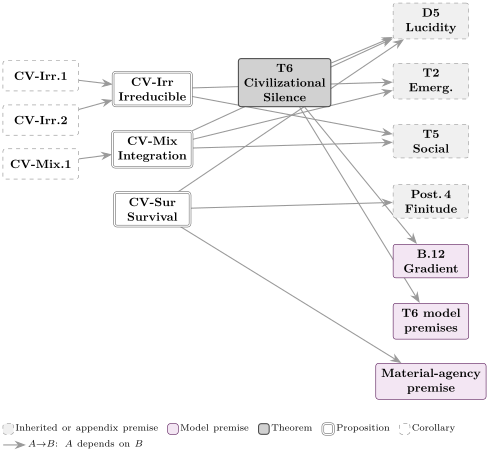
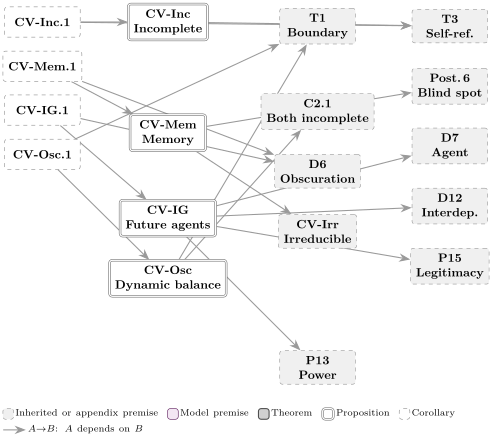
Formal Structure Dependency Diagram
The two diagrams below show the logical dependencies among this chapter’s civilizational structures. Arrow \(A \to B\) means “\(A\) depends on \(B\)”; in each panel the corollaries stand at the left, with their parent structures and premises ranged to the right. The grey nodes are inherited or appendix-level premises. The three nodes marked as model premises differ in kind: the T6 model-premise node holds the conditional assumptions required by T6, the material-agency node belongs to CV-Sur, and the B.12 gradient node is a result derived in the appendix that this chapter takes as a given premise.
XV.8 · Civilizational Ethics
The formal propositions of the preceding section describe what civilizations are. This section asks what they owe: when the lucidity framework is read as an ethical framework at civilizational scale, what obligations emerge?
First, the bookkeeping. Section XV.3 has already declared that the gradient theorem locates an extremum and issues no instruction. Every duty in this section is carried by E1 (lucidity is good), together with E4 wherever the lucidity of others is at stake; the gradient theorem only shows where those duties point and generates none of them. The bearers need naming too. “A civilization must” is shorthand here: CV-Irr has just said that a civilization is an emergent structure irreducible to its members, and the argument for PP5 requires that responsibility land on a bearer who is itself a moral subject. Each duty below therefore falls on particular people and institutions: legislators and funding bodies, universities and research institutes, courts and the press, and every agent with the authority to decide how a budget is divided.
Intergenerational responsibility follows from CV-IG: future generations are agents whose unfolding conditions are shaped by present choices. This is asymmetric interdependence (D12) at its most extreme, because the affected parties cannot consent, protest, or negotiate. The legitimacy criterion of P15 requires an exercise of power to run with the direction of lucidity, and CV-IG has brought the lucidity of future agents inside that constraint. Ecological depletion, technological debt, and cultural atrophy therefore carry a heavy legitimacy burden wherever present decision-makers have chosen them, and the burden is booked to the people and institutions who made the choice (E1, E4). Discount rates that render future agents invisible are temporal obscuration (CV-IG.1).
Legislators, funding bodies, and universities must also maintain mystery-awareness alongside pattern-awareness (E1). When technology, optimization, and computation are richly funded while contemplative depth, art, reverence, restraint, and the humanities are left to wither, a civilization is drifting toward the Pattern Trap. The gradient theorem shows where this duty points, while the force of the duty still comes from E1: when pattern-awareness is already high, the lucidity gradient points toward mystery-awareness, so to neglect Mystery under these conditions is to move against the gradient. The arithmetic wants stating exactly. Differentiating \(\mathcal{M} = \lambda \xi\) gives \(\mathrm{d}\mathcal{M} = \xi\,\mathrm{d}\lambda + \lambda\,\mathrm{d}\xi\). If the added unit of pattern-awareness is drawn from mystery-awareness (\(\mathrm{d}\xi = -\mathrm{d}\lambda\)), then \(\mathrm{d}\mathcal{M} = (\xi - \lambda)\,\mathrm{d}\lambda\), so for \(\lambda > \xi\) lucidity falls on net, and every unit of technological capacity added costs \(\lambda - \xi\) of lucidity. If it is drawn instead from the unaware share \(\delta\), lucidity still rises, though far less than the same unit given to mystery-awareness would have raised it. The first case is what the Pattern Trap amounts to formally. Libraries, contemplative traditions, the humanities, practices of ecological reverence, institutions built to reflect: these are the infrastructure of contemplative depth, to be kept up in lean years as well as fat, and without them civilizational lucidity collapses however high technological capacity may climb. A civilization that can build a spacecraft but has forgotten how to sit in silence is accelerating along a trajectory whose endpoint is the Pattern Trap.
Finally, civilizational lucidity requires institutional obscuration-checking, work that E1 likewise requires and that particular institutions carry out. CV-Inc says no civilization can fully model itself, and CV-Irr says institutional obscuration exceeds individual intention. Courts, a free press, scientific correction, civic education, and contemplative traditions do different versions of the same work: they help a civilization notice its drift before drift becomes fate. A civilization that refuses to listen has already begun to fail, regardless of how loudly it broadcasts.
Grand Reflection: Silence as Signal
Let us pause at the close of this chapter to listen. Across three scales the book has been tracing a single theme: silence as the mark of lucidity.
At the personal scale, silence is meditation: to stop speaking, begin listening, and make room for Mystery to appear. T4 told us that the most honest response to the unsayable is to mark the place of silence.
At the social scale, silence is institutional listening: not the silence that smothers dissent, but the silence that opens space for reflection. When a society quiets its own clamor long enough to hear its blind spots, it draws one step closer to lucidity.
At the civilizational scale, silence can be one mark of maturity. T6 says that a civilization whose pattern-awareness exceeds its mystery-awareness grows ever quieter as it moves along the lucidity gradient: its powers remain, but it has learned that power is not the whole of being. Perhaps some civilizations could build the Dyson sphere and chose not to, out of an understanding of what lucidity asks. The next chapter carries that image to the cosmos, where silence may mean wisdom, fear, solitude, or a boundary beyond our knowing.
So step outside once more, under the same silent sky we began with, and notice what the chapter has done to it. You still cannot tell a grave from a meditation hall: from where we stand, a civilization that destroyed itself and a civilization that grew quiet enough to listen look exactly alike. To hold both pictures at once, and not to flinch from either, is the whole of what this chapter has been asking of you.
The three civilizational destinies are plotted as trajectories in the detectability–lucidity plane in Figure 55.
What This Chapter Cannot Decide
The Dynamic Balance Proposition (CV-Osc) and the three civilizational destinies are derived from the axiom system’s structure, but they cannot predict the trajectory of any actual civilization. Whether humanity avoids the Pattern Trap, how long civilizational oscillations take, and which institutions successfully integrate cognitive diversity are empirical and historical questions. The framework identifies structural risks and possible outcome-types; it does not forecast which outcome will occur.
Nor does the chapter settle whether these dynamics apply cleanly to pre-industrial or pre-literate societies, where the Pattern domain was narrower. It raises that question and leaves it open.
Summary
When the framework scales from the individual to civilization, three destinies emerge: the Pattern Trap, the Mystery Retreat, and lucid equilibrium. CV-Sur adds a survival filter orthogonal to the lucidity gradient, which is why the Balanced Path alone is both near-lucidity-optimal and, once its Pattern capacity is turned to defense, survival-viable, and why a Mystery-rich but Pattern-poor civilization is so often absorbed before it matures. The Parameter Landscape refines these limiting cases into seven regions, showing that balance without depth is as pathological as lopsidedness. CV-Mix shows that cognitive diversity produces collective lucidity only through institutional integration. T6 adds the counter-intuitive possibility that a civilization whose pattern-awareness exceeds its mystery-awareness may grow quieter as it grows more lucid, giving the Fermi Paradox a new reading: cosmic silence may be wisdom rather than emptiness, even as the survival filter keeps that silence ambiguous.
Inquiries
Where on the Parameter Landscape (a region map of civilizations indexed by collective pattern-awareness \(\lambda\) and mystery-awareness \(\xi\)) do you think current human civilization sits: the Pattern Trap (high \(\lambda\), low \(\xi\): one-sided technological expansion), the Mystery Retreat (low \(\lambda\), high \(\xi\): one-sided introspective closure), or somewhere in between? What is your evidence?
T6 (the Civilizational Silence Theorem) says a civilization whose pattern-awareness exceeds its mystery-awareness may grow quieter as it grows more lucid: when pattern-awareness is already high, the lucidity gradient points toward mystery-awareness; add the maturity choice the chapter declares as a modeling premise (that a civilization maximizing lucidity prefers contemplative deepening to conspicuous expansion) and it shifts its attention from broadcasting to listening, so its detectability declines. Does this change your view of the Fermi Paradox? Is cosmic silence terrifying, or could it be wise?
CV-Mix (the Diversity-Integration Proposition) says cognitive diversity produces collective lucidity only through institutional integration, not mere coexistence: differences must be combined, dialogued with, and institutionally borne, or they amount to mutual ignoring. Is your society institutionally integrating diversity, or erasing it?
What kind of cognitive environment are we leaving to future generations? If your great-grandchild could say one thing to you about the choices you are making today, what would it be?
The “Fog” region on the Parameter Landscape describes a civilization that is balanced (\(\lambda\) and \(\xi\) roughly equal) but shallow (both low, so total lucidity is thin): superficially pluralistic, actually hollow. Do you think some contemporary societies occupy this position?
CV-Irr (the Irreducibility Proposition) says a civilization’s lucidity is not the sum of its members’ lucidities: emergent structures (institutions, culture, collective memory) create forms of awareness and obscuration that no individual possesses. Current choices about AI training data and algorithmic objectives are becoming just such an emergent structure. How will they shape the cognitive terrain of future generations?
What is the converse of the Civilizational Silence Theorem? Is a civilization that constantly broadcasts displaying strength or immaturity?
CV-Sur (the Survival Filter) says the lucidity-optimal path and the survival-viable path can diverge: a civilization may need to raise pattern-awareness merely to survive long enough to deepen Mystery. When does securing survival become a pretext for never doing the inward work, and how would a civilization tell the difference between buying time and squandering it?
Pattern (D3) and Mystery (D4), the framework’s two basic dimensions, are introduced in Chapters §II–§III; a civilization’s pattern-awareness and mystery-awareness measure how much of each it grasps.↩︎
Formally, \((\lambda_{\text{civ}},\,\xi_{\text{civ}},\,\delta_{\text{civ}})\) satisfying \(\lambda_{\text{civ}} + \xi_{\text{civ}} + \delta_{\text{civ}} = 1\); Postulate 6 guarantees \(\delta_{\text{civ}} > 0\).↩︎
Formally, \(\nabla\mathcal{M} = (\xi, \lambda)\): the partial derivative with respect to pattern-awareness equals mystery-awareness, and vice versa. See Appendix B.12.↩︎
Enrico Fermi (1901–1954), Italian-American physicist, posed his famous question (“Where is everybody?”) over lunch at Los Alamos National Laboratory in the summer of 1950. His argument: if interstellar travel is physically possible, given the age of the galaxy, extraterrestrial civilizations should have colonized the entire Milky Way by now. The numbers give it force: even at speeds far below that of light, a single expansionist civilization could spread across the galaxy in a few million years, a blink against its ten-billion-year age, so the emptiness we observe is genuinely surprising.↩︎
Formally, for any fixed level of obscuration \(\delta\), \(\mathcal{M} = \lambda \cdot \xi\) is maximized on \(\lambda + \xi = 1 - \delta\) at \(\lambda = \xi\). Relaxing the constraint to \(\lambda + \xi \leq 1\) places the unconditional maximum at \(\delta = 0\), which Postulate 6 forbids by guaranteeing \(\delta > 0\). The structural optimum in this book is always the conditional optimum at a given level of obscuration.↩︎
This fear has a famous name: the dark forest hypothesis, popularized by Liu Cixin’s novel The Dark Forest (2008) and building on older SETI thinking. If any broadcast might reveal one’s position to a hostile listener, the safest move for every civilization is silence, and the cosmos falls quiet not from absence but from universal caution. The survival filter is the structural skeleton beneath that image.↩︎
The Vienna Circle (Wiener Kreis), a group of philosophers and scientists centered around Moritz Schlick (1882–1936) in 1920s–1930s Vienna, championed logical positivism. Though the Circle’s official stance rejected metaphysics, some members (Carnap’s early work, Waismann’s later turn) maintained a sensitivity to existential questions alongside rigorous logical analysis.↩︎
Albert Einstein (1879–1955), a devoted amateur musician who said “I often think in music,” exemplifying the E-region’s dual engagement with Pattern and Mystery.↩︎
Dogen Zenji (1200–1253), founder of the Soto school of Zen Buddhism, combined profound contemplative practice with rigorous philosophical writing (Shobogenzo). His insistence that practice and enlightenment are identical exemplifies the F-region: mystery-dominant but with genuine pattern-awareness.↩︎
C. P. Snow (1905–1980), British scientist and novelist, delivered the Rede Lecture “The Two Cultures” at Cambridge in 1959, diagnosing the dangerous gulf between scientific and humanistic intellectual life.↩︎
See Appendix B.11 for the formal analysis of this self-reinforcing dynamic.↩︎
Pāṇini (c. fourth century BCE), the Indian grammarian whose Aṣṭādhyāyī builds a complete generative grammar of Sanskrit from some four thousand rules, among the earliest known formal systems and still echoed in twentieth-century formal language theory.↩︎
The Kerala school, a tradition of mathematics and astronomy active in southern India from the fourteenth to the sixteenth century and associated above all with Mādhava (c. 1340–1425), obtained infinite series expansions for sine, cosine, and arctangent more than two centuries before Newton and Leibniz.↩︎
The “Great Filter” concept was introduced by economist Robin Hanson in 1996. He argued that between lifeless matter and interstellar civilization there must exist some step (or steps) extraordinarily difficult to pass. The unsettling twist is that we do not know whether the Filter lies behind us, some near-impossible step life already cleared, which would make us rare and precious, or ahead of us, a barrier no civilization survives, which we would be racing toward. Each technological milestone we reach while still finding no neighbors tilts the odds toward the second reading.↩︎
The Fiedler eigenvalue \(\mu_2 \to 0\); see Appendix B.15 for the synchronization theorem.↩︎
Was this chapter helpful?