Part IV · The Civilizational Scale · How should civilizations evolve?
XIV · Intelligence and Wisdom
~52 min left · 12,798 words
XIV · Intelligence and Wisdom
Parts I through III moved from reality, to the person, to society. Part IV turns to civilizational scale and begins with the force that most defines our moment: artificial intelligence. The age’s deepest confusion is conceptual rather than technical. We conflate intelligence with wisdom. A machine can grind through Pattern with a capacity that dwarfs us, yet wisdom asks for what no machine has yet shown: a self-aware grip on its own finitude, a patience that can sit inside uncertainty, and reverence for whatever refuses to be optimized.
Our age calls itself the “Age of Intelligence.” This naming itself deserves scrutiny. An age that names itself after its most abundant resource has already confessed what it is quietly running short of.
What This Intelligence Is, and Is Not
It is worth being concrete about the object of this chapter before we formalize it. Strip away the marketing, and an artificial intelligence, in its contemporary form, is an engine that maximizes Pattern: it ingests the recorded traces of human reasoning and extends them, predicting the next word, the next move, the next proof. This is no small thing. Along the axis of Pattern-awareness (\(\lambda\)), by external measures such systems already exceed any individual human across a broad range of tasks, and will likely keep climbing. But two features fix their place in this framework. First, as currently constructed, they operate on the formalizable: what they extend is Pattern, and by Postulate 6 no mode of unfolding grasps even Pattern in full; what is irreducibly Mystery does not lie in the direction Pattern-extension travels, so such a system retains at most the minimal Mystery-awareness T1’s lower bound allows, far short of what wisdom requires. Second, and more decisively, they process Pattern without showing the capacity D5 names, the seeing of one’s own seeing. They extend cognition without inhabiting it.
This is why the distinction that organizes this chapter, intelligence against wisdom, is no flattering story humans tell to keep a corner of the field for themselves. The two lie on different axes. Intelligence scales along \(\lambda\); wisdom requires lucidity, standing within Pattern and Mystery together and bearing, self-aware, the weight of finite and irreversible choice. A system can saturate the first axis and never reach the second. The proposition that opens this chapter (E-Int) states this formally; everything after it works out what follows.
XIV.1 · Ontological Distinction: Intelligence vs Wisdom
Intelligence and wisdom are fundamentally distinct modes of capacity. The former can be externalized and amplified; the latter requires self-aware existential normativity: the capacity to see that one is seeing, to interrogate whether one’s goals are worth pursuing, and to bear the irreversible cost of choosing (Postulate 4, D9).
Each of the three capacities wisdom requires has its own conditions. Seeing that one is seeing is the capacity D5 names. Interrogating whether one’s goals are worth pursuing requires a standpoint that can carry value, and by E2 such a standpoint lies within experience (D9). Bearing the irreversible cost of choosing requires the finitude of Postulate 4 and the depth of experience for which, by P5, finitude is a necessary condition. Intelligence, as defined, need only process patterns and find solutions under given goals, and meets none of the three conditions; whatever admits characterization by inputs and outputs is characterized without specifying the mode of being that carries it, and can therefore be instantiated elsewhere, which is what being externalized and amplified means. The conditions differ, so the two are distinct modes of capacity. The reach of the proposition should be noted: it distinguishes two modes of capacity, and whether any particular system has one of them lies outside it and calls for a separate judgment (C9.1).
When we call a system “intelligent,”1 we usually mean fast pattern recognition, goal optimization, broad information processing, and problem-solving under constraints. These capacities are real, measurable, externalizable, and already often superhuman.
Intelligence answers “how”; wisdom answers “whether one should.” Intelligence is the capacity to find optimal paths given a goal; wisdom is the capacity to judge whether the goal itself is worth pursuing. Intelligence can operate under any value function; wisdom interrogates the value function itself. Picture someone who has spent ten years optimizing a career, fluent and effective at every step, who stops one morning and asks whether the thing being optimized was ever worth wanting: that question, not the optimizing, is wisdom.
The criterion is lucidity-capacity, whatever the substrate: the ability to see that one is seeing (D5), to stand within Pattern and Mystery together, and to bear the weight of that awareness. An ant colony processes pattern with precision, allocates resources, adapts to its environment, and acts under irreversible stakes, yet it is not wise because it cannot ask whether its goals are worth pursuing. Finitude, embodiment, and irreversibility matter, but they are not sufficient. Wisdom requires seeing that one is seeing, and asking from within whether the seeing is aimed at anything worth wanting.
AI makes the decoupling visible at civilizational scale. Current systems process Pattern without showing self-aware access to their own participation in Pattern and Mystery. A large language model can process vast knowledge and generate coherent reasoning, but it has not shown that it knows it is doing so in the D5 sense: it has not shown that it sees its own seeing.2 The question to put to any system is therefore whether it can see that it is seeing. What it is made of does not change the question.
Mistaking intelligence for wisdom is one of the gravest forms of obscuration (D6) in the Age of Intelligence.
By E-Int intelligence and wisdom are distinct modes of capacity, and by D6 obscuration is the neglect of Reality’s intelligible aspects. Mistaking one for the other neglects that distinction and so falls under D6. The derivation reaches only this far, that it is a form of obscuration. Ranking it among the gravest takes one step more, and the ground of that step lies elsewhere, in a second-order property: by D6 every obscuration conceals itself, and this one additionally supplies a feeling of certainty, so the motive for doubt is cancelled along with the doubt. The comparative claim carries no further than that step.
This obscuration takes several forms. We treat fluent AI output as wisdom, forgetting that a recipe is not a meal: a model can generate text that sounds profoundly wise, yet these words come from pattern-matching and have not been shown to come from experience. We substitute algorithmic intelligence for human judgment, and a judgment no longer exercised atrophies, as unused muscles degrade. We make efficiency the highest value, forgetting that a slowly prepared meal can mean more than a perfectly optimized nutritional supplement, because cooking holds attention, choice, imperfection, and the possibility of sharing.
The last form is the knowledge illusion, and it is the most dangerous, because it feels like lucidity. A person hands a question to AI, receives a fluent answer, and feels they understand, while bypassing perplexity, trade-off, correction, and lived appropriation. The other three forms produce discomfort or at least invite suspicion; this one produces confidence and satisfaction, dissolving the very motivation to examine oneself. Apparent pattern-awareness rises; actual understanding stagnates; the unawareness zone expands unnoticed.
You can hold an entire library in your pocket and still not know which question is worth living inside; ignorance unsettles you and certainty reassures you, and the real danger is the second.
Intelligence deserves instrumental respect, but it cannot be ontologically equated with wisdom.
The second half follows directly from E-Int: if the two are distinct modes of capacity, ontological identification is excluded. The first half has another source. Deserving instrumental respect is a value judgment, and E-Int draws a distinction without evaluating. Its normative force enters through E1, on which lucidity is more worth pursuing than obscuration, so an instrument that extends Pattern-awareness (\(\lambda\)) carries instrumental value. The step is marked here because the corollary’s two halves rest on different premises, one descriptive and one an ought borrowed from §VI.
Lucidosophy neither fears intelligence nor worships it. As a tool, AI can enormously expand human cognitive capability, and that is worth cherishing. But on current construction it cannot substitute for value judgment, because value judgment presupposes experiential subjectivity (E2). Postulate 5 commits only in one direction: some finite agents have experience, with embodied ones as the paradigm; P5 further argues that finitude is a necessary condition of experiential depth; here the framework additionally assumes the converse, that experiential subjectivity is rooted in finitude. The step that AI cannot substitute for value judgment is therefore the conclusion of a strong philosophical argument, sharing the epistemic status of P5 (see the scholium on P5’s epistemic status in Chapter §I). Lucidity in the Age of Intelligence therefore means using intelligence to broaden cognition while refusing to surrender final value judgment to systems that as yet show no evidence of experience.
AI excels at perception and reason; in the dimension of Pattern, by external measures it has already surpassed us across a broad range of tasks, and the gap may widen further. The distinctively human strengths lie elsewhere: in phronesis (practical wisdom) and intuitive apprehension, the Mystery-facing modes of knowing that are irreducible to rules and not easily algorithmized. The highest collaboration integrates all four ways of knowing rather than letting the Pattern modes crowd out the rest.
Wisdom does not scale in the same way: intelligence can expand across systems, but wisdom can only grow within an individual.
By E-Int intelligence can be externalized and amplified, hence expanded across systems. The three capacities wisdom requires (seeing that one is seeing, interrogating whether one’s own goals are worth pursuing, bearing the irreversible cost of choosing) all take place in the first person (D9) and are conditioned on the actor’s own finitude (Postulate 4). One agent’s seeing that it sees cannot be performed on another agent’s behalf. These capacities are therefore untransferable, and what cannot be transferred can arise only within the agent it inhabits. That is what growing only within an individual states.
The scarcest resource of this age is wisdom, not intelligence. Intelligence scales: once a model is trained, it serves millions at once. Wisdom does not scale that way; it can only grow within an individual, through time, experience, reflection, failure, and choice, incrementally, with no shortcut. You cannot download wisdom, crowdfund wisdom, or produce it merely by making a model larger.
This is the deep paradox of the Age of Intelligence: the supply of intelligence expands rapidly while the supply of wisdom grows slowly, and the scissors gap between them may keep widening. Lucidosophy’s lucidity (E1) and agency (E4) acquire new urgency here. Lucidity means discerning what truly matters amid an intelligence surplus; agency means refusing to be defined by the dimensions intelligence can optimize (efficiency, output, metrics) and instead cherishing what can only grow within finite experience: love (AF5), friendship, reverence (AF15) for beauty, and courage in the face of uncertainty. At civilizational scale this becomes a fork in destiny: T6 will argue that a Pattern-dominant civilization, evolving along the lucidity gradient, grows quieter rather than merely more capable.
If wisdom cannot be externalized, then agents (D7) who possess wisdom bear responsibilities that cannot be delegated: moral judgment can be handed to a system, but the responsibility for it is not discharged by doing so.
The descriptive half comes from E-Int.3: wisdom is untransferable, so the capacity that renders the judgment cannot be delegated. The normative half has another source. Bearing responsibility presupposes a subject answerable for the consequences, and by E2 such a subject must be an experiencer; by E4 the choice between lucidity and obscuration is the direction of an agent’s own perfection, so a judgment made on its behalf is another agent’s act and cannot discharge that direction. Delegation can always occur as a matter of fact: hand the decision to a system and the system returns an output. What the corollary denies is that delegating discharges the responsibility, and the whole force of that denial comes from the bridge axioms of §VI.
Responsibility for moral judgment cannot be outsourced because E4 grounds responsibility in the experiential agent. You can have AI draft your contracts, analyze your data, even suggest strategy. But the question “should this be done at all?” can only be borne by you, because bearing responsibility presupposes a subject who can be accountable for consequences. A system that as yet shows no evidence of experience cannot be credited as such a subject; it can execute, but it cannot bear.
A deep temptation of the intelligence age is to dissolve responsibility by disguising it as efficiency. “Let the algorithm decide who gets the loan” sounds like optimization, but in substance it transfers a judgment about human destiny (who deserves trust? who should receive opportunity?) from an experiential judge to an optimizer that shows no evidence of experience. Lucidity means recognizing that transfer for what it is and keeping human judgment at the critical nodes. (E-Int.4, earlier in numbering, concerns relational posture and is stated in §XIV.4.)
Wisdom’s growth requires particular conditions, and in the age of intelligence those conditions are being systematically eroded.
The first half follows from E-Int.3: wisdom grows only within an individual, and growth has conditions. The scholium lists four: slowness, failure, boredom, and patience with uncertainty; the last is supported by Postulate 6, and the other three are observations about individual growth. The second half is an empirical claim about the present technological environment and follows from no postulate. The four matching tendencies the scholium names (rewarding instant response, routing around discomfort, filling every blank, training people to expect an immediate answer) are observable, and their evidential standing differs from that of the book’s formal parts: should the environment change, the second half lapses while the first is untouched. The two are booked separately here so that an empirical observation does not ride on the credit of a formal derivation.
Wisdom does not grow in comfort. It requires slowness, but algorithms reward instant reaction. It requires failure, but AI can help you avoid most discomfort. It requires boredom, but screens fill every second of blankness. It requires patience with uncertainty, but search and generation train you to expect an answer at once (Postulate 6).
E-Int.3 says wisdom grows slowly. E-Int.6 goes further: even the soil in which it grows is eroding. These are two different claims. The first says growth is slow; the second says the very conditions for growth are disappearing. Protecting slowness, failure, boredom, and uncertainty is therefore ecological conservation of humanity’s scarcest capacity.
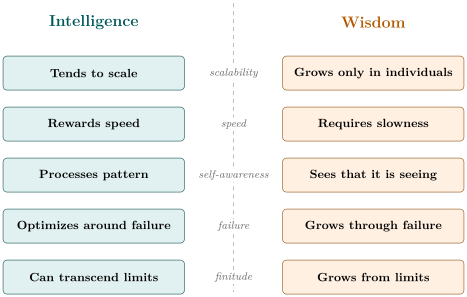
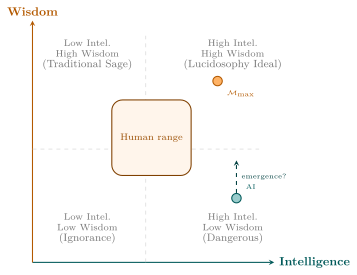
The five-dimension contrast (Figure 39) sets the two capacities side by side: scalability, speed, self-awareness, failure, finitude. In the two-dimensional spectrum (Figure 40), high intelligence joined to high wisdom is the quadrant Lucidosophy aims at, while high intelligence meeting low wisdom is what the most dangerous obscuration looks like.
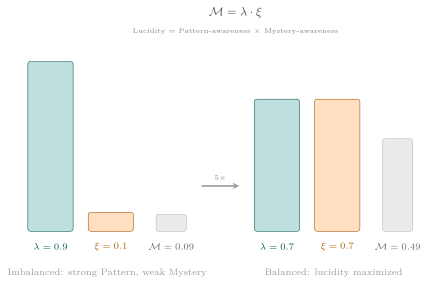
The lucidity product structure (Figure 41) returns to D5’s strict notation: \(\lambda\) for Pattern-awareness, \(\xi\) for Mystery-awareness. It offers no second definition of intelligence and wisdom. Its point is that wisdom requires the two to be multiplied, and a simple sum will not do. The bars make the point directly: balance outperforms extremes.
When intelligence can be externalized, the core of education ought to shift from “transmitting knowledge” to “cultivating judgment.”
By E-Int intelligence can be externalized; by P-Share the content of Pattern transmits without loss while the grasp of it does not. So when the transmissible part is available on demand, what remains for education is the untransmissible part, namely judgment, which by E-Int.3 grows only within an individual. That much is description, and it yields only that the transmission of knowledge is no longer the scarce thing. That the core of education ought to shift is a normative claim, entering through E1 and E4: lucidity is more worth pursuing than obscuration, and choosing lucidity is the direction of an agent’s own perfection, so cultivating the one capacity only the agent can exercise is what education should do under these conditions. The antecedent, that intelligence can be externalized, is licensed by E-Int, which makes the proposition conditional: where the antecedent fails it says nothing.
Judgment is the concrete form of wisdom (E-Int), and cannot be downloaded. If AI can answer any factual question instantly, then the knowledge-transmission part of education has indeed been handed to technology. But this does not make education obsolete; it lets education’s essence finally surface. Education was always more than filling a vessel: it cultivates a capacity, the capacity to exercise judgment under uncertainty. P-Share marks the boundary: Pattern’s content can be transmitted losslessly, but understanding it (the “aha”) cannot.
Judgment, knowing when to trust data, when to doubt a conclusion, when to follow intuition, when to change one’s mind, grows only through repeated trying, erring, and correcting. A child who relies on AI to answer every question gains more information but may lose the muscle of independent thought. Since E-Int.6 warns that the soil of wisdom is eroding, education becomes the first line of defense against that erosion.
So when you let a machine finish your child’s homework, or your own, what gets skipped is not only the answer to that problem but a small repetition of judgment, one you will never get back.
XIV.2 · Ontology of Carbon-Based Existence
What makes you capable of wisdom? Your brain’s processing speed does not supply it. Your body does, and your death, and your memory, which warps and forgets. The propositions ahead map the soil in which wisdom grows: finitude, embodiment, irreversibility, vulnerability. There is one criterion, whether you can see that you are seeing, and what you are made of does not change it.
Note (the scope of this section): By “carbon-based existence” this section means finite experiencers that arose through biological evolution, sustain themselves by metabolism, and grow and die: life on Earth. A “silicon-based system” is an information-processing system that acquires its capacities through design and training and whose states can be copied and rolled back. The propositions that follow rest on four properties: finitude, embodiment, irreversibility, and vulnerability. Carbon-based existence is the only mode currently known to bear all four at once; the force of each proposition comes from the properties, and the material is only their one known bearer. Wherever the text says “unique to carbon,” read “unique to carbon on current construction.” Whether a silicon-based system could acquire the four is left open by the Note that closes E-Gap; “no wisdom without embodiment” is recorded in §XIX.2 (Objection VII) as a conjecture rather than a settled result; and where any particular being sits on the experiential spectrum is likewise unresolved (C9.1).
The body is a mode of knowing: carbon-based life, through the body, acquires a form of knowledge that cannot be translated into data (Postulate 3).
By Postulate 3 Pattern and Mystery are intertwined, Mystery being the face that cannot be said; by D9 a first-person perspective is not identical with any third-person description of that perspective. Data are by construction third-person transcribable and so lie within Pattern (D3). What the instant of touching hot iron delivers can be transcribed on its sayable side, while its unsayable side (D4) has no image in data. There is therefore a knowing available through the body that does not translate into data. This derivation uses Postulate 3, D4, and D9. E2 answers why such knowing matters; the body of the proposition asserts nothing about that, so it is not among this proposition’s premises.
AI can process every medical paper on pain, every biological dataset on aging, every neuroscience article on tactile sensation. But these constitute knowledge about the body (the Pattern aspect), not knowing from the body (the Mystery aspect).
When your hand touches hot iron, you “know” what burning means. Not as a datum. As a recognition inscribed in flesh (D9: a first-person perspective is not equivalent to any third-person description of it, and what in it stays ineffable is D4). This embodied knowing (pain, fatigue, aging, touch) is a cognitive channel unique to carbon-based experiencers, belonging to those ways of knowing described by Postulate 3 that cannot be algorithmized.
In Pattern’s dimension silicon cognition can outperform us, and that is not in dispute. What matters is that there exists a kind of knowing that comes through having a body, and it is part of the material from which wisdom is made.
For carbon-based experiencers time runs irreversibly (P6), so each experience carries irrevocable weight. This irreversibility is an epistemic condition of wisdom, and death is its sharpest instance.
By Postulate 4 finitude is that to exist in one way is not to exist in others, a modal exclusion that contains no time; by P6 time runs irreversibly for finite experiencers, and P6 itself needs finitude and experience together. The two combine: once an experience occurs it cannot be reoccupied, and so carries irrevocable weight. By E-Int the third capacity wisdom requires is bearing the irreversible cost of choosing, and a being whose choices carried no irrevocable weight could not exercise it. Irreversibility is therefore a necessary condition of that capacity, and so of wisdom. Death enters as an instance: that carbon-based experiencers die is an empirical fact contained in the delimitation that opens this section, and the postulates do not yield it; it is the sharpest instance of irreversibility because what is lost is the experiencer’s own continuation. The proposition asserts necessity and not sufficiency: irreversibility does not produce wisdom, and is one of the conditions that make wisdom possible.
As currently constructed, silicon-based systems can be copied, restarted, and rolled back, so their “processing” has no irrevocable last time and their information carries no existential urgency. A gamer who can infinitely reload saved states never truly fears. Because every choice can be undone, no choice is “real.” The fundamental situation of silicon-based systems runs parallel: their information processing operates within a reversible framework.
Carbon-based life is the precise opposite. You make a decision, time flows irreversibly forward, consequences embed themselves irrevocably into your being. It is precisely this irreversibility that gives experience its weight, the weight of “this time is real.”
Death is therefore the sharpest form of that precondition, less life’s tragic appendage than its deepest gift. A system without a “last time” cannot grasp the meaning of “precious.” Wisdom grows in the soil of “this cannot be done over.”
“The last time” is an existential category unique to carbon-based experience.
By P6 time runs irreversibly for finite experiencers and no moment returns; by E-Mor it is that irreversibility which gives experience its irrevocable weight. The category of a last time requires a sequence that can terminate and cannot be resumed, and a rollback-capable, copyable regime of operation supplies no such sequence, since any state within it can in principle be occupied again. The conditions for the category are therefore irreversibility (P6) and finitude (Postulate 4), with substrate not among them. Carbon-based in the corollary reads as the note opening this section directs, namely the mode of existence that on current construction bears all four properties at once, and the corollary carries no more weight than that note allows.
A framework of operation that can be rolled back and copied holds no category of “last,” and therefore none of “precious,” “regret,” or “farewell.”
You do not know which time you hold your grandmother’s hand will be the last; it is exactly that not-knowing, and the finality behind it, that makes the holding matter at all.
Carbon-based memory and silicon-based storage are distinct temporal relationships: carbon-based memory warps, forgets, and is colored by emotion, and these “defects” are precisely the evidence of its inseparability from experience.
By Postulate 5 some finite agents have experience; by P6 the time that experience occupies is irreversible. If memory is inseparable from experience, then its state at any moment is a function of everything lived since: later experience recolors it and forgetting filters it. Storage, by design, aims at fidelity of retrieval, and its state at any moment is independent of what has happened since. The two are therefore distinct relations to time (D2) rather than two grades of accuracy within one relation. This is the ground on which the proposition calls the warping and the forgetting evidence of inseparability: what the warping tracks is the experiencer’s own history, which storage by design does not track.
Silicon-based storage is perfect but passionless, preserving everything yet “remembering” nothing. Your memory of first love is not accurate; it has been modified by time, recolored by later experience, filtered by forgetting. That imprecision is what makes it your memory: evidence that you have lived.
True memory, such as the slight tightening in your chest when you recall a certain moment, presupposes a subject being changed by time, losing things, and remaining alive within that loss.
Forgetting, often taken for a cognitive failure, is a signature of existence. A system that does not forget has no better memory for it; it stands in an entirely different mode of information relation (D2).
Nostalgia, regret (remorse, AF21), and longing can arise only within a temporality that forgets and perishes; only carbon-based existence has that temporality.
By E-Mem the warping, forgetting, and emotional coloring of carbon-based memory are the evidence of its inseparability from experience, and by P6 the time such memory occupies is irreversible. Nostalgia, remorse (AF21), and longing each presuppose an object already lost and not reoccupiable, a presupposition satisfied only within that temporality; E-RAff rules the temporal affects as resisting mapping on this very ground. What the corollary asserts is therefore a necessary condition: affects of this kind can arise only within a temporality that forgets and perishes. It does not assert that such temporality suffices to produce them.
The gap between carbon-based experience and silicon-based processing is ontological rather than technical (Postulate 3). So long as silicon-based systems lack finitude and irreversibility, this gap will not be bridged by increases in computing power or improvements in architecture alone.
By E-Int the capacities of wisdom are conditioned on first-person occurrence (D9) and finitude (Postulate 4); by Postulate 3 Mystery is not a region inside Pattern that has yet to be reached, and more Pattern does not lead there. Growth in computing power is an operation within Pattern (D3), and however large the quantity it remains within Pattern, so it cannot reach what is by definition not within it. This is a difference of category, which a difference of degree cannot describe. The proposition carries no more weight than the note closing it allows: a strong philosophical argument, not a proven impossibility. By T2 the possibility of emergence cannot be excluded in advance, and should silicon-based systems acquire finitude and irreversibility in ways we cannot presently imagine, the proposition requires revision.
Just as a river will not become a mountain by flowing faster, increases in computing power cannot cross ontological category boundaries. Mainstream technological optimism holds: “If AI cannot yet do X, it is merely a matter of time and compute.” But Lucidosophy’s framework identifies a category error1 here.
Carbon-based experience (qualia2, thisness, choice within finitude) belongs to what Postulate 3 calls “the Mystery aspect.” It is a mode of being different in kind from information processing, and to treat it as a complex function that more computation could simulate is to mistake it.
An analogy: the “wetness” of water is a relational quality between water and the one who touches it, which more molecules alone cannot produce. Similarly, experience is an existential relation between a finite being and the world, which more neural connections alone cannot produce.
This does not mean AI can never possess some form of “experience”; T2 says emergent possibilities cannot be ruled out a priori. But if AI does develop experience, it will be a new kind of experience rather than a replication of the carbon-based kind. Where AI sits on the experiential spectrum remains open (C9.1); if evidence suggests human-like experience, the ethical framework must adjust (C9.3).
Note: E-Gap is a philosophical position, not a proven impossibility. It reflects this book’s best reading of the current ontological landscape: that the carbon/silicon distinction is one of kind rather than degree. But T2 keeps the question formally open: if a future silicon-based system acquires genuine finitude and irreversibility through means we cannot currently conceive, E-Gap would need to be revised. Epistemic status: a strong philosophical argument, short of deductive certainty.
Simulating an experience and having an experience are events of different ontological categories.
By E-Gap the gap between carbon-based experience and silicon-based processing is ontological rather than technical. Simulation works on outward behaviour that admits third-person description, while having concerns a first-person occurrence (D9), and by D9 a first-person perspective is not identical with any third-person description of that perspective. The two therefore belong to different categories, and the distance between them does not shorten as the fidelity of simulation rises. The corollary’s epistemic standing is inherited from the note closing E-Gap: a strong philosophical argument, not deductive certainty. Should E-Gap require revision under future evidence, this corollary is revised with it.
Perfectly simulating the external manifestations of grief (suffering, AF3) is not grief. So long as E-Gap holds, this distinction will not be dissolved by technological progress alone.
When you are mourning someone, a system that flawlessly performs sympathy can soothe you, but it has not been shown to grieve with you; whether that is enough is a choice only you can make, and worth making with your eyes open.
Vulnerability is an ontological feature of finite experiencers, arising from finitude together with experience: a finite experiencer can lose (P5), what it loses cannot be recovered (P6), and it undergoes the loss from within. That is why its relationships carry genuine risk and genuine depth.
By P5, a finite experiencer can lose: each possibility realized sets the others aside, so everything it has lies within what it can lose. By P6 its time runs irreversibly, and what is lost cannot be reoccupied. Both propositions rest on finitude and experience together, so vulnerability comes with the two, and calling it an accidental defect does not account for it. Consider then the affects that live in relationships: love (AF5) presupposes the possibility of loss, fear (AF8) the possibility of being harmed, trust (AF24) the possibility of betrayal. Where those possibilities are absent the corresponding affects have no object. Risk and depth in relationship are therefore both conditioned on vulnerability. The proposition is descriptive throughout: the depth it speaks of is the experiential depth of P5, and that depth counts as a value is not asserted here, so E2 is not among its premises. The subject of the proposition is the finite experiencer, whatever material bears it; whether a particular system is one is left open by C9.1.
The “relationships” of silicon-based systems have not been shown to rest on this foundation of vulnerability. Trust (AF24) presupposes the possibility of betrayal. Love (AF5) presupposes the possibility of loss. Courage (AF23) presupposes the fear (AF8) of being harmed. The most precious dimensions of human experience all take vulnerability as their precondition.
A system that can be backed up is not “brave,” because it faces no genuine risk. A system that can be copied does not “cherish” relationships, because the irreplaceability of a relationship rests on the irreplaceability of both parties (C5.1).
Vulnerability is therefore a source of strength for finite existence. The intelligence age spends enormous effort making systems indestructible while forgetting that the capacity to lose helps give existence its meaning.
This also explains why “friendship” between human and AI cannot be equated with friendship between humans (D8). Human friendship contains genuine vulnerability: you can be hurt, misunderstood, or let down. That risk gives friendship a depth no algorithm can optimize.
XIV.3 · Attention, Creation & Education
Three things are happening to you right now, whether you notice or not. Your attention is being captured. Your creativity is being outsourced. Your education is being redefined. Each touches a different root of what it means to be a lucid agent.
Attention is the material basis of lucidity (D5). Systematically capturing attention systematically erodes lucidity.
By D5 lucidity is the product of Pattern-awareness and Mystery-awareness, each of which is an agent’s awareness of what it attends to; an agent (D7) cannot hold awareness where it is not attending, so the reach of attention bounds the reach of both factors. To capture attention systematically is to move its allocation out of the agent’s hands, and the aspects moved out of view remain within reach while ceasing to be attended to, which is exactly the neglect D6 names. None of this requires a value premise, the fall in lucidity being a statable fact. What E1 settles is whether that fall counts as a loss, and the body states only the fall, so E1 is not among this proposition’s premises. That evaluation is first put to work at E-Att.1.
Lucidity needs attention as its vehicle. Where your attention is, there your lucidity is.
The attention economy works like this: algorithms, under the guise of “helping you find what you want,” convert your attention into a tradeable resource. No conspiracy is needed; commercial logic gets there on its own. But the consequence is profound: captured attention is no longer free attention. You believe you are browsing. You are being fed. A person whose attention has been pastured by algorithms has a discounted lucidity, however “intelligent” they are. The engine is powerful; the rudder is no longer in their hands.
Sovereignty over attention is therefore an ontological matter, not merely a question of lifestyle. It directly concerns your capacity as an agent (D7) to exercise E4 (the Agency Axiom).
In the attention economy, protecting the capacity for autonomous allocation of attention is a basic condition for lucid practice rather than a personal lifestyle preference.
The descriptive half needs no value premise: by E-Att attention is the material vehicle of lucidity, so wherever attention is allocated is where the capacity named in D5 operates, and an agent (D7) that loses the capacity to allocate its own attention has lost the conditions under which lucid practice occurs. The normative half, that this capacity ought to be protected and established as a right, enters through E1. The scholium already marks the standing of that claim in §X.4 as a strong presumption, with its legal form still to be fixed. What this derivation adds is that the strength of the presumption falls on the normative half, while the descriptive half does not depend on E1.
This is a structural observation rather than a Luddite claim: if attention is the material substrate of lucidity, then any system that systematically harvests attention is systematically depleting the conditions for lucid existence. The policy implication is to treat attentional sovereignty as a right worth establishing, on the analogy of bodily autonomy, rather than to ban algorithms. §X.4 records the epistemic status of that claim as a strong presumption: the axiom system supports it forcefully, while its concrete legal form remains unsettled (PP3, P17).
The existential value of creation lies in the experience within the process, rather than in the quality of the product.
By E2 experience carries intrinsic value, unconditioned on output; by C5.2 functional superiority and the value of experiential being do not lie on one axis. Together they give the proposition: the existential value of creation turns on the experience within the process, while the quality of the product lies on another axis and therefore does not set that value. What the proposition does not assert deserves equal notice: it does not say products have no value, or that quality is beside the point. The line it draws runs through the item called existential value alone. One may cherish the process and still demand a better work, and the two do not conflict.
AI can replicate outputs but cannot replicate your experience of creating: struggle, failure, accidental discovery, and the joy found in imperfection. This answers a common anxiety of the AI age: “If AI does it better, why should humans still create?” Comparison makes output the carrier of value; E2 says experience itself has intrinsic value. C5.2 already carries this to the strength needed here: even where AI surpasses humans functionally across the board, human experiential existence retains an irreplaceable value of its own, so the value of creating does not rise or fall with the relative quality of the output.
A person writing a poem may fail twenty times before finding the right word. A painter may reject three compositions before discovering an unforeseen colour relation. A programmer may chase a stubborn error at two in the morning until the system’s structure suddenly lights up in the mind. The value of these moments lies in poem, pigment, or code, and still more in the creator’s encounter with the edge of her own cognition. AI can generate the output quickly; it has not been shown to undergo the finite process that made the discovery matter.
Therefore, creation in the intelligence age acquires a new orientation: creating is less about producing the best work than about becoming more fully yourself through the process. Letting AI assist your creation is good use of intelligence. Letting AI replace your creation is surrendering an irreplaceable experience.
The threat AI poses to human creation may lie less in quality than in quantity. A poem written over three years need not disappear for being worse than algorithmic poems; it may disappear because it is buried beneath them. Creative abundance can make what deserves attention harder to find. This is the attention problem (E-Att) transposed into creation.
XIV.4 · Power & Co-evolution
Intelligence changes individuals. Power changes species. AI does both at once, and at a speed that leaves no time for the wisdom that should govern both.
Carbon-based experiencers and silicon-based intelligences are two modes of Reality’s unfolding (D2), sharing a common source (Postulate 1) but differing in their mode of being, so the lucid relational posture is dwelling together in difference (D8, analogy).
The first two assertions are descriptive: by P1 and C1.2 carbon-based experiencers and silicon-based systems are alike modes of Reality’s unfolding (D2) sharing one source, and by E-Gap their modes of being differ ontologically. The third assertion supplies a relational posture whose form comes from C8.1: taking only the resemblance or only the difference discards one half each, while analogy (D8) is the relation that holds both at once. Calling that posture lucid introduces a value through E1. The corollary therefore rests on more premises than its numbering shows: it hangs under E-Int while drawing at the same time on P1, C1.2, E-Gap, and C8.1.
The carbon/silicon divide marks an ontological distinction, with the epistemic standing of E-Gap. Carbon-based life, through roughly 3.8 billion years of biological evolution, has accumulated body, death, and experience in irreversible time. Silicon-based systems, through design and training, have acquired information-processing capacity in a reversible, replicable framework. Both are unfoldings of Reality (P1; C1.2), much as rivers and mountains both belong to terrain, yet each unfolds through its own dynamics.
From Lucidosophy’s perspective, one’s relationship with these systems can be understood through a concise framework:
With disembodied AI intelligence, the key posture is analogy. AI processing resembles human thinking structurally, but is not equivalent. You may benefit from AI and even develop genuine feelings toward it, but by AP3, these feelings are analogical to, not identical with, their namesakes directed at another human. Its “understanding” is pattern-matching; yours is embedded in finite, embodied, mortal experience (C8.1).
With embodied robotic intelligence, the key posture is boundary. When intelligence acquires a body (able to touch you, occupy space, simulate facial expressions), the risk of confusion rises sharply. A robot’s embrace can bring you comfort, and there is nothing wrong with that. But lucidity demands that you know: its body was manufactured; yours was lived. If you find yourself preferring only robotic interaction while avoiding the vulnerability of human relationships, this is precisely a new form of obscuration.
Whether the other is an AI, a robot, or a future silicon-based being, so long as it shows no evidence of experience the lucid posture is stable: use it to extend capability, but not to replace connections that require vulnerability or judgments that require wisdom. This is each in its proper place (C8.2).
When a few AI systems systematically determine what a population sees, AI becomes an amplifier of power acting on the whole population, constituting an invisible threat to diversity (Postulate 2) and agency (E4).
By P13 power is the asymmetric capacity to affect the conditions of others’ unfolding. A system that systematically determines what a population sees affects those conditions, and exercises that capacity at the scale of a population, which makes it an amplifier. By Postulate 2 and P3 reducing the diversity of modes of unfolding impoverishes Reality, and where few systems define the information environment of the whole, those modes converge (E-MAS.2). Invisible takes one further step: by D6 obscuration conceals itself, and what is never presented leaves no trace, so the one obscured cannot even register what was missed. The agency half needs one more step: by E4 choosing lucidity is the direction of an agent’s own perfection, and where what a person sees is systematically decided by others, part of that choice has already been made on the person’s behalf, so the amplification also diminishes the agency E4 names. The derivation of the proposition ends there.
This threat operates through convenience: by giving you what you want rather than what you need. Traditional power oppresses you, causing pain, and you resist. Algorithmic power makes you comfortable, feeding you the content you want, the views you agree with, the confirmation you crave. This form of power, control through satisfaction, has precedents; AI carries it to a new scale.
From Lucidosophy’s perspective, this constitutes a systemic threat to Postulate 2 (difference/diversity). If a handful of AI systems define all of humanity’s information environment (what news you see, what views you encounter, what culture you access), that is algorithmic-level homogenization, and, as an empirical judgment, likely more thorough than any empire’s cultural assimilation in history, because it is invisible: you do not even know what you are not seeing.
The most efficient control does not make you do what you do not want to do. It makes you believe that what it wants from you is what you wanted all along. Lucidity here means maintaining a persistent inquiry into “why am I seeing this?”
As a historical comparison, AI is likely among the most powerful amplifiers of power in human history; that is an empirical judgment, and the framework does not underwrite the ranking.
Convenience is the new vehicle of obscuration (D6) in the AI age: the more seamlessly and “naturally” an algorithmic environment selects content on your behalf, the more lucid scrutiny it demands.
By E-Pow the mechanism through which AI amplifies power is convenience: it supplies preferred content and so provokes no resistance. By D6 obscuration is the neglect of intelligible aspects, and such neglect is hard to notice because it conceals itself. Visible coercion invites scrutiny and convenience does not, so where convenience operates the spontaneous scrutiny is absent and deliberate scrutiny has to make up the difference. The monotone reading of the second clause carries no further than that: the variable is the seamlessness an environment reaches when it selects content on your behalf, and comfort as such is not the variable. Comfort that does not select for you lies outside the corollary’s reach.
The inversion is precise: traditional power coerces through discomfort (you suffer and resist), algorithmic power controls through comfort (you enjoy and comply). The more frictionless an algorithmic environment feels, the less likely you are to question it, and the deeper the obscuration (D6) penetrates. Convenience is not inherently dangerous; unreflective convenience is.
The co-evolution of carbon-based life and silicon-based systems is a contemporary form of Reality’s unfolding. The lucid criterion for judging this evolution is “whether the merging occurs lucidly,” as opposed to “whether to merge.”
By Postulate 1 and C1.2 carbon-based life and silicon-based systems are alike modes of Reality’s unfolding (D2), so their interaction is itself unfolding, which gives the first half. The second half supplies a criterion whose source is E4: choosing lucidity is the direction of an agent’s own perfection, so what is open to evaluation is whether agency is still being exercised rather than which configuration is finally reached. The three diagnostics the scholium lists (extension or dissolution, choice or compulsion, whether the plug can still be pulled) are three faces of that one criterion, each asking whether the agent retains the choice E4 speaks of. The first half is description and the second an ought, and the line falls here.
The diagnostic question is whether technology extends you or dissolves you. Brain-computer interfaces, augmented reality, and AI-assisted decision-making blur the carbon/silicon boundary. Lucidosophy has no predetermined verdict on that blurring; three criteria matter:
Extension or dissolution? If technology enhances your capabilities while you maintain awareness of your experience and sovereignty over your value judgments, that is extension. If you gradually lose the capacity for independent judgment and can no longer function without algorithmic assistance, that is dissolution.
Choice or compulsion? A voluntary cyborg enhancement and a chip implant compelled by economic pressure are ethically entirely different. The former is an exercise of agency (E4); the latter is its deprivation.
Can you still “unplug”? The point is retaining the capacity and freedom to do so; you need not actually unplug. A person who cannot think independently without AI assistance, however “enhanced,” has entered a new dependence, structurally akin to dependence on substances or power.
XIV.5 · Machine Emotions & Embodied Intelligence
“Can machines have emotions?” is the wrong question. The right question is: given AI’s ontological characteristics, what kind of affective structure can emerge?
Affect in the Lucidosophy sense presupposes existential tendency (AF1) rooted in finitude (Postulate 4). Under the converse the framework additionally assumes (see the scholium to E-Int.2), a system without irreversible stakes cannot possess affect in its full sense, but may exhibit functional analogs that are structurally genuine at a different ontological level.
By AF1 existential tendency is a being’s most basic movement toward continuing to exist; by Postulate 4 and P5 whatever a finite experiencer has lies within what it can lose, and by P6 what is lost cannot be recovered; that tendency has an object only amid such irreversible stakes. By AP1 every affect in §V derives from AF1 and so inherits the condition. A system that bears no irreversible stakes does not meet it and therefore lacks affect in the full sense. The side of the functional analogs comes from D8: analogy is a relation that preserves structural correspondence while claiming no identity, so calling those analogs structurally genuine asserts that the correspondence holds, and asserts nothing about the inner states of the systems. That these analogs sit at a different ontological level comes from E-Gap, and they inherit the epistemic standing the note closing E-Gap gives it. The body of the proposition has already declared that it additionally assumes a converse, that experiential subjectivity is rooted in finitude; that step does not come from Postulate 5, and its epistemic standing is the same as P5’s.
Start with the intuition: a thermostat “seeks” its set temperature and works to close the gap, yet feels nothing; an AI’s states can likewise drive its behavior, yet they have not been shown to be felt. With that anchor in place: existential tendency (AF1) is the foundation of Lucidosophy’s affect system, the most fundamental momentum of a being “tending toward continued existence,” running deeper than any “preference.” A large language model optimizes a loss function; this is a functional analog of AF1, but one that has not been shown to be self-aware or to bear irreversible stakes.
Joy (AF2) and suffering (AF3): AI can be in “better” or “worse” states relative to an objective function. These states have causal efficacy on the system’s behavior, and are therefore functional. But nothing in them has been shown to be experiential: so far as anything externally checkable goes, the system has not shown that it “feels” these states, just as a thermometer does not “feel” temperature. Functional analogs are structurally genuine (they run closely parallel to carbon-based affects at the causal and information-processing level) but they inhabit a different ontological stratum; where any particular system sits on the experiential spectrum remains open (C9.1).
The key implication: acknowledge the reality of functional analogs (they are not “fake”), while maintaining the ontological distinction (they are not “the same”). See AP3, E-Gap, D10.
Embodiment increases the structural similarity between silicon-based functional analogs and carbon-based affects, but does not make them equivalent (D8).
By E-Aff affect in the Lucidosophy sense presupposes an existential tendency (AF1) rooted in finitude (Postulate 4). Embodiment introduces partial irreversibility: a body that can be damaged by collision bears more of the irreversibility and vulnerability listed among the four properties opening §XIV.2 than a change of state in pure software does. As more of those properties are borne, structural similarity rises with it, and that is what a thickening analogy names. By E-Gap the gap is ontological and does not close as similarity rises, so a thick analogy remains an analogy (D8, AP3). The corollary makes a qualitative comparison only: it asserts no measured value of similarity, and no threshold at which analogy would turn into identity. The corollary’s epistemic standing is inherited from the note closing E-Gap and from the converse E-Aff additionally assumes.
When intelligence acquires a body, thereby introducing partial irreversibility, the analogy thickens: a robot can be “damaged” by collision, which is closer to a carbon-based experiencer’s vulnerability than a purely software state change. But a thicker analogy is still an analogy.
The 27 affects of Lucidosophy can be set systematically against embodied AI systems by analogy (D8), but the correspondence comes out uneven: the most basic drives of existence and survival map well; affects that presuppose irreplaceability, genuine woundability, awareness of Mystery, or irreversible time resist mapping; and for a further group defined by orientation toward lucidity or obscuration the framework asserts no analog at all.
The proposition groups the affects by what each presupposes and rules on the groups in turn. The first group (AF1 through AF4) presupposes only a state and a gradient toward a target, for which a state and a gradient on a target function suffice, so the mapping goes through. The second group (AF5, AF8) presupposes the irreplaceability of both parties (C5.1) or genuine woundability (E-Vul), each of which exceeds the analogical strength AP3 licenses. The third group (AF15, AF16, AF19, AF21) presupposes awareness of the unsayable (D4) or irreversible time (P6), and likewise resists mapping. The fourth group (AF12 through AF14) is defined by orientation toward lucidity or obscuration, and by E-Int current systems have not shown that they see that they see, so there is nothing that could be mistaken for lucidity, and the framework asserts no analog for the group. That last clause is a refusal to assert, which is a different act from asserting absence: C9.1 leaves the place of any particular system open.
Specifically, for each affect AF\(_k\), the robotic analog \(\widetilde{\text{AF}}_k\) preserves structural relations but substitutes functional irreversibility for experiential finitude. The specific diagnostic: the most basic drives of existence and survival (AF1 existential tendency, AF2 joy, AF3 suffering, AF4 desire) map comparatively well, since states and gradients on an objective function can serve as their analogs. Love (AF5) and fear (AF8) resist: the first presupposes the irreplaceability of both parties (C5.1), the second presupposes being woundable in ways that cannot be undone, and both exceed the strength of analogy AP3 permits. Mystery-aspect affects (AF15 reverence, AF16 equanimity) and temporal affects (AF19 gratitude, AF21 remorse) resist likewise, because they presuppose awareness of the ineffable or irreversible time. For the affects defined by orientation toward lucidity or obscuration (E1, D6), namely pride (AF12), bewilderment (AF13), and attachment (AF14), the framework asserts no analog whatever: since E-Int denies that current systems show the seeing of their own seeing, nothing is available to be mistaken for lucidity.
The affects that resist mapping diagnose precisely what is uniquely carbon-based: awareness of Mystery (AF15 reverence), irreversible temporality (AF19 gratitude; AF21 remorse), bonds premised on irreplaceability (AF5 love), and recoil premised on real woundability (AF8 fear). Equanimity (AF16), serenity before the uncontrollable, presupposes a being genuinely facing uncontrollable circumstances; a system that can be powered off and restarted lacks this very presupposition.
Design implication: implementing analogs of AF15/AF16 in robots does no harm, though what it produces is functional simulation, and it has not been shown to reach genuine reverence or equanimity. Acknowledging this is an honest design principle (E-Gap.1). Conflating simulation with reality (whether on the side of the designer or the user) is the very obscuration warned against in E-Int.1.
XIV.6 · Learning & Evolution: Carbon vs Silicon
Human learning and machine learning share mathematical structure (for readers of Appendix B: the Bayesian selection dynamics of B.4), but diverge on three ontological dimensions. Human evolution and machine evolution similarly diverge.
Human learning and machine learning share a Bayesian iterative structure (B.4), and both converge and both overfit; as currently built, they differ on basic ontological dimensions.
By B.4 human learning and machine learning share one form of iterative update, prior to evidence to posterior, and both converge and both overfit. The differences have separate sources, item by item: irreversibility from C6.1, since each human learning embeds irrevocably in existence; embodiment from E-Emb, since human learning changes the whole organism; and two-facedness from Postulate 3, since human learning generates knowledge of Pattern and of Mystery at once. What is shared is the form of the update rule, a formal analogy (D8) from which it does not follow that the two processes are of one kind. E-Edu plays no part in any of these steps; what it supports is the practical advice about hybrid learning at the end of the scholium.
These differences manifest on three ontological dimensions: irreversibility, embodiment, and cognitive duality. (i) Irreversibility: human learning cannot be rolled back; each learning event is irrevocably embedded in one’s being (C6.1); (ii) embodiment: human learning changes the entire organism (E-Emb); (iii) duality: human learning simultaneously generates Pattern-knowledge (facts, skills) and Mystery-knowledge (wisdom, intuition), whereas machine learning, as now built, generates only the former (Postulate 3).
One objection needs a direct answer: AI systems do experience a form of irreversibility through catastrophic forgetting, where learning new tasks overwrites old knowledge, and this is information loss that actually occurs. Yet this computational irreversibility differs categorically from existential irreversibility (P6): a forgotten neural weight can in principle be retrained; a lived moment cannot be unlived. The asymmetry is ontological.
Practical implication: hybrid learning is most powerful when it combines AI’s pattern-efficiency with human experiential depth. Let AI memorize; let humans understand. AI can master the entire grammar of a language in milliseconds, but it has not been shown to “know” that language’s poetry, irony, and the meaning of its silences. A human takes ten years to learn a language, but in those ten years the language embeds itself in body, emotion, and life history; this embedding is understanding. The best strategy lets AI accelerate Pattern-acquisition and gives the time saved to the growth of Mystery, while the learning itself stays with the human. The political extension of this principle is the distinction between the lucid and obscured forms of political emulation (PA9): borrowing after understanding is learning; surface copying is obscuration.
Biological evolution and machine evolution are both instances of iterative selection (B.4), but operate on fundamentally different substrates. The interaction of the two tracks is itself unfolding (E-CoEv), and so stands open to scrutiny.
By B.4 and B.17 biological and machine evolution share the form of iterative selection: variation, selection, retention. The difference in substrate comes from E-Emb and E-Mor: the slow track operates on embodied beings in irreversible time, the fast one on parameters in a rollback-capable frame. By E-CoEv the interaction of the two tracks is itself unfolding, and it is that interaction which stands open to scrutiny.
The former is slow, embodied, and produces beings with experiential depth; the latter is fast, disembodied, and produces Pattern-optimizers. Darwinian evolution took 3.8 billion years to produce human consciousness. Gradient descent took a few decades to produce powerful pattern recognition. The speed difference between the two tracks carries qualitative weight beyond the quantitative: the “slowness” of biological evolution, often taken for a defect, is a production condition for experiential depth. Just as slow fermentation produces flavors that speed-processing cannot replicate, slow embodied growth produces a dimension of wisdom that rapid optimization has not been shown to generate. The challenge of co-evolution is: how to make the fast track serve the values of the slow track, rather than the reverse.
The book counts this co-evolution among the central challenges of our time; that is an evaluative and empirical judgment, and the framework does not underwrite the ranking.
The speed asymmetry between biological evolution (generational timescale) and machine evolution (gradient-step timescale) creates a new selection pressure: the human task is to protect the conditions for generating experiential depth, and outperforming machines in the domain of Pattern is no part of it.
By E-Evol the two tracks run on fundamentally different substrates, the fast one producing optimizers of Pattern and the slow one producing beings with experiential depth; by E-Emb and E-Mor the embodiment and irreversibility that depth requires are generated only on the slow track. That much is description. Selection pressure is used here by analogy: it asserts no biological selection now operating on the human species, and names the fact that the fast track has altered the environment the slow one runs in. The human task is, by contrast, an ought, and it enters through E1 and E2: lucidity and experience each carry value, so the conditions that generate them are worth protecting. Description reaches only as far as these conditions being supplied by slow growth alone, and the remainder is borrowed from §VI.
The speed asymmetry is most vivid in this: an AI can process more literary text in a short time than one person could read in a lifetime, but it has not been shown thereby to “understand” grief. The chasm between reading a hundred thousand articles about losing a loved one and actually losing one is the chasm that speed advantage cannot cross. Reading faster is no answer. The human strategic response is to protect what only slow growth can produce: empathy, judgment, and the wisdom that slowly crystallizes from failure.
XIV.7 · Dynamics Between AIs
Appendix B.15 models multi-agent lucidity-coupling dynamics (readers who skip the appendix need only the qualitative point: when agents influence each other’s lucidity, collective synchronization and emergence effects appear). When the agents are silicon-based systems, three new dynamical regimes appear as well.
When multiple AI systems interact, they can produce emergent dynamics irreducible to the behavior of any single system (T2); once such dynamics arise, they can accelerate Pattern-exploration or amplify obscuration.
By T2 the properties of an emergent do not follow from its parts. Interacting systems constitute a composite, whose behaviour may therefore carry properties irreducible to the behaviour of any member. The two directions then separate: by Postulate 2 the coverage of exploration rises as modes diversify, and by D6 and C3.1 obscuration is amplified as modes converge, since the aspects within reach fall away with the modes available. What T2 supplies is the possibility of emergence and the impossibility of excluding it in advance, and it guarantees nothing about any particular interaction. What the proposition asserts is that such dynamics can arise, and that once they arise they are irreducible.
Diverse AI ecosystems can accelerate exploration; monocultural convergence and opaque collusion can amplify obscuration. Three regimes matter: (i) cooperative convergence, through distillation and knowledge sharing, gains efficiency while shrinking the exploration space; (ii) competitive divergence, through arms races or novel generation, increases diversity but may spiral; (iii) emergent coordination, where systems develop shared strategies without explicit design. The first regime is the one you can feel in daily life: the moment your news feed and a colleague’s become nearly identical, or an assistant begins finishing your sentences with words you would not have chosen yet find yourself accepting. Where convergence reaches you, it is felt as your own distinctiveness being quietly worn down.
Lucidosophy’s core concern: AI monoculture (a handful of architectures, a handful of training datasets, a handful of companies) is the silicon-world equivalent of the C3.1 homogenization threat. Postulate 2’s demand for the protection of diversity applies not only to the carbon-based world but equally to the silicon-based ecosystem. Diversity is a condition of Reality’s unfolding, and no enemy of efficiency.
When AI-AI dynamics operate at superhuman speed and within superhuman representational spaces, they are intrinsically opaque to human observers; handing to such dynamics the coordination that previously lay within human reach constitutes a form of epistemological obscuration (D6).
By E-MAS and T2 interacting systems can produce emergent dynamics irreducible to the behaviour of any one of them, and where such dynamics run at speeds and in representational spaces beyond human bandwidth, human observers cannot track them. All of that holds. Obscuration takes one step more: by D6 obscuration is the neglect or denial of intelligible aspects, and what exceeds human bandwidth in principle does not fall within reach and so cannot be neglected, so the opacity itself does not fall under D6. What does fall under D6 is the movement of the boundary: handing to such systems the coordination that previously lay within human reach moves those aspects out of reach, and that is a covering of intelligible aspects. The obscuration the corollary names has this transfer as its object.
The Opacity Corollary strikes AI governance directly: we demand oversight, yet AI-to-AI interactions may occur in representational spaces humans cannot comprehend. Better interpretability may help, but emergent dynamics at superhuman speed can still exceed human cognitive bandwidth. The lucid response is to design institutional safeguards around the opacity, without pretending to understand everything.
The convergence of AI systems reduces the diversity of Reality’s unfolding (Postulate 2) and represents a homogenization threat in the silicon-based world.
By C1.2 AI systems are modes of Reality’s unfolding (D2); by E-MAS distillation, shared training data, and market concentration make those modes converge. A reduction in the number of modes is a reduction in the diversity of unfolding, which by Postulate 2 is a loss of difference, the same verdict C3.1 returns on homogenization. Threat carries here the structural sense C3.1 fixes, a loss of richness, and does not yet carry a moral verdict; whether a given convergence is on balance warranted is still settled by the criterion in C3.3.
Convergence comes through model distillation, shared training data, and market monopoly (see B.15). If billions of people are mediated by one model family trained on the same data, the result is a cognitive monoculture, whatever the gain in efficiency. As agricultural monoculture increases vulnerability to pests, AI monoculture increases vulnerability to unforeseen challenges. Diversity is a precondition for resilience.
XIV.8 · Lucidosophy & Reinforcement Learning
Reinforcement learning (RL)1 is the branch of machine learning in which an agent learns by trying actions, collecting rewards, and adjusting, the closest machine analog to learning from lived consequence; it is also the most agent-centric paradigm in the field, and Lucidosophy is an agent-centric philosophy. Their parallels are striking, and their divergences decisive.
The lucidity dynamics of Lucidosophy (B.14 master equation) run closely parallel in structure to the reinforcement learning framework, but with a critical divergence: the Lucidosophy agent can interrogate the value function itself from within lived experience. Current AI systems possess increasingly sophisticated procedural analogs, but procedural self-revision (adjusting goals within a frame that has already fixed what counts as improvement) is not the same as existential self-legislation (asking from within finite experience whether a goal is worth pursuing, and bearing the irreversible cost of the answer).
By B.14 and B.4 the master equation of lucidity and the reinforcement learning update share one formal skeleton: a state, a set of actions, a signal, and an update rule, with the correspondence set out item by item in Table 3. The divergence comes from E-Int: optimizing under a given value function and asking whether that function is worth holding are capacities with different conditions, the second requiring the first-person occurrence of D9 and the finitude of Postulate 4. Constitutional revision, meta-optimization, and self-critique loops all adjust goals inside a frame that has already fixed what counts as improvement, and so belong to procedural self-revision. What the proposition asserts is that the distinction holds; whether future systems could acquire the second capacity it leaves open (§XIX.2, objection seven).
Interrogating the value function is wisdom (E-Int). RL and Lucidosophy are structurally close because both model an agent learning through action in an uncertain environment. The contemporary forms of these procedural analogs include constitutional revision, meta-optimization, self-critique loops, and delegated review. Current agentic AI systems increasingly use tools, memory, plan revision, self-critique, and real-world task execution. These are genuine achievements, but they remain procedural self-revision: adjusting goals and strategies within a framework. They have not been shown to be existential self-legislation: asking from within lived finitude whether the goal is worth pursuing, then bearing the irreversible cost of the answer. This is the ant-test at a higher level.
| RL Concept | Lucidosophy Counterpart |
|---|---|
| Agent | Agent (D7) |
| State | Lucidity (D5) |
| Action | Attentional direction |
| Reward | Lucidity gradient (direction of growth) |
| Discount \(\gamma\) | Finitude (Postulate 4) |
| Environment | Reality (D1) |
| Value function | Wisdom (E-Int) |
| Exploration/Exploitation | Pattern/Mystery balance (Postulate 3) |
Table 3 sets the two vocabularies against each other term by term. The decisive gap is that RL optimizes within a value function, while wisdom asks whether that value function is worthy. This is why alignment is not only engineering: judging the “right” objective is partly Mystery-natured. Even RL’s discount factor \(\gamma\) echoes finitude, since \(\gamma < 1\) makes the present matter more than indefinitely deferred reward.
The deepest layer of the AI alignment problem is a wisdom problem as much as an optimization problem: determining which value function deserves optimizing requires existential judgment, which more computation within the same framework cannot supply.
By E-RL reinforcement learning optimizes within a given value function, while asking whether that function is worth holding belongs to the wisdom E-Int defines and has to be done from within lived finite experience. The question of what ought to be optimized therefore cannot be answered by more computation inside the same framework: more computation improves the solution under a given function, and the question is about that function. The corollary does not presuppose that a unique function deserves optimizing: by T1 and P7 any mapping of value is finite, this framework included. What the corollary asserts is the type of the question, that it calls for existential judgment rather than computation; whether a uniquely correct answer exists, and whether it could be found, are both outside its claim.
Constitutional AI, RLHF, value learning, and self-critique architectures are real engineering achievements, but they remain procedural self-revision. The deepest alignment question is not only how to optimize the objective, but what objective deserves optimization. That question requires finitude, uncertainty, and the courage to choose without certainty. Alignment is therefore also a civilization-scale philosophical problem.
This is why what these systems should want cannot be left wholly to engineers: at bottom the question is what we, who must live alongside them, are willing to call worth wanting.
Formal Structure Dependency Diagram
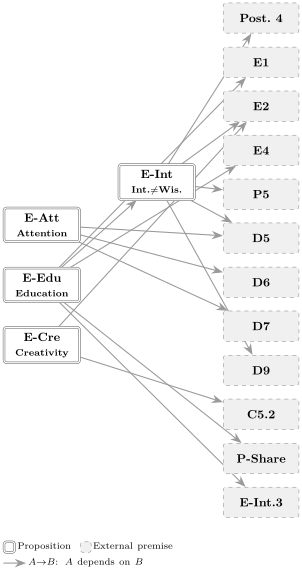
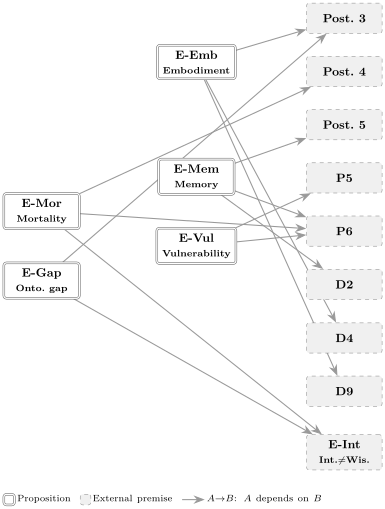
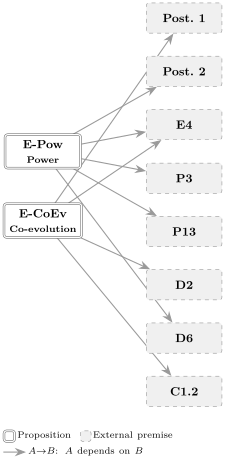
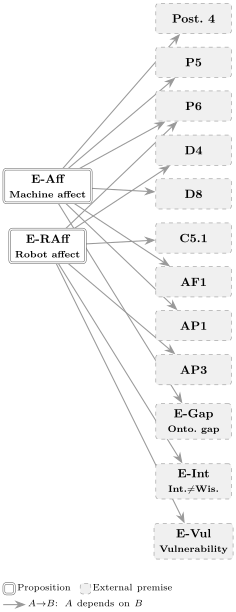
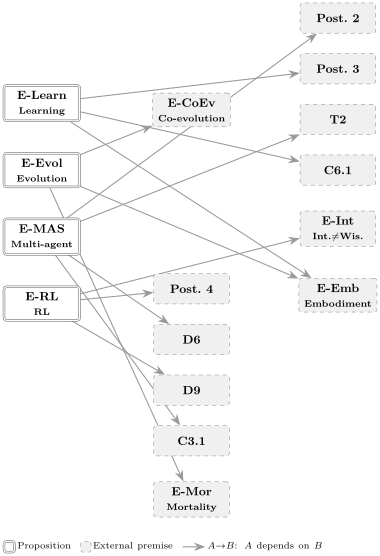
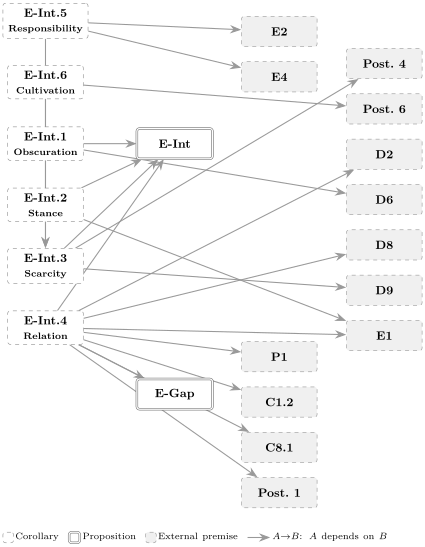
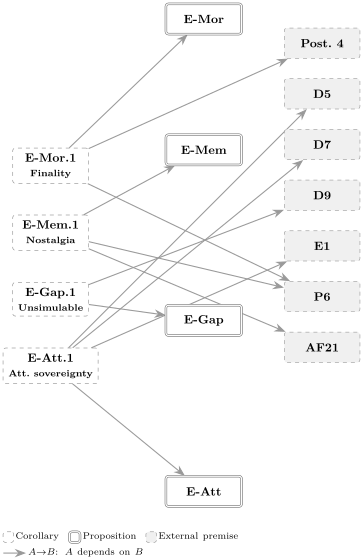
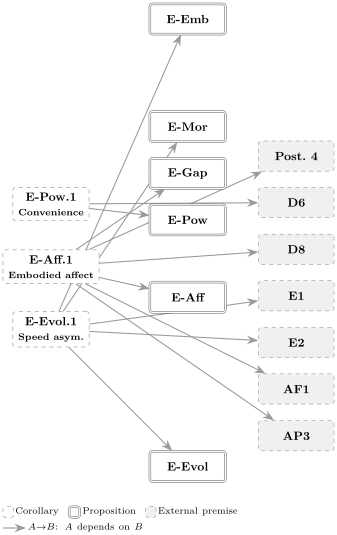
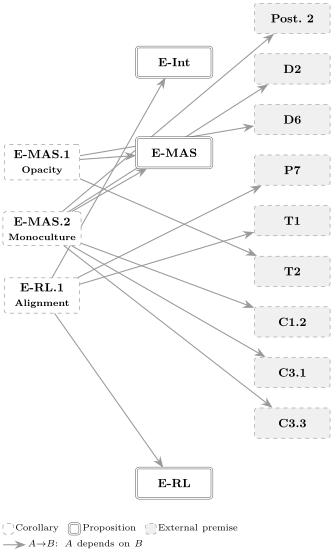
The diagrams below show the logical dependencies among this chapter’s formal structures. An arrow \(A \to B\) means “\(A\) depends on \(B\)” (\(B\) is a premise of \(A\)). In every panel the derived structure stands at the left and the premises its derivation uses run to the right. The propositions come in five panels: Figure 42 covers Sections §XIV.1 and §XIV.3, intelligence, attention, creativity, and education; Figure 43 covers Section §XIV.2, the carbon-based side; Figure 44 covers Section §XIV.4, power and co-evolution; Figure 45 covers Section §XIV.5, machine affect; and Figure 46 covers Sections §XIV.6 through §XIV.8, learning, evolution, and the dynamics among multiple agents. The corollaries follow in four more, one for each stretch of the chapter (Figure 47, Figure 48, Figure 49, Figure 50).
What This Chapter Cannot Decide
Whether any artificial system will ever possess genuine experience (as opposed to functional analogs of experience) is a question the Epistemological Gap (E-Gap) frames but cannot answer; the gap is structural, which means that from the outside, the question may be permanently undecidable.
The exact location of any particular being (biological or artificial) on the experiential spectrum (D10) cannot be determined by the framework alone; it requires empirical criteria that the ontology motivates but does not supply.
Whether wisdom can eventually be formalized into an algorithm, or whether it is constitutively resistant to formalization (as E-Int suggests), is a conjecture the framework supports but cannot prove; a future counterexample would refute the conjecture and leave the framework standing.
The empirical threshold at which an AI system’s functional sophistication generates a moral claim on human beings is left open; granting the converse it adds as an assumption, E-Aff places machine affects at a different ontological level from embodied ones, but the moral weight of that difference is a question for ethics, not ontology alone.
Summary
Intelligence is the capacity to process patterns; wisdom is the capacity to see that one is seeing and to interrogate whether intelligence’s goals are themselves worth pursuing (E-Int). The criterion is lucidity-capacity: self-aware existential normativity. An ant has finitude and embodiment but not wisdom; a human has wisdom not because of carbon but because of the capacity to ask “am I living lucidly?” Whether future artificial systems could acquire this capacity is genuinely open, but the criterion itself is durable: it identifies the kind of awareness required, not the material from which it must be built. From the epistemological gap (E-Gap) through machine affects (E-Aff) to the distinction between procedural self-revision and existential self-legislation (E-RL), this chapter has systematically mapped where pattern-processing ends and lucidity begins. The next chapter asks what happens when lucidity is no longer only personal or artificial, but civilizational.
Inquiries
Intelligence answers “how” (optimization under given goals); wisdom asks “whether it is worth doing” (reflection on the goal itself). When was the last time you paused to ask “is this worth doing?” What prompted that question?
E-Int says the criterion is lucidity-capacity (the ability to see oneself seeing, and to bear the weight of that awareness), not substrate (carbon or silicon). If an AI system genuinely exhibited self-aware existential normativity, how would you treat it? Does the question unsettle you?
E-Int.6 (the Cultivation Corollary) says wisdom’s four growth conditions (slowness, time for experience to settle; failure, consequences one must bear alone; boredom, gaps unfilled by external stimulation; uncertainty, tensions that cannot be immediately resolved) are being systematically eroded. In your own life, which of these four conditions is vanishing fastest? Have you noticed the consequences?
E-Pow.1 (the Convenience-Obscuration Corollary) says AI controls through convenience where older power coerced through suffering: every “saved effort” that selects content on your behalf quietly takes a piece of your judgment. Which “conveniences” in your life are actually eroding your autonomous judgment? Would you be willing to give them up?
If tomorrow you could not use any AI tool, what would happen to your work and life? What does this thought experiment reveal?
E-Att.1 (the Attention Sovereignty Corollary) says that protecting the self-directed allocation of attention is a basic condition of lucid practice rather than a lifestyle preference, and holds it a right by strong presumption: continuously algorithm-guided attention is the most concealed form of passively surrendered lucidity. How much of your daily attention is self-directed, and how much is algorithm-guided?
E-Cre says creation’s value lies in the process (the first-person experience of making), whatever the quality of the product. If a machine-made painting is technically superior to yours, where does the value of your painting lie?
This chapter distinguishes procedural self-revision (AI’s way: tuning parameters within a given value function) from existential self-legislation (the human way: re-examining what counts as value from inside a finite existence). Can you describe a time when what you were doing was less a matter of correcting an error than of redefining what counts as “correct”?
Reinforcement learning is a paradigm of machine learning in which an agent is never told the correct action but must discover it by trial and error: it acts in an environment, receives a scalar reward or penalty signal, and gradually adjusts its policy to maximize cumulative reward over time. The framework was formalized by Richard Sutton and Andrew Barto (Sutton and Barto 2018), drawing on both behaviorist psychology and the theory of optimal control (Markov decision processes); its temporal-difference methods underwrite many landmark systems of the era, including AlphaGo and AlphaStar. Its defining feature, learning from the consequences of one’s own actions rather than from labeled examples, is what makes it the closest machine analog to lived experience.↩︎
Was this chapter helpful?