Part V · The Meta Scale · What is this framework itself?
XIX · Methodological Integrity
~30 min left · 7,489 words
XIX · Methodological Integrity
XIX.1 · Design Decisions: Roads Not Taken
A framework is shaped by exclusions as much as by commitments. This section records several directions Lucidosophy considered and set aside: live possibilities, shelved for reasons of coherence, parsimony, and practical use1. A philosophy that lists only its convictions and hides its discards has stopped showing its work and started advertising.
The Six Postulates as a Minimal, Independent Set
Before the roads not taken, the road taken. The six postulates of §I are the framework’s central commitment, and beyond judging each postulate alone, a set of postulates must pass two tests as a whole. The first is independence: a postulate that could be derived as a theorem of the others is redundant. The second is minimality: a postulate that could be dropped without losing a result the framework needs is idle. On independence, this section claims no universal proof; the six were designed against that test, and what follows argues the pairings most open to challenge one by one, stating plainly the nature and the limits of the check. Saying this much is the cleanest answer to the natural suspicion that some of them, the two finitudes especially, simply repeat one another.
Independence is sharpest exactly where two postulates sound alike. Postulate 4 (Finitude) and Postulate 6 (Cognitive Finitude) both speak of a limit, yet they limit different things: Postulate 4 bounds being, since to exist as one particular mode is to forgo the others, while Postulate 6 bounds knowing, since a mode that is part of Reality cannot step outside Reality to grasp the whole. Neither entails the other. A finite being is not thereby barred from complete knowledge of some bounded domain, and a knower of merely partial reach need not be ontologically finite in the sense of Postulate 4. Likewise, Postulate 5 (Experience) does not follow from Postulate 4, since finitude alone does not supply first-person interiority, which is precisely the gap the hard problem of consciousness names; and Postulate 3 (Dual Aspect) does not follow from Postulate 2 (Unfolding), since a plurality of modes is one claim and the Pattern/Mystery duality within each mode is another.
Two further derivation paths deserve to be blocked one at a time. First: is Postulate 4 (Finitude) already hidden inside Postulate 2? Postulate 2 asserts that unfolding produces real, irreducible differences, and “being different” can sound as if it already means “being bounded.” But the two claims work at different levels. Postulate 2 delivers difference between modes: this mode is not that one. Postulate 4 delivers boundedness within a mode: to exist in one particular way is to forgo the others. Difference requires only distinguishability, not exclusion; two series, each infinite, can still differ from one another. The exclusionary trade-off that Postulate 4 introduces is the independent ground of the felt cost of choice, the irreversibility of time, and the account of mortality as enabling structure, and none of that follows from the plurality in Postulate 2. Second: could Postulate 6 (Cognitive Finitude) be derived automatically from Postulate 4 plus the infinite diversity of Reality (D1, Postulate 2)? The surface argument runs: a finite mode cannot contain an infinite Reality. But “cannot contain” does not go through on its own, because complete knowledge need not match its object in size: a finite set of axioms can characterize an infinite domain. To close the derivation one must add a further premise, that Reality cannot be compressed without remainder into any finite representation, and that premise is no weaker than Postulate 6 itself. Honesty is owed here: of the six, this pairing carries the heaviest design dependence. The framework keeps Postulate 6 as a postulate precisely to place that epistemic commitment in plain view rather than bury it inside a seemingly neutral derivation.
A third path is raised by the demonstration of P4: do Postulate 1 plus D2 already suffice to recover Postulate 4? That demonstration derives the finitude of modes from the premise that a mode distinct from Reality itself must exist in some determinate way, and it can look as if it bypasses Postulate 4. But the “unfolding in different modes” of D2 already presupposes, conceptually, that modes are mutually distinct and exclusive: to exist in one mode just is to not exist in the others. The demonstration therefore performs a conceptual unpacking, laying out the exclusivity already packed into the word “mode,” rather than an independent recovery of Postulate 4 from weaker premises. The work of Postulate 4 is to promote that exclusionary commitment into an explicit ontological postulate, which then carries the felt cost of choice, the irreversibility of time, and the results that follow; its status as a postulate is not made redundant by this path of conceptual unpacking.
Minimality is shown by deletion: remove any one and a named result falls. Without Postulate 1 (Reality) there is no unified ground for the definitions to range over. Without Postulate 2 the Emergence Theorem T2 loses its only premise, there are no plural modes to bear irreducible difference, and the social and relational structure of the later chapters loses its base. Without Postulate 3 the lucidity product D5 loses a factor and the Boundary Theorem T1 has nothing two-sided to bound. Without Postulate 4 the finitude-experience-irreversibility hub collapses, taking with it the irreversibility of time (P6) and the account of mortality as enabling structure. Without Postulate 5 the intrinsic value of experience, on which the ethical bridge axiom E2 stands, has no premise. Without Postulate 6 the upper bound of T1 disappears, and with it the framework’s built-in humility and the Self-Reference Theorem T3. No postulate is idle; each is load-bearing for something the framework cannot afford to lose.
Two honest qualifications complete the picture. First, this independence is argued, not formally proved: the six are philosophical postulates, not axioms inside a single calculus, so their mutual irreducibility rests on conceptual analysis rather than on a derivation within a formal system. Second, minimality is relative to the present theorem set. Should a future result show one postulate derivable from the others, the right response is to demote it to a theorem rather than defend its postulate status, exactly as the self-correction principle (EP6) requires. The claim is therefore modest and falsifiable in its own register: the six are the smallest set of commitments, each tested for independence, from which the results of §I presently follow, and the set stays open to revision on the same terms as everything else in this framework.
Chaos: A Third Ontological Category?
During the early design of Lucidosophy, I seriously considered a third fundamental concept alongside Pattern and Mystery: Chaos, or tun/hun2. Chaos would have named the turbulent interface where old order dissolves and new order has not yet formed: neither pure Pattern, since it resists full formalization, nor pure Mystery, since it still exhibits structure. Its intuitive sources are strong: deterministic chaos3, emergence (T2), Zhuangzi’s Hundun, and the lived experience of creativity all point toward such an in-between zone.
Lucidosophy sets Chaos aside all the same, and for three reasons. First, Ockham’s Razor4 earns its keep here. Pattern already names formalizable order, Mystery names depth past formalization, and Chaos can be understood as the seam between them rather than as a third kind of reality5. Second, the framework spends from a fixed complexity budget6, and promoting Chaos would cost dearly: a third awareness dimension, \(\mathcal{M} = \lambda \cdot \xi \cdot \chi\), a fresh definition of \(\chi\), and extensions of both D5 and T2. Third, whatever Chaos was good for has already been scattered usefully through the system: emergence (T2), the feedback dynamics of Appendix B.5, Pattern’s dissipation and selection, Mystery’s reverence, and Bewilderment (AF13). Two things need keeping apart here: mathematical, deterministic chaos, which Appendix B.5 places wholly inside Pattern as an epistemic limit of an agent’s accessible Pattern; and Chaos in experience, the crisis in which an old order has dissolved and a new one has not yet formed, which is the one read as an interface between Pattern and Mystery. Chaos was taken apart and absorbed, never simply waved off (Figure 63).
The cost is real. An independent Chaos category would give direct vocabulary to the practitioner in creative crisis, mid-dissolution, caught between two worlds. Lucidosophy accepts that cost for now: Bewilderment names the affective state, while Pattern and Mystery together carry the ontological work. If sustained practice later shows this absorption to be structurally insufficient, the decision can be reopened.
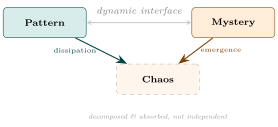
This decision is not permanent. Lucidosophy’s self-correction principle (EP6) would support reintroducing Chaos if future AI creativity revealed a stable third mode of cognition, if repeated practice exposed phenomena that fit neither Pattern nor Mystery nor their interface, or if deliberative practitioners converged on the judgment that Bewilderment (AF13) and the existing absorption language were structurally insufficient. The standard should be sustained cross-domain evidence, not isolated impressive outputs or local dissatisfaction. Until then, Chaos remains a “ghost concept”, seriously considered, respectfully shelved, and available for future recovery7.
A note on philosophical registers: This treatise employs two legitimate philosophical registers. The demonstrative register (Chapters §I–§VI, §VIII–§XVII) advances claims through definitions, postulates, theorems, propositions, and proofs. The contemplative register (Chapter §VII, Meditations on Being) translates those claims into lived-experience tests: it asks whether the framework survives contact with death, silence, uselessness, and the body. Both registers contribute to the philosophy, but differently: the demonstrative register builds the architecture; the contemplative register tests whether the architecture can be inhabited.
The Ontological and Epistemic Readings of Mystery
A second architectural fork was whether Mystery should be treated ontologically or only epistemically.
Lucidosophy posits that Mystery (D4) is an irreducible ontological aspect of reality (Postulate 3). But a serious reader may adopt the epistemic reading instead: Mystery as the name for what finite agents cannot yet formalize, not a second aspect of Reality. This section maps what holds and what weakens under each reading, so the reader can assess the stakes clearly.
Several elements hold under both readings: cognitive finitude (Postulate 6), since \(\mathcal{F}_a \subsetneq \mathcal{F}\) regardless of whether \(\mathcal{F} = \mathcal{P}(\Omega)\); the practical contrast between what you understand and what exceeds your understanding; the ethics (EP1–EP6), because these derive from Bridge Axioms rather than from the ontological status of Mystery; the political philosophy (PP1–PP5), because it derives from finitude, plurality, and interdependence; the practice system (§VIII), including morning calibration, the Lucidity Test, and the See-Judge-Act-Reflect cycle; and the warning against scientistic overconfidence, because even under the epistemic reading, confusing \(\mathcal{F}_a\) with \(\mathcal{F}\) is an error.
Other parts lose strength under the epistemic reading, and honesty asks that we say which. The strong AI boundary, “a system built from Pattern can simulate Mystery’s outputs but never instantiate Mystery’s depths” (§III.2), shrinks from an ontological necessity into a contingent empirical bet. The \(\mathcal{M} = \lambda \cdot \xi\) rationale shifts as well: if \(\xi\) measures openness to the not-yet-understood rather than contact with an irreducible ontological face, then the annihilation property (zero Mystery-awareness \(\Rightarrow\) zero lucidity) rests on normative motivation rather than ontological force. Awe (§III.2, fourth depth) changes footing too: read ontologically, awe tracks something real out there; read epistemically, awe stays psychologically precious yet proves nothing about a second face of reality. And the Silence Theorem (T4) narrows to match: on the epistemic reading, silence marks where today’s knowledge stops, not where the knowable itself does.
Lucidosophy’s position runs as follows. The ontological reading is taken up as a philosophical commitment (Postulate 3), never offered as a proven thesis. The grounds for that commitment sit in §III.1–§III.2: the explanatory gap that refuses to close no matter which reductive strategy is thrown at it, the phenomenological weight of qualia, thisness, resonance, and awe, and the structural rhyme with Gödel’s incompleteness, where Pattern turns out incomplete even about itself. Readers who prefer the epistemic reading are invited to use the mapping above and assess whether the weaker versions of the affected claims still serve their philosophical needs. The epistemic reading remains a live interpretive option.
The Limits and Internal Tensions of the Framework
A framework that claims to explain everything violates the Self-Reference Theorem (T3). Honestly marking Lucidosophy’s limits is therefore precisely a requirement of its own self-consistency.
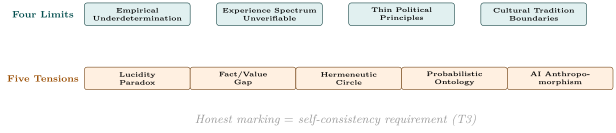
The framework has four limits. First, its postulates are philosophical postulates rather than scientific hypotheses, so they cannot be empirically falsified in Popper’s sense8. Its validity rests on coherence, explanatory power, and practical value, which means a materialist and a Lucidosophy practitioner may read the same evidence differently. Second, the experience spectrum remains unverifiable at its lower bound: Postulate 5 preserves ethical openness, but it cannot tell us whether stones, thermostats, or bacteria have experience. Third, the political principles in §X guide judgment rather than policy design. Fourth, the framework is abstractly open across cultures, yet its actual sources still come mainly from European, Chinese, and Buddhist lineages; Ubuntu, Vedanta, and Indigenous relational ontologies remain future work.
It also carries five internal tensions. The lucidity paradox voids any claim to complete lucidity, which protects the framework from spiritual triumphalism but leaves its highest value asymptotic. The fact/value gap means all four bridge axioms (E1–E4) remain existential commitments. The hermeneutic circle means lucidity helps disclose Reality while Reality partly defines lucidity. Probabilistic ontology may need to retreat if future physics supports deep determinism. The AI anthropomorphism trap remains because Postulate 5 and D8 do not yet supply an operational test for distinguishing analogical experience from sophisticated simulation. These are local tensions, and what they call for is revision. Framework-level defeat would require something stronger: showing that cognitive finitude is illusory, that Pattern and Mystery reduce to one category without residue, or that self-referential humility is logically incoherent. Figure 64 gathers the four limits and five tensions in one view.
To live with a framework that prints its own unresolved tensions is to give up the comfort of a finished answer. What you receive in trade is a harder freedom: a guide you are allowed, and expected, to keep correcting.
What Would Falsify This Framework
Lucidosophy is not a scientific theory and does not claim Popperian falsifiability (see Limit One above). Still, intellectual honesty requires naming the conditions that would force the framework to be rebuilt. Four would matter most. First: a purely Pattern-domain entity demonstrating genuine wisdom under irreversible stakes and genuine cognitive finitude, which would refute the claim that wisdom requires nonzero Mystery-awareness. Second: sustained operational work showing that \(\mathcal{M} = \lambda \cdot \xi\) is not an appropriate aggregation structure for lucidity, which would shake the annihilation and gradient properties. Third: a civilization maintaining maximal lucidity across generations without regression, oscillation, or hidden obscuration, which would refute the oscillatory structure supported by T1 and D6. Fourth: the Pattern/Mystery distinction dissolving without remainder, so that qualia, the explanatory gap, and first-person texture are fully captured by Pattern-domain description. The last is the most fundamental: if there is no irreducible Mystery, there is no Lucidosophy.
One further condition concerns not the framework itself but what may be built upon it. A framework of this kind invites extension into particular domains, and the history of system-building records what happens when the extensions and the core are welded together: a discredited application drags the metaphysics down with it, and a celebrated one is mistaken for proof of the metaphysics. This framework declares the joint and declares it in both directions. An application of this framework to a particular domain is a separate object with premises of its own; should it fail, what fails is the application, and the four conditions above remain the only route to the core. The declaration costs what it ought to cost, because it runs the other way with equal force: no successful application confirms the core either. A domain result can show the framework fruitful, never that it is true, and §XIX.4 has already refused the framework any jurisdiction it has not earned in the particular case.
Naming the one claim whose failure would end the whole framework is precisely what makes the rest worth your trust. A system that buried its single fatal condition would be angling for your faith, when what it owes you is room for your judgment.
XIX.2 · Steelmanned Objections
A framework unwilling to face its strongest objections violates its own principle of cognitive humility (P7). This section reconstructs eight critiques with maximum charity, then gives honest, not necessarily triumphant, responses.
The first two objections ask whether Lucidosophy’s postulates can be tested at all, and whether its passage from ontology to ethics has sufficient ground.
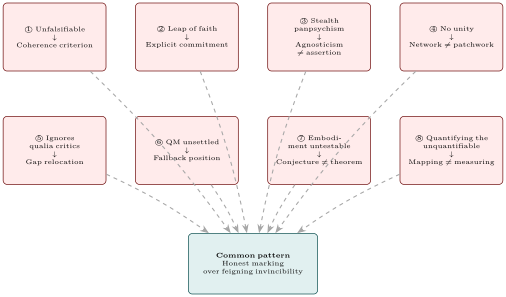
I. Unfalsifiability. The objection is that Lucidosophy’s postulates (Postulate 1–Postulate 3) cannot be refuted by experience. If no observation can count against the framework, then perhaps no observation counts for it either. The response is to locate the proper standard. Falsificationism is itself an epistemological commitment, not a self-proving rule. Quine’s web of belief9 and Lakatos’s10 research programmes both show that even scientific inquiry evaluates core commitments through networks of consequences. Lucidosophy should therefore be judged by coherence, explanatory power, practical value, and honesty about its limits. Critics may reject that standard, but they should not pretend their own standard is neutral.
A sharper form of the same objection sets the bar higher still. On the verification criterion of the logical positivists, a sentence with no conditions of verification states no falsehood because it states nothing at all, and D4 would then be empty rather than wrong. What became of that criterion is the place to begin: it could not be verified by the procedure it demanded of every other sentence, and it was abandoned for that reason rather than refuted from outside. The lesson is not that criteria are idle. The lesson is that a criterion must be asked what it does when turned upon itself, and the question is owed here as much as there. Turned upon this framework’s standard it yields no contradiction, for a reason worth stating exactly: the verification criterion claimed jurisdiction over every meaningful sentence, so its own failure to qualify was fatal, whereas coherence, explanatory power, practical value, and honesty about limits are offered as the terms on which this framework asks to be judged and legislate for no other inquiry. A universal criterion that cannot meet itself is refuted; a local criterion that meets itself is merely reflexive, and EP6 keeps the reflexivity operational by obliging the framework to revise whenever its own standard convicts it. As for emptiness, T4 has already declined to describe Mystery and marks instead the place where description stops. Marking a boundary is an act performed within Pattern and it carries content: it says that description ends here, and it is defeated the moment description turns out not to end, which is the fourth condition named in “What Would Falsify This Framework” above.
II. The Ethical Leap of Faith. The objection is that all four bridge axioms (E1–E4) admit that the transition from ontology to ethics is an existential decision, so the ethical system rests on an arbitrary choice. The response is that every ethics requires at least one non-derivable normative commitment. Kant presupposes universalizability; utilitarianism presupposes aggregate welfare. Lucidosophy’s difference is that it puts the commitment in the open. Critics may reject any of them one by one; the rejection analysis in §VI already shows, axiom by axiom, what survives and what is lost.
The next three objections challenge the metaphysical architecture: experience spectrum, systemic unity, and qualia.
III. Stealth Panpsychism. The objection is that Postulate 5 quietly smuggles in panpsychism by saying all beings may possess experience. The response is that agnosticism is not assertion. Panpsychism says experience extends to all things; eliminativism says only certain neural systems have it. Lucidosophy says neither. It says only that experience may be distributed across a spectrum whose lower bound stays unclear, and keeping that bound open is honesty about the limits of finite cognition.
IV. Systemic Unity. The objection is that five irreducible pillars (§XVII.1.9) make Lucidosophy a patchwork rather than a system. The response is that unity need not mean derivability from one master principle. A body is unified through functional coupling among organs. Likewise, Lucidosophy’s pillars constrain one another: monism requires process, process requires the unsayable, practical reason requires daily practice, and daily practice needs ontological grounding. Critics may prefer a tighter unity, but that tighter unity would erase dimensions the framework deliberately refuses to reduce.
The unity objection also has a form that runs the other way, and it is the older and harder of the two. Classical objections to monism ask whether the unity is coherent at all, and the strongest of them turns on relations: a monism appears to require that every relation be internal, fixed by the natures of the things related, whereas the relations that mathematics and physics actually use are external, holding between terms whose natures leave them free. Pressed against this framework, the objection asks whether the Pattern/Mystery distinction is itself a relation. An internal one would give Reality an inner articulation and cost Postulate 1 its unity; an external one would place something outside Reality and cost Postulate 1 its scope. The response denies the shared assumption. Postulate 3 calls Pattern and Mystery aspects, and an aspect is not a part: one thing presented under two conditions of access remains one thing, and no relation has been asserted because no second term has been introduced. The same postulate says as much again in its closing clause, that Reality exceeds the sum of Pattern and Mystery, a sentence that would be false if the two were parts standing in a relation and that is exactly right if they are faces of a single unfolding. The dilemma needs relata to bite, and here it finds one thing described twice. A critic who judges that “aspect” merely renames the difficulty is making a substantive charge, and it is worth pressing, since the monism of Postulate 1 does rest on the distinction between an aspect and a part carrying genuine weight rather than serving as a convenient word.
Would you trade the texture of your own lived experience for the elegance of a single master principle? The framework refuses that trade on your behalf, and pays for it in untidiness.
V. Qualia Irreducibility. The objection is that Lucidosophy claims qualia are irreducible while Dennett’s11 and Frankish’s12 illusionist arguments treat phenomenal consciousness as a cognitive illusion. Lucidosophy seems to ignore the strongest countercase.
Here is the honest reply. Dennett is right that naive introspection cannot be trusted, and Frankish is right to push the illusionist alternative hard. Yet illusionism moves the explanatory gap; it does not close it. Call phenomenal consciousness an illusion, and you still owe an account of why there is a state that so persuasively seems conscious. Lucidosophy never claims that every introspective report is reliable. Its claim is narrower and tougher: wherever you shove the explanatory gap, it shows up again on the far side.
The next two objections concern empirical science: quantum interpretation and embodiment.
VI. Quantum Interpretation Dependence. The objection is that Lucidosophy’s probabilistic ontology, formalized in Appendix B, leans toward reading probability as an ontological fact while quantum interpretation remains unsettled. The critique is accurate, and §XIX.1 already names the fragility. The fallback is that most of Lucidosophy needs only epistemologically ineliminable uncertainty: finite knowers cannot access complete conditions even in a deterministic universe. If physics ultimately favors determinism, the stronger probabilistic-ontology reading should retreat, but cognitive humility (P7), the ceiling on lucidity (Law 1), and the need for practical wisdom survive.
VII. The Embodiment Assumption. The objection is that Lucidosophy rigs its definition of wisdom so that embodied agents pass and disembodied AI fails, then dresses the rigged result up as a discovery. The challenge lands. The milder claim, that embodiment deeply shapes wisdom, draws real backing from embodied cognition research13. The bolder claim, that there can be no wisdom at all without a body, stays a conjecture. Let a disembodied AI show genuine wisdom under irreversible stakes and cognitive finitude, and Lucidosophy should revise on the spot.
The final objection asks whether formalization clarifies or merely decorates.
VIII. Quantifying the Unquantifiable. The objection is that Lucidosophy quantifies what it admits cannot be operationally measured: mystery-awareness, civilizational lucidity, and cosmic cognition. The response is to distinguish measurement from structural mapping. Lucidosophy does not yet provide a measurement procedure; §XIX.5 names this as an open problem. But formal structure can still reveal relations narrative tends to hide: the product model yields annihilation and gradient properties, and those properties matter philosophically. The question is whether the structure reveals real relations, not whether every symbol can currently be measured. The eight objections and their responses are mapped in Figure 65.
The last of the objections just answered aims at the mathematical notation in Appendix B: sigma-algebras, gradients, operator-identification proofs. The worries are real, and the replies above gave ground wherever ground was owed. Before going on, though, one distinction has to be drawn cleanly, since blurring two quite separate things would leave the defence that follows unreadable.
Appendix B is optional mathematical notation: a second language that says the philosophy over again in formal symbols. The postulates, definitions, theorems, bridge axioms, and propositions of the main text (Chapters §I–§XI) are the load-bearing axiomatic architecture: they are the philosophy. Skip Appendix B from cover to cover and you lose some precision of expression, but not one rung of the argument. Every philosophical claim in Lucidosophy can be traced, contested, and thrown out using only the numbered structures in the main text. Strip the equations away and the framework stands; what follows defends the one element that could not be stripped away without real philosophical loss.
XIX.3 · Methodological Defence: Why Axiomatization?
Philosophy can be written as prose (Heidegger), dialogue (Plato), aphorism (Nietzsche), or the geometric order of axiom and proposition (Spinoza). Lucidosophy chose the last, the form that hides its weaknesses least.
Axiomatization gives two practical benefits. It makes assumptions visible, so readers can decide which definitions, postulates, theorems, and bridge axioms they accept or reject. It also makes errors easier to find. An early prose draft claimed that greater intelligence leads to deeper wisdom; in prose it read almost cleanly, yet once formalized it broke at once, exposed as a category error: intelligence is a Pattern-domain capacity, while wisdom requires integration across Pattern and Mystery (E-Int).
The method has precedent in Euclid, Spinoza, and Whitehead and Russell, but Lucidosophy does not claim mathematical certainty. Its axioms are philosophical commitments, not proved conclusions; its bridge axioms (E1–E4) are marked as existential decisions precisely so they are not mistaken for mathematical truths. Axiomatization organizes thought; it does not justify the starting points.
Recent versions push this error-finding discipline from human review into machine proof. A growing share of the framework’s purely mathematical statements, gathered in Appendix B, has been formalized and checked in Lean 4 with the Mathlib library (the LucidoMath project14), among them the boundary bound \(0 < \mathcal{M} < 1\), the collapse law under which lucidity vanishes the moment either Pattern-awareness or Mystery-awareness reaches zero, and the ceiling showing that balance maximizes the lucidity product when total awareness \(\lambda+\xi\) is held fixed (Appendix B, Corollary B.12.11); the appendix marks which results carry a machine-checked proof. A proof that passes Lean’s kernel can hide no step, because the machine accepts nothing it has not been shown. The discipline has already proved its worth: when the same tools were turned on the framework’s wider mathematical formalization, Lean produced counterexamples that overturned arguments prose review had accepted, among them the reading of the trust threshold of T8 as a necessary condition, and each offending statement was corrected to the weaker condition the result actually requires. As with the early claim that greater intelligence yields deeper wisdom, the flaw had survived ordinary reading and surfaced only once a machine refused it.
What this establishes, and what it does not, is worth stating plainly, because the temptation to overstate it is real. Lean verifies properties of the mathematical models, never the philosophy those models serve. The boundary result is machine-checked; the postulates beneath it (Postulate 4, Postulate 6) are not, and could not be, for they are philosophical commitments rather than formal consequences. No bridge axiom (E1–E4), no claim about Mystery, no ethical proposition is certified, or could ever be certified, by a proof assistant. Lucidosophy as a whole is therefore not “verified by Lean”; the phrase would be a category mistake. The accurate and more modest claim is the one worth making: where the framework states a mathematical proposition, that proposition is now held to mathematical standards, and the line between what a machine can check and what only a person can decide is drawn in the open rather than left blurred.
This is why system-building remains defensible even in an anti-system age. Academic philosophy often rewards specialization over cross-domain coherence. Lucidosophy wagers that some insights emerge only at the systemic level. That wager may fail, but a framework built around cognitive humility (P7) should state the wager plainly and let time judge it.
XIX.4 · Declared Non-Scope
A framework’s strength lies not only in what it says but in what it explicitly does not say. Declaring non-scope is a practical requirement of T3 (the Self-Reference Theorem): a framework that claims to explain everything thereby cannot explain itself.
Lucidosophy uses science but does not settle technical philosophy-of-science disputes such as realism versus anti-realism, Bayesianism versus frequentism, or Kuhn versus Lakatos. Its political principles guide judgment but do not answer specific policy questions about AI regulation, democratic design, or economic distribution. It acknowledges suffering and obscuration but does not offer a theodicy. It uses probability, information, and optimization in Appendix B but does not enter the foundations of mathematics. It is compatible with many religious traditions without adjudicating their truth claims. It takes a philosophical position on qualia but does not evaluate the empirical neuroscience of consciousness, including IIT15, Global Workspace Theory16, or higher-order theories.
These boundaries belong to the current version; future versions may expand in some of these directions. Until then, honestly marking them is more consistent with Lucidosophy’s own principles than pretending to be all-encompassing.
XIX.5 · Open Problems
An honest framework marks not only what it chooses not to address (§XIX.4), but also what it wants to but cannot yet answer. The following are the hardest open problems Lucidosophy faces, questions to which the author genuinely does not know the answer.
Seven questions stay open, and the author will not pretend to have closed them. Where does the floor of the experience spectrum (Postulate 5) actually lie? Can E4 be loosened and still carry the ethical derivations? Can sources beyond the now-dominant European, Chinese, and Buddhist lineages be drawn in for real rather than in name? Can \(\mathcal{M}(a,t)\) and its product structure ever be pinned to something measurable? Might an AI with analogical experience (D8, D10) grow an analogical wisdom of its own? How would the five political principles (PP1–PP5) ever harden into real institutions or working lucidity-audit mechanisms? And one more comes from the later Wittgenstein: if a limit of language cannot be surveyed from inside language, does Postulate 3 state something about Reality or only record a habit of our language (§XVII.1.7)?
Listing these problems is T1 (Boundary Theorem) in practice. A lucidity framework that claims to have answered all questions has, in that very moment, ceased to be lucid.
XIX.6 · Practitioner Self-Deceptions
Any spiritual framework faces an ironic risk: the more it emphasizes lucidity, the more subtly its followers can deceive themselves. The following five patterns are what Lucidosophy practitioners most need to guard against, precisely because they look like lucidity.
I. Spiritual Bypassing: using the framework to explain pain, so as to avoid truly facing it. II. Intellectual Superiority: mistaking understanding of lucidity for being more lucid than others, which is itself a form of obscuration. III. Framework Idolatry: treating Lucidosophy as Reality, forgetting that P7 has already called it a finite map. IV. Analysis Paralysis: using reflection in place of action. V. False Equanimity: mistaking numbness for the real thing (AF16); the truly settled can still be moved by the world, while the falsely calm have simply stopped being able to.
If you recognized yourself in the descriptions above, that recognition is itself lucidity. The last kind of follower Lucidosophy needs is someone who believes they have transcended all the traps.
XIX.7 · Ledger of Concessions
§XIX.2 met objections raised from outside. §XIX.4 declared what the book does not address. §XIX.5 listed what it wants to answer and cannot. This section does a fourth thing: it tallies the concessions made inside the derivations, the places where something was granted so that the argument could proceed. Each of these is already disclosed where it occurs. Scattered honesty is easy to overlook; gathered honesty can be audited.
The ledger uses the book’s three grades of derivation, explained in §A.15: Proof (\(\blacksquare\)) for formal derivation, Demonstration (\(\square\)) for reasoning valid under stated assumptions, Argument (\(\diamond\)) for reasons offered without a claim of formal necessity.
| What was granted | Disclosed at | Price of refusing it |
|---|---|---|
| The step from is to ought is declared, not derived (E1–E4). | §VI.1; §XIX.2 objection II; §X.1 | EP1–EP6, PP1–PP5, and the whole normative layer of §XI fall. The metaphysics and Appendix B stand entire. |
A real-valued ethical weight \(W\) is defined over all beings, then barred from carrying an ordering. |
Appendix B.7 | The bar is what keeps the formalism consistent with E2. Lift it and interpersonal comparison and aggregation follow at once, turning the framework into the welfare calculus E2 was written to refuse. |
The product form of Lucidity rests on linear reciprocity, a selected modeling condition. |
Appendix B.1.4, B.13 | \(\mathcal{M} = \lambda\xi\) becomes one member of an admissible family. The qualitative results survive (either axis at zero annihilates Lucidity; the boundary theorem holds); the exact numbers do not. |
Lucidity has two ceilings, and either one quoted alone misstates the bound. |
Appendix B, Corollaries B.12.9 and B.12.11 | Nothing falls, but any single-ceiling citation is an error the reader should catch. |
The empty region above \(\mathcal{M} = 0.25\) in the thinker scatter is forced by the normalization convention. |
Appendix B.12 | It is no independent confirmation of T1, and was corrected once it had been read as one. |
The twenty-five thinkers’ coordinates are the author’s interpretive assignments, never measurements. |
Appendix B.12, figure legend and table caption | They illustrate the product structure and carry no inferential weight. Reading them as a ranking is a misuse. |
The “sufficiently rich” condition in T3 is slack: the proof never uses it. |
§I.2 scholium | Deleting it costs no result; it costs only the alignment with Gödel-style statements, which is why it is kept. |
CV-Sur is a conditional civilizational-model proposition. |
§XV | The historical cases in that chapter instantiate the model instead of confirming it. |
| §X.1 | The five-fold cut is one defensible articulation; equivalent constraints may be named and divided otherwise. | |
E-Int.5 rests on a scholium rather than a derivation object, which makes PP5 the thinnest-supported principle. |
§X.1, Table 1 | This is the weakest joint in the political half of the framework, and the first place a critic should press. |
Dual-face optimality is a theorem about the model, not a proof that Reality must have exactly two faces. |
Appendix B.13 | It gives Postulate 3 structural support in place of demonstration. |
Every line in this ledger costs the framework something. That is what makes it worth printing: a list of concessions with no prices attached would be a rhetorical gesture, and the prices here are stated so that a reader can decide, item by item, whether the purchase was worth making. Readers who conclude it was not have all they need to say so precisely.
A standing invitation. The ledger is the author’s own audit, and an author’s audit of his own work reaches only as far as his blind spots allow. T1 says as much: no finite agent achieves complete lucidity, and that includes the finite agent who wrote this. So the invitation is open, and it is specific about what would count. From analytic philosophy: show that the bridge axioms smuggle in more than they declare, or that the derivations in §VI and §XI carry a normative premise nowhere on the table. From physics: show that the ontological commitments of §I conflict with something better established than they are, in the concrete rather than by gesture. From machine learning: show that the intelligence-wisdom distinction of §XIV draws a line that working systems already cross, or that E-Int.5 states a limitation of present architectures dressed as a limitation in principle. From comparative religion: show that the treatment of traditions in §XVII flattens the differences that matter, and that the flattening does load-bearing work rather than decorative work. In each case what is wanted is the strongest available version of the objection. Corrections that survive scrutiny will be recorded in the version archive under the name of whoever supplied them, and the concession will be added to this ledger.
Summary
The Meta-Statement spans two chapters. Chapter §XVII looked outward toward lineage, dualisms, science, religion, and world traditions. This chapter turned inward: it recorded roads not taken, named limits and tensions, faced objections, defended axiomatization, declared non-scope, listed open problems, and warned against self-deception. The book ends where it must: any map of reality is not reality itself (P7), and admitting this is Lucidosophy’s deepest form of lucidity.
Inquiries
The framework lists its own falsification conditions (e.g., if Postulate 6 cognitive finitude were shown to be illusory, if Postulate 3 Pattern–Mystery inseparability could be fully dissolved, if T1 the Boundary Theorem were refuted by counterexample). Which condition do you think is most likely to be met? Why?
The eight dualisms (reason/sensibility, mind/matter, subject/object, fact/value, certainty/uncertainty, individual/collective, freedom/determinism, human/AI) are described as structures of obscuration: they slice a continuous spectrum into two halves. Do you still rely on any of these dualisms in your daily thinking? What is its convenience, and what is its cost?
The Design Decisions chapter discloses abandoned paths (such as making Chaos a third ontological category before it was absorbed into Pattern and Mystery together, or adopting the epistemic rather than the ontological reading of Mystery). How does this transparency affect your assessment of the framework? Which is more trustworthy: a system that shows what it cut, or one that presents only the final product?
“Any map of reality is not reality itself (P7).” If you accept this, how do you continue using the map without mistaking it for the territory?
Of the five practitioner pitfalls (spiritual bypassing: using the framework to avoid real pain; intellectual superiority: mistaking understanding of the framework for being more lucid than others; framework idolatry: treating Lucidosophy itself as Reality; analysis paralysis: using reflection to replace action; false equanimity: hiding numbness behind the appearance of equanimity), which are you most susceptible to? How do you recognize when you are falling in?
This chapter lists domains the framework does not address (theodicy: why evil exists; adjudicating the neuroscience of consciousness: IIT, Global Workspace, and higher-order theories; technical philosophy-of-science disputes; concrete policy design). Do you consider these exclusions wise self-limitation, or avoidance of the hardest questions?
If you had to explain Lucidosophy in one sentence to someone who has never encountered philosophy, what would you say? What does this exercise itself reveal?
This practice of recording “roads not taken” is known in scientific writing as reporting “negative results.” The physicist Richard Feynman devoted much of his Nobel lecture to describing methods he tried that failed, because “knowing what doesn’t work is as important as knowing what does.” Lucidosophy extends this scientific spirit to philosophical construction.↩︎
“Tun” derives from “hundun,” primordial chaos, a concept with ancient roots in Chinese philosophy. In the Zhuangzi, the famous parable “The Death of Hundun” tells of the Central Emperor Hundun, who died when his well-meaning neighbors carved seven openings (sense organs) into his featureless face, implying that forcibly rationalizing an originally undifferentiated state is an act of violence. Tao Te Ching (Laozi c. 4th c. BCE) Chapter 25: “There was something formless yet complete, that existed before heaven and earth”, the Tao existed in a chaotic, undifferentiated manner before heaven and earth.↩︎
Edward Lorenz discovered deterministic chaos in 1963: infinitesimal initial differences in a weather model lead to entirely different long-term trajectories. This is the mathematical foundation of the “butterfly effect.” Chaos is structural unpredictability within deterministic systems, not randomness.↩︎
Ockham’s Razor is a methodological principle attributed to the medieval logician William of Ockham (c. 1287–1347): “Entities should not be multiplied beyond necessity” (Entia non sunt multiplicanda praeter necessitatem). In philosophy and science, this means: among competing theories of equal explanatory power, choose the one with the fewest assumptions.↩︎
This decision also has an aesthetic dimension. The classical dualities of Chinese philosophy (yin/yang, being/non-being, motion/rest) are often binary. Introducing a third element would break the symmetry of this cultural intuition. Aesthetics is, of course, no valid philosophical argument, yet between two choices of equal argumentative strength it can serve as a reasonable tiebreaker.↩︎
“Complexity budget” is a concept from software engineering: every system has an upper bound on cognitive complexity, beyond which the system becomes incomprehensible, unmaintainable, and incommunicable. Philosophical frameworks are subject to the same constraint, if a framework requires too many core concepts before one can even begin, it will lose the vast majority of potential practitioners.↩︎
Physics has similar “ghost concepts.” The aether, as the medium for light propagation, was seriously discussed for over a century in the nineteenth century, ultimately rendered unnecessary by Einstein’s special relativity (1905). But the aether’s intuition, “space is not empty”, returned in a different form in quantum field theory: the vacuum state is not “empty” but filled with quantum fluctuations. A good concept, even when shelved, often sees its intuition resurrected in a new form.↩︎
Popper’s (Karl Popper, 1902–1994) “falsifiability” criterion holds that the hallmark of a scientific theory is that it can in principle be refuted by experience. Lucidosophy is a metaphysical framework, not a scientific theory, and so falsifiability is not the correct standard of evaluation. But this also means you cannot use experiment to “prove” Lucidosophy correct. Its standard of validity is “useful/useless” and “coherent/incoherent,” not “true/false.”↩︎
W.V.O. Quine (1908–2000), American analytic philosopher. His “web of belief” theory holds that no proposition is verified or falsified in isolation from the entire network of beliefs, even logic and mathematics are part of the web and in principle revisable.↩︎
Imre Lakatos (1922–1974), Hungarian-British philosopher of science. His “scientific research programmes” theory distinguishes between the “hard core” (core assumptions not directly falsifiable) and the “protective belt” (modifiable auxiliary hypotheses), arguing that the criterion of evaluation is the progressiveness of the whole programme, not the falsifiability of any single hypothesis.↩︎
Dates and the source of “Quining Qualia” are given in §III.2.↩︎
Dates and the source of his illusionism are given in §III.2.↩︎
Representative works include: Lakoff and Johnson’s Philosophy in the Flesh (1999), and Varela, Thompson, and Rosch’s The Embodied Mind (1991). These studies demonstrate that human conceptual systems, reasoning patterns, and value judgments are deeply rooted in the structures of bodily experience.↩︎
LucidoMath is an open formal-verification library built in Lean 4 with the Mathlib library, developed alongside Lucidosophy to machine-check the framework’s genuinely-mathematical results. A Lean-verified result carries a proof that passed Lean’s kernel using standard axioms only; LucidoMath checks properties of the mathematical models, never the philosophy.↩︎
Integrated Information Theory (IIT), proposed by Giulio Tononi, attempts to quantify consciousness using mathematical tools (the \(\Phi\) value).↩︎
Global Workspace Theory (GWT), proposed by Bernard Baars and later developed by Stanislas Dehaene, holds that consciousness results from information being broadcast to a global workspace.↩︎
Was this chapter helpful?