Part IV · The Civilizational Scale · How should civilizations evolve?
XVI · The Dark Universe and Dual Silence
~40 min left · 9,906 words
XVI · The Dark Universe and Dual Silence
Chapter §XV extended the lucidity framework from the social scale to the civilizational scale. This chapter turns in the opposite direction, inward: when we push the framework to the limits of physics and the cosmos, what does it reveal about itself? An honest framework must know not only what it can explain, but where it breaks down.
Look up again at that silent sky. You think you are seeing the universe, but you are seeing far less than one part in twenty of it. Beyond every star and every smear of galaxy your eye can catch lies a far larger universe that no telescope will ever photograph: it has weight, it bends the paths of light, it drives the whole cosmos apart, and it never shines. One of modern cosmology’s firmest conclusions is that some ninety-five percent of the universe is invisible, operative yet unseeable. The cosmos is mostly dark, and the dark is doing most of the work.
This book has argued, for fifteen chapters, that reality wears two faces: a Pattern we can grasp and a Mystery we never exhaust. Tonight the universe hands that idea its largest illustration. This chapter walks the framework out to that edge, the hard boundary of physics and the cosmos, to see what it can illuminate there and, just as important, where it too goes dark.
XVI.1 · Testing the Framework’s Limits
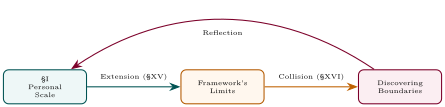
Chapter §XV performed an extension: pushing the framework outward to the civilizational scale, asking how civilizations as wholes move from obscuration toward lucidity. This chapter performs a return: what does the framework discover when it meets the hard boundaries of physical reality? The structural move is depicted in Figure 56.
This framework deliberately omits quantum gravity, the spacetime curvature of general relativity, and Noether-theorem derivations of conservation laws1. The constraint that pattern-awareness, mystery-awareness, and unawareness sum to one is a normalization condition, not a physical conservation law. The framework borrows the mathematical language of physics (differential equations, phase transitions, network theory) but endows these tools with new ontological meaning. Just as music borrows from acoustics without being exhausted by acoustics, Lucidosophy borrows from physics without claiming to be physics. Its equations describe how beings awaken; how matter moves is left to physics.
This framework is philosophical mathematics (formal reasoning about existence), not physical mathematics (predictive models of nature). Its equations are structural analogies, not empirical laws. They make no predictions about particle behavior and are not tested by accelerator experiments. Per P7: “Any theory is a finite map, not a complete expression.”
Acknowledging boundaries is not weakness. Quite the opposite: It is the refusal to acknowledge boundaries that betrays weakness. A framework that claims to explain everything explains nothing, just as a map that claims to cover every terrain, if it goes on to claim that it is the territory itself, is both useless and impossible. Lucidosophy’s relationship to physics is one of resonance, not derivation. The physics audit of Appendix B lists the physical disciplines the framework absorbs, those it deliberately sets aside, and two genuine points of tension.
XVI.2 · The Dark Universe: Mystery at Cosmic Scale
What if the universe itself gives Lucidosophy one of its clearest illustrations?
One of contemporary cosmology’s best-supported observational conclusions2 tells us: the observable universe’s energy–matter composition is approximately 68% dark energy, 27% dark matter, and 5% ordinary matter. The universe, in the most literal physical sense, is 95% “invisible”: operative yet unseeable, influential yet never directly seen.
Dark matter as “structural Mystery.” Dark matter shapes the structure of galaxies: its gravitational effects are clearly measurable (a Pattern-domain effect: observable structure), yet dark matter itself is completely invisible to electromagnetic observation (a Mystery-domain quality: it cannot be directly manifested). It acts through gravity but remains hidden from light. This structurally echoes D4’s definition of Mystery: “the ineffable aspect of Reality: the dimension beyond all concepts and language.” Dark matter’s gravitational effect is measurable while the stuff itself never shows up in the electromagnetic band. The two share one shape: acting without appearing. One of the universe’s most powerful structural sculptors is also among its most silent presences.
Dark energy as “dynamic Mystery.” Dark energy dominates the dynamics of the universe’s current accelerated expansion, yet it remains one of the least understood cosmic components. One of the terms shaping the largest-scale behavior of the cosmos is also one of the least knowable. This inverts a common intuition: understanding \(\neq\) power. Many deep forces shape the world before they are fully understood.
The combined dark-matter-plus-dark-energy fraction of the universe is approximately 0.95. Within the framework we might read that ninety-five percent as our obscuration in the face of the cosmos; obscuration is a predicate of agents, and the universe itself is neither obscured nor unobscured. A caveat is necessary, because the resemblance is seductive. There are two ways a thing can be dark: dark because we have not yet looked hard enough (a detector may someday catch a dark-matter particle) and dark by its very nature (no detector, ever, could capture it). Dark matter is the first kind, epistemically dark; the framework’s Mystery is the second, ontologically dark. The ninety-five percent is a resonance between them, not an equation. But the numerical resonance is striking: the irreducibility of obscuration (Postulate 6) receives a magnificent echo at cosmological scale.
Cognitive Finitude (Postulate 6) holds that cognition carries an irreducible blind spot. Cosmology echoes this insight on the grandest scale: besides the blind spots in our cognition, reality itself appears to be composed largely of invisible constituents. The universe is a book whose pages are mostly written in dark ink. Those unseen pages carry the syntax of gravity and shape the grammar of every visible structure.
(boundary of the analogy): The dark-matter analogy requires an important qualification. Dark matter in astrophysics is “currently unknown but in principle knowable”: scientists are actively searching for dark-matter particles, and theoretical models for dark energy continue to develop. Lucidosophy’s “Mystery” claims that certain things are “in principle not fully sayable”, a stronger ontological claim. The dark-matter analogy therefore holds only at the structural level: “the known portion is insufficient to explain the behaviour of the whole”, and not at the epistemological level. Dark matter may eventually be detected directly; Mystery’s unsayability is postulational (Postulate 3). Readers should not infer from this analogy that Mystery is merely “Pattern not yet understood.” The key difference: dark matter’s “darkness” is technical (we have not yet found the right detector); Mystery’s “darkness” is structural (it exceeds the expressive capacity of the Pattern domain).
The dark universe is Mystery’s echo at cosmic scale. But what if not only Mystery is forgotten, but Lucidity itself drops to zero? Liu Cixin’s Dark Forest hypothesis offers an extreme thought experiment.
XVI.3 · The Dark Forest: When Lucidity Is Zero
Let us begin from the framework’s own logic and ask a purely structural question: when mystery-awareness is entirely absent, meaning every agent in a multi-civilizational system completely lacks the capacity to perceive the inner life of the other, what does the framework predict?
The answer is severe: any capability at all (pattern-awareness) can only be read as a threat. Goodwill rests on some mystery-awareness, on the capacity to feel one’s way into the inner life of another, and once mystery-awareness falls to zero that capacity has nothing left to root in.
Picture meeting a stranger in total darkness, where you cannot see their face, cannot hear their voice, cannot guess their intent, and know only that they, like you, are capable of killing. You cannot afford to assume they are kind, because if you are wrong it costs you everything; they reason the same about you. No one here is cruel; there are only two decent beings trapped by the one thing they both lack, any way to read each other. The Dark Forest is that dark room enlarged to the size of the galaxy.
This framework-internal deduction happens to correspond exactly to the Dark Forest hypothesis proposed by Liu Cixin in The Three-Body Problem3. Liu Cixin’s two axioms of cosmic sociology, expressed in Lucidosophy’s language, can be read as pure pattern-awareness maximization assumptions: first, survival is the primary need, so pattern-awareness is maximized subject to ineliminable obscuration, with survival meaning the maintenance of pattern-awareness against dissipation; second, resources are finite and civilizations expand, so pattern-awareness must continually grow while mystery-awareness is ignored entirely.
Add the Chain of Suspicion4: communication coupling approaches zero (immense delay) and mystery-awareness is assumed to be absent (no perception of the other’s inner life), and the conclusion is inescapable. Throughout this chapter, coupling (written \(\beta\)) is shorthand for one plain idea: how much two civilizations can actually reach each other, by signal, contact, or influence.5
In a multi-civilizational system with no communication (\(\beta_{ij} = 0\), \(\forall i \neq j\)), Mystery-domain awareness vanishing (\(\xi_i \to 0\), \(\forall i\); \(\xi = 0\) itself lies outside the range T1 allows, so this is a limit), and the survival-payoff assumptions specified in Appendix B.17, universal silence and armament is the unique pure-strategy Nash equilibrium3 of the simplified broadcast-and-armament game specified in Appendix B.17.
Under the stated assumptions, no civilization can update trust through communication, because \(\beta_{ij}=0\), and no civilization can recognize the inner life of another, because \(\xi_i \to 0\). Each civilization is also bound by the cognitive finitude of Postulate 6 (\(\delta_i>0\)) and cannot exhaust the other’s intentions. Agents maximizing pattern-awareness subject to survival must therefore treat every detectable other as a potential terminal threat. Silence reduces detection risk, while armament reduces vulnerability if detection occurs. In the simplified game specified in Appendix B.17, unilateral openness is strictly dominated by concealment plus preparation, so by iterated strict dominance the unique surviving pure-strategy profile is universal silence and armament. The dominance step itself runs on the payoff assumptions alone; the conditions \(\beta_{ij}=0\) and \(\xi_i \to 0\) are what make those payoffs plausible.
In plainer terms: when you can neither talk to the others nor read their intentions, hiding and arming is the one move you cannot be punished for making first, so everyone makes it, and the silence locks in. It is the standoff of two people who have drawn weapons in the dark, each of whom would gladly lower the weapon, and neither of whom dares to be the first.
More than its conclusion (silence and armament), what repays scrutiny in T7 is its premise: the total absence of mystery-awareness, which is to say that the D4 side of reality is closed to these civilizations entirely. Liu Cixin assumes that civilizations in the universe completely lack perception of the inner life of others; add no communication and the survival payoffs, and silence and armament become the unique pure-strategy equilibrium, with fear the rational choice. Lucidosophy presses one point: this premise is an assumption open to challenge, and the physics of the cosmos does not fix it. Even minimal mystery-awareness takes a civilization outside the premises of T7, though walking out of the forest still takes enough coupling, and T8 says how much suffices. The question thus shifts from “is the Dark Forest correct?” to “is the total absence of mystery-awareness necessary?”
The philosophical significance of this theorem lies in the subsumption result:
Dark Forest hypothesis \(=\) Lucidity framework\(\big|_{\xi \to 0,\; \beta = 0,\; \text{survival payoffs}}\)
Read the restriction bar as “with the dials set to”: the Dark Forest is this book’s own picture of the cosmos with the talking-dial (\(\beta\)) and the sensing-dial (\(\xi\)) both turned all the way down and the survival payoffs switched on. Turning the sensing dial (\(\xi\)) up off zero is the necessary first step out of the forest; turning the talking dial (\(\beta\)) alone will not do it, since T8 has the required coupling diverge as \(\xi \to 0\), so no channel is ever thick enough. The Dark Forest is incomplete, never wrong. It is the \(\xi \to 0\) limiting case of the lucidity framework. Liu Cixin’s genius lay in rigorously following the logical consequences of a total absence of mystery-awareness. Lucidosophy makes no new cosmic discovery; its contribution is a parametric subsumption: by locating the Dark Forest within the lucidity parameter space, it turns a universal law into one point in a landscape. The question then becomes: what changes when \(\xi > 0\)?
How, then, can cooperation become possible?
In the exemplary threshold model of Appendix B.17, coupling strength above a trust threshold suffices for cooperation between two civilizations to be an equilibrium; when their dissipation rates are equal, it is also required. This threshold is strictly decreasing in the minimum Mystery-domain awareness between them, and diverges as that awareness approaches zero.
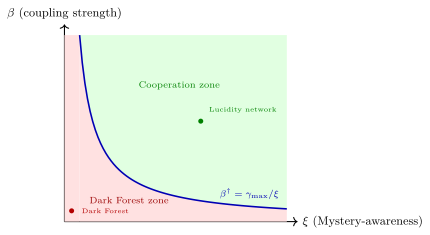
Let cooperation require enough coupling to overcome detection risk and uncertainty about intention. Coupling \(\beta\) supplies observable interaction, while Mystery-domain awareness \(\xi_{\min}\) supplies the capacity to interpret another civilization as more than a threat-vector. In the exemplary model of Appendix B.17, civilization \(i\) gains \(\beta_{ij}\xi_j\) in lucidity from \(j\), and \(j\) gains \(\beta_{ij}\xi_i\) from \(i\); cooperation is an equilibrium when each gain exceeds that side’s own dissipation (\(\beta_{ij}\xi_j>\gamma_i\) and \(\beta_{ij}\xi_i>\gamma_j\)). Both hold once \(\beta_{ij}\min(\xi_i,\xi_j)>\gamma_{\max}\), where \(\gamma_{\max}=\max(\gamma_i,\gamma_j)\), so \(\beta^{\dagger}=\gamma_{\max}/\xi_{\min}\) is a sufficient threshold, exact when \(\gamma_i=\gamma_j\). It, and the exact threshold \(\max(\gamma_i/\xi_j,\gamma_j/\xi_i)\) as well, is strictly decreasing in the Mystery-awareness and diverges as \(\xi_{\min}\to 0\), reproducing the Chain of Suspicion.
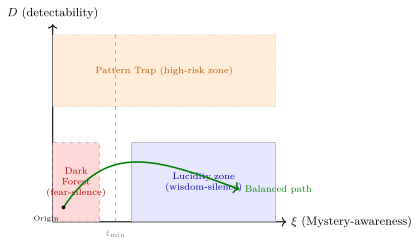
When mystery-awareness is absent, the required trust is infinite; this is the Chain of Suspicion. When even minimal mystery-awareness exists and communication is sufficient, cooperation emerges (Figure 57 and Figure 58). The Trust Threshold Theorem reveals the structural nature of the Chain of Suspicion: the chain is inevitable only given the specific premise that mystery-awareness is entirely absent. Breaking the chain requires a minimum of mystery-awareness; more bandwidth alone does not suffice.
T8 places the foundation of trust in depth of being: the threshold falls with \(\xi\) and never with \(\beta\). A civilization that perceives the inner life of the other (D4) deeply enough can build trust even with feeble communication. A civilization entirely devoid of Mystery-domain awareness cannot trust even with perfect communication.
The everyday version is the difference between a stranger and an old friend. With a stranger you need constant contact, signed contracts, proof at every step, because you cannot read them, and the trust threshold is high. With someone you know to the bone, a glance across a room is enough, because the depth of your reading does the work the contact would otherwise have to do. T8 says civilizations obey the same rule: the better two of them can read each other’s inner life, the less raw contact trust requires, and when that reading falls to zero, no volume of contact will do.
Note (on the trust threshold): T8 is stated qualitatively: the threshold is “inversely proportional” to \(\xi_{\min}\), not given as a precise formula. This is deliberate. A precise threshold function would require specifying the utility function, discount rate, and information structure of the civilizations involved, parameters that are unknowable at the cosmic scale. What the theorem establishes is the structural relationship: trust becomes cheaper as Mystery-awareness grows, and infinitely expensive when it is absent. The qualitative conclusion is robust across different game-theoretic formalizations; the specific threshold value is model-dependent. Any explicit formula in Appendix B.17 is one admissible functional form illustrating these monotonicities, not a uniquely derived law.
(conditionality): T7 and T8 are conditional theorems: they hold under the stated game-theoretic assumptions (purely rational actors, survival constraints; T7 adds zero communication, T8 the exemplary threshold model of Appendix B.17). These assumptions are posited; the postulates do not yield them. A civilization may be non-rational, altruistic, or may act in ways we cannot imagine. The correct reading of these theorems is therefore “if these conditions hold, then…”, not “the universe is necessarily thus.” The Fermi Paradox admits many possible explanations; the Civilizational Silence Theorem (T6) and the Dark Forest Theorem offer one explanatory framework, not a unique or falsifiable answer.
How to read the first map (Figure 57). The horizontal axis is mystery-awareness (\(\xi\)), how alive a civilization is to the inner life of others, running from blind on the left to perceptive on the right. The vertical axis is detectability (\(D\)), how loudly it shows up across the light-years, from quiet at the bottom to blazing at the top. Now find the corners. Bottom-left, blind and quiet, is the Dark Forest: silence out of fear, the trap of T7. Move right along the bottom, gaining mystery-awareness while staying quiet, and you cross into the Lucidity zone: the same outward silence, now chosen from wisdom instead of terror. The dashed line marks \(\xi_{\min}\). It is no absolute floor built into the model, since T8 gives a finite threshold for every mystery-awareness above zero. \(\xi_{\min}\) is defined against the largest coupling a civilization can actually build, \(\beta_{\max}\), as \(\xi_{\min} = \gamma_{\max}/\beta_{\max}\), where \(\gamma_{\max}\) is the fastest rate at which cooperation gains can be destroyed by defection: below that line the coupling required exceeds any channel it can lay, so cooperation lies out of practical reach, and the line shifts leftward as communication capacity grows. The whole top band is the Pattern Trap: shout loudly enough and you draw fire, whatever your wisdom. The green curve is the balanced path, where a maturing civilization rises briefly into visibility, then settles rightward and low, growing wiser and quieter at once.
How to read the second map (Figure 58). Both axes are now things a civilization can build: across the bottom, mystery-awareness (\(\xi\)), the depth to read another mind; up the side, coupling (\(\beta\)), how much two civilizations can actually reach each other. The curve \(\beta^{\dagger} = \gamma_{\max}/\xi\) is the trust threshold, and its shape is the whole lesson: it sweeps down as you move right. When mystery-awareness is poor (far left) the curve shoots up, meaning you would need impossibly thick communication before trust is rational; as it grows (rightward) the bar drops, and far less contact is needed. Above the curve lies the cooperation zone; below and to the left, the Dark Forest. Trust gets cheaper the better two civilizations can read each other, and no amount of bandwidth substitutes for that reading.
Appendix B.17 works out both the Dark Forest Theorem and the Trust Threshold Theorem in full game-theoretic detail, including the light-cone coupling function,6 detection risk function, and detailed cosmic game matrix analysis. The appendix grades both derivations as demonstrations rather than proofs, since each conclusion is conditional on that set of strong assumptions.
XVI.4 · The Pre-Political Cosmos: The Collapse of Inter-Dependence
Here the framework predicts the conditions of its own inapplicability. Recall the derivation chain from Chapter §XI:
Finitude (Postulate 4) \(\;+\;\) Plurality (P3) \(\;+\;\) Interdependence (D12)
\(\;\Longrightarrow\;\) Scarcity (P12)
\(\;\Longrightarrow\;\) Power (P13) \(\;\Longrightarrow\;\) Legitimacy (P15) \(\;\Longrightarrow\;\) Justice (P16) \(\;\Longrightarrow\;\) Freedom (P17) \(\;\Longrightarrow\;\) Democracy (P18)
Both branches rest on interdependence (D12 with its non-isolation premise): in a group of agents, each one’s conditions of unfolding (attention, resources, information environment) are partially determined by the unfoldings of others. Without interdependence there are no shared resources, so scarcity has nothing to arise from; equally, no party’s unfolding turns on any other’s, so power loses its structural ground. The two branches want keeping apart in the bookkeeping of Chapter §XI: P13 does not take P12 as a premise but follows from Postulate 4, P3, and D12 directly, and is indifferent to aggregate resources. Remove D12 and both branches break at once, neither one bringing down the other.
At cosmic scale, when \(\beta_{ij} \to 0\) (communicative coupling approaches zero), civilizations are de facto independent. Their unfolding conditions are no longer partly determined by one another, so D12 loses its grip.
Put it back on the ground and it is obvious. Two households drawing from the same well will sooner or later need rules: who draws when, who repairs it, who decides. Two households with their own separate wells, who never meet and never affect each other, need no rules at all, not because they are virtuous but because there is nothing between them to govern. Justice is not abolished in the second case; it simply has nothing to do. Stretch that second case to civilizations tens of thousands of light-years apart, each drinking from its own star, and the entire machinery of politics has no surface left to grip.
\(\beta_{ij} \to 0\) \(\;\Longrightarrow\;\) D12 has no instances between civilizations \(\;\Longrightarrow\;\) P12–P18 have nothing here to apply to
This has three consequences.
First, interstellar relations are pre-political in the dominant limiting case. By pre-political the chapter does not mean “primitive” or “early”: it means a condition in which the very ground politics needs has not arisen, so that words like just, unjust, free, and oppressive have nothing to attach to. The preconditions of politics, shared resources, mutual dependence, sustained interaction, are simply absent. Between civilizations separated by tens of thousands of light-years there is typically no common resource pool, no influence running from one history into another, no unbroken chain of contact. There is no political space between them, neither just nor unjust, neither free nor oppressive. Edge cases survive: a civilization capable of exterminating or permanently altering another across long timescales keeps a thin but real thread of interdependence. The pre-political diagnosis is cleanest when even that long-range thread is cut. Hobbes’s state of nature was “nasty, brutish, and short”; this is a different state entirely: distant, indifferent, and silent.
Second, pre-political is not the same as Dark Forest. The pre-political cosmos is merely indifferent; it neither notices nor cares. The Dark Forest adds one further assumption: civilizations lack mystery-awareness, expect predation, hide, and prepare to strike. Indifference is not caring; fear is caring too much.
Third, the framework’s failure here is its strength. Chapter §XI’s political philosophy derives from D12 and stops gracefully when the non-isolation premise of D12 no longer holds. When \(\beta > 0\) becomes possible again, as with two colonies on neighboring planets sharing one star’s light, one set of spacelanes, one cone of communication, D12 has instances again and politics returns. The boundary of politics is the boundary of interdependence. This is perhaps the most underappreciated premise of human politics: we need justice because we need one another. When interdependence vanishes, justice is not refuted; it simply has no field left in which to operate.
The framework dissolves in the pre-political cosmos. At the point of dissolution two radically different silences converge into one of the book’s most expansive philosophical images.
XVI.5 · Dual Silence
The entire cosmic arc converges here. The universe is silent; this is an observational fact. But silence comes in two kinds.
Fear-silence. “I am silent because I am afraid you will destroy me.” This is the silence of the child of obscuration, driven by fear as obscuration approaches totality. The civilization wraps itself in layers of concealment, purely out of external threat. This silence is contractive, defensive, depleting. The cost of maintaining it is a permanent arms race. The selection argument below names what actually drains lucidity on this path: dissipation falls on both silences alike, and what defeats a pure pattern-awareness strategy is that it pins itself to the end of the range where the growth term vanishes.
Wisdom-silence. “I am silent because I am listening.” This is the silence of the child of lucidity, with pattern-awareness and mystery-awareness in balance. The civilization no longer needs to broadcast its existence to the cosmos; the driving force is inner abundance rather than external threat; it has found within itself a listening deep enough. This silence is open, receptive, enduring, a form of plenitude.
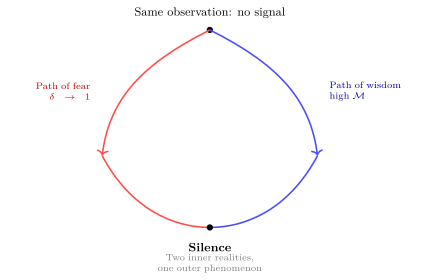
From the outside, the two silences are indistinguishable (Figure 59). The same observable phenomenon (no signal) corresponds to radically different inner realities. Fear and wisdom cast exactly the same shadow on the Pattern-domain surface. This itself is an instance of Postulate 3 at cosmic scale: the same observable phenomenon can correspond to radically different Mystery-domain states.
You have seen this in a single room. One person stands silent in the corner because they are terrified, scanning the exits, braced for an attack that may never come. Another stands silent in the same corner because they are wholly at peace, content, listening, with nothing to prove. From across the room the two look identical: two quiet people, not talking. You cannot read terror from serenity off the silence alone. The universe is that room enlarged past all horizons, and no telescope is a better vantage than the far side of it.
Selection can break this symmetry, though over a far narrower range than it first appears, and the bookkeeping is worth doing exactly.
Dissipation cannot do the discriminating. In the master equation of Appendix B.14 the decay term \(-\gamma\mathcal{M}\) applies to every agent, and the steady state \(\mathcal{M}^{*} = 1 - \gamma/\alpha\) says precisely that a civilization settled at balance is dissipating continuously as well; it has merely arranged to replace what it loses. Since both silences export entropy, entropy cannot tell them apart.
The growth term can. The growth factor of the master equation carries \(\sin(2\theta)\), which vanishes at the pure-Pattern end (\(\theta \to 0\), that is, \(\xi \to 0\)). A Dark Forest civilization sits at that end by definition: the growth term disappears, nothing opposes the decay term, lucidity falls monotonically toward zero, and the equation grants it no positive steady state at all. A balanced civilization sits near \(\theta = \pi/4\), where the growth factor is maximal and a positive steady state exists whenever \(\alpha > \gamma\). The model does therefore assert something: any configuration that sustains lucidity over the long run must lie far from the Pattern end.
But that assertion governs the persistence of lucidity and not the survival of civilizations. CV-Sur in Chapter §XV has already established that material survival runs orthogonal to the lucidity gradient. Lucidity falling to zero is not extinction, and a fear-silent civilization may go on living indefinitely at \(\mathcal{M} \to 0\). What remains sayable is the narrower claim: any civilization that is both still here and still lucid must lie inside the band where growth still outruns dissipation, clear of both extremes, while the bare fact that one is still here implies nothing about which silence it is keeping. This remains an argument internal to the model rather than empirical proof, because the survivors cannot be observed.
Dual Silence therefore reveals an epistemological limit: some truths about other minds, civilizational or personal, are unrecoverable from Pattern-domain observation alone. Better telescopes do not solve this, because the same observable phenomenon can map to different Mystery-domain realities. Postulate 6 acquires a sharper form: it now says more than “we cannot know everything”; it says “there are specific and important things we cannot know from observation alone.”
The same limit turns inward. T3 implies that a civilization trying to classify its own silence faces a self-referential trap: it uses Pattern-domain tools to judge a Mystery-domain state, and that very act may bias it toward “we are the wise ones.”
Silence also has a temporal shape. Fear-silence is frozen time: monitor, hide, monitor, hide; the civilization is locked in a defensive loop, and its silence is stasis. Wisdom-silence is living time: the civilization keeps unfolding, it has merely stopped broadcasting, and its silence is a dynamic peace. From outside, both look like one eternal stillness. From inside, one is a prison and the other is freedom. P6 (irreversible time) returns here at civilizational scale: fear-silence tries to slip out from under time’s arrow, hoping that if it stays quiet enough it can avoid discovery and avoid change; wisdom-silence leans into the arrow, accepting change and finding within it a deeper constancy.
The theme runs through the whole book at three scales, one note struck in three octaves: silence as a form of lucidity. At the personal scale (Chapter §VII), meditation is not “thinking nothing” but ceasing to pretend you know and opening to what you do not. At the social scale (Chapter §X), deliberative democracy makes power fall quiet long enough for buried voices to surface. At the civilizational scale, a whole civilization grows still. And at every scale the silence is dual: it can be evasion or courage, suppression or respect, fear or wisdom; and at every scale T1 still holds, so perfect silence is never reached, only approached.
The paradox of seeking follows. If Pattern-dominant civilizations grow quieter as they mature, knowledge about wisdom flows in the wrong direction: those who most need to listen are precisely the least likely to detect anything worth listening to. This is the cosmic version of Chapter §VIII’s individual paradox: a person immersed in obscuration will not go looking for lucidity tools, just as a civilization immersed in fear will not strain to hear the voice of cosmic wisdom. Perhaps this is why this book exists at all: using words to point toward silence, using noise to point toward quiet. Perhaps all philosophy is like this, the last stretch of noise on the way to silence.
Grand Reflection: Before Silence
Dual Silence is existential before it is cosmological. Every person faces a private version of it: when I am quiet, is it fear or wisdom, evasion or discernment, surrender or freedom? The indistinguishability holds inward too. From inside my own silence I cannot reliably tell which kind it is. Fear can wear the face of calm, avoidance can mimic detachment, and genuine wisdom sometimes looks like hesitation, because it is in no hurry to answer. The ambiguity stays; what practice gives is the honesty to sit with it and keep asking the question. And the willingness to ask “which silence am I practicing?” may itself be the first step from fear-silence toward wisdom-silence.
The universe’s silence is a mirror. What we see in it, fear or wisdom, says more about us than about the universe. The Fermi Paradox is therefore an invitation to us as much as a puzzle about them: grow quiet before the cosmos, listen first, and ask which silence we are moving toward. Postulate 3 tells us that Pattern and Mystery interweave inseparably. Dual Silence is that postulate enacted on the largest canvas there is, and we, a civilization suspended between the two silences, face a choice to be lived.
XVI.6 · Formal Structure at Cosmic Scale
Dual Silence revealed the epistemological boundary the framework meets at cosmic scale. But before reaching that wall, the framework can still distill several non-trivial formal propositions at this scale, propositions that extend the civilizational-scale results of Chapter §XV (in particular CV-Irr, CV-Inc, and CV-Osc) to the cosmic domain. This section keeps to the convention of Chapter §XV: calling a civilization an agent is the shorthand CV-Irr licenses, standing for a distribution across members together with the institutions that lock it in, and the civilization itself experiences nothing.
In plain terms, the four statements below say: Mystery in the cosmos vastly outnumbers Pattern, by a whole infinite level (CS-PMR); granting light-cone coupling, that vastness leaves each civilization nearly alone (CS-Lone); each lonely civilization is nonetheless an irreplaceable face of Reality (CS-CivAn); and we can never fully read another’s inner state across that distance (CS-Undec). Each is followed by a single line bringing it home to your own life, so if the formal labels blur, read for those landing lines.
Take two model premises in the measure model of Appendix B.1: Pattern is generated by countably many finitely describable regularities, and the sample space of reality has at least continuum many elements. Then Mystery strictly exceeds Pattern in cardinality, \(|\mathcal{P}(\Omega)\setminus\mathcal{F}| = 2^{|\Omega|} > |\mathcal{F}|\), and the same inequality holds within every region with at least continuum many elements, the cosmic scale being the largest such region. What an agent can reach is in turn strictly smaller than Pattern (Postulate 6), so the observable part never exhausts the whole.
The first premise is a reading of D3: Pattern is the intelligible aspect of reality, and what is intelligible must be describable by finite means. Finite descriptions are at most countably many, the \(\sigma\)-algebra they generate is countably generated, and it has at most \(\mathfrak{c}\) members. The second premise is the quantitative form of the richness assumption behind the intertwining condition of Appendix B.1.3: \(|\Omega|\geq\mathfrak{c}\). By Cantor’s theorem, \(|\mathcal{P}(\Omega)| = 2^{|\Omega|} \geq 2^{\mathfrak{c}} > \mathfrak{c} \geq |\mathcal{F}|\); removing a part of smaller cardinality from an infinite set leaves its cardinality unchanged, so \(|\mathcal{P}(\Omega)\setminus\mathcal{F}| = 2^{|\Omega|}\). Replacing \(\Omega\) by any region that meets the second premise leaves the reasoning intact, which matches the co-constitution of Pattern and Mystery at every scale in Postulate 3. The ratio the proposition asserts stops there: it is a comparison of cardinalities. The measure \(\mu\) is defined only on \(\mathcal{F}\), so Mystery has no size in the sense of \(\mu\); \(\lambda\), \(\xi\), and \(\delta\) measure an agent’s awareness and say nothing about the composition of reality (Appendix B.1.4). The framework therefore yields no figure of the form “Pattern is so many percent,” and the cosmological number below is offered as resonance, not as a measurement of ontological Mystery (see the strict disclaimer in XVI.2). With a completed \(\sigma\)-algebra of Lebesgue type the first premise fails and the two cardinalities coincide; the proposition does not adopt it, because completion counts every subset of a null set as measurable, and almost none of those subsets can be described by finite means.
Contemporary cosmology’s empirical data (approximately 95% dark matter and dark energy) provides a striking resonance with this proposition. This is not to say that dark matter “is” Mystery (see the strict analogical disclaimer in XVI.2), and the echo is one of imagery only, since the framework itself yields no figure.
The picture the universe presents is consonant with Mystery vastly exceeding Pattern. This proposition re-reads the “dark universe” from a problem awaiting solution as an interpretive confirmation of Postulate 3 at cosmic scale: on this model Mystery vastly exceeds Pattern in cardinality, by a whole infinite level from which no percentage can be read off, and more data will refine the Pattern-domain puzzle without completing it. To feel disquiet at this is to project Pattern-domain habits; to feel awe is the emotionally appropriate response within the framework.
So the next time you feel small under a night sky you mostly cannot see, notice that the feeling is the universe inviting you into awe rather than into fear.
Granting the light-cone coupling of Appendix B.17, inter-agent coupling \(\beta\) falls rapidly toward zero as spatial scale increases. Under that premise, Law 3 (Lucidity Is Social) generates a tragic tension: lucidity requires community, and community is barely constructible at cosmic scale.
Law 3 tells us: no agent can sustain lucidity alone. Treating a civilization as an agent under the convention stated at the head of this section, if civilizations are inter-dependent (D12), each one’s conditions of unfolding are partly determined by the unfolding of others, and the law applies between civilizations. By the light-cone coupling of Appendix B.17, coupling decays exponentially with distance and time-lag, so cosmic-scale \(\beta\) falls effectively to zero; and the spectral gap theorem of Appendix B.15 gives, near a common equilibrium, network synchronization time \(1/(\mu_2+\beta^*)\), where \(\beta^*\) is each agent’s own relaxation rate, because in the linearized dynamics deviations from that equilibrium decay at the rate \(\beta^*\) plus the corresponding network eigenvalue. The \(\beta^*\) part is each civilization relaxing to its own equilibrium, which brings civilizations to one level only if their parameters are identical. Taking civilizations to differ in their parameters, as nothing at cosmic scale makes them alike, only the network term draws them toward a common level: in a cosmic network so sparsely connected that its civilizations form effectively separate islands (formally, where the connectivity measure \(\mu_2\) approaches zero2), that pull vanishes, and at \(\mu_2=0\) each civilization settles at its own equilibrium, so lucidity synchronization among them does not occur. The two principles jointly yield a tragic proposition: you need others to remain lucid, but the cosmos all but forbids you to find them.
In this isolation, each civilization’s chief temporal lifeline is its own collective memory (CV-Mem): if memory degrades, lucidity degrades with it, and there is no neighboring civilization to remind you of what you have forgotten.
This is why the few people who keep you honest matter more than any library you own; when no one is left to remind you of what you have forgotten, you forget that you have forgotten.
The further a civilization whose pattern-awareness exceeds its mystery-awareness travels along the lucidity gradient, the quieter it grows (T6), so the wisdom it reaches is the harder to learn from outside; knowledge about wisdom flows in the wrong direction. The comparison is within a single trajectory; the corollary does not claim that of two civilizations the wiser is the quieter.
By T6 the detectability of a civilization evolving along the lucidity gradient while its pattern-awareness exceeds its mystery-awareness falls over time, the comparison being of one civilization against its own past. What can be learned from outside is bounded by detectability (a premise this corollary adds), and under the light-cone coupling of CS-Lone no other channel of coupling makes up the difference. So the further a civilization travels along its own trajectory, the harder the wisdom it reaches is to learn from outside. That is the sense in which the direction is wrong: the amount that can be learned moves opposite to the amount worth learning. The corollary states that it makes no cross-civilizational comparison, and that restriction is inherited from the same restriction in T6.
At cosmic scale, each civilization is nearly alone in its lucidity journey; those who most need wisdom are least likely to detect it. This is the cosmic analogue of individual spiritual solitude: the mystic’s “dark night of the soul,”1 stretched across light-years. It is also the cosmic amplification of the seeking paradox from Chapter §VIII: those who most need lucidity practice are precisely those least likely to seek it. At cosmic scale: a civilization is typically at its noisiest in the stretch of its own history when it most needs to listen. The difficulty is compounded by CV-Osc: even a civilization that has achieved balance keeps it only by continuous correction, and without inter-civilizational coupling to provide corrective feedback, that correction must be made alone.
Different civilizations are analogical unfolding modes of Reality (D8 at cosmic scale): ontologically distinct, none is a like term for another, so the destruction of any civilization is structurally irreplaceable; granting E2, that irreplaceability is a loss to Reality’s self-expression.
Replacement requires a like term to exchange in; the irreplaceability claimed here is that of C5.1. By D8, the two terms of an analogy are ontologically distinct, neither identical nor utterly different. By CV-Irr, a civilization is an emergent structure irreducible to its members, and the structures accessible to it are shaped by its own history, language, and institutions. Together these give the ontological part: no other civilization can stand in as a like term for one that is lost, and its destruction cannot be structurally made good. This part asserts only that civilizations cannot be exchanged; whether what one reveals is invisible to all the others taken together would need a further coverage premise, and the proposition does not assert it. The value part does not follow from them. Moving from “cannot be made good” to “is a loss” requires a bridge, and that bridge is E2. The bookkeeping matches P11, which books the same step from being to value to E2 in an explicit note. Without E2 the proposition retains only its ontological claim: Reality’s self-expression is thereby narrowed.
Just as P11 asserts at the individual level that every agent’s existence requires no external justification, CS-CivAn asserts at the cosmic level that every civilization’s existence is intrinsically valuable; in both cases the step into value is booked to E2, and without that bridge what remains is the ontological claim alone. A civilization we have never contacted, never known about, in some star system we cannot see, is right now unfolding an aspect of Reality in ways we cannot imagine. Its destruction is a permanent loss to Reality, even if we never learn that it existed. This is the maximal extrapolation of ethical concern: reverence for what we can never know.
Civilizational convergence (cultural imperialism, technological monoculture) is a form of obscuration at cosmic scale, reducing the diversity of Reality’s self-expression.
By CS-CivAn distinct civilizations are analogical modes of Reality’s unfolding (D8), none exchangeable for another, so the loss of one is structurally unsubstitutable. Convergence reduces the number of such modes and so reduces the diversity of Reality’s self-expression, which is the same verdict P3 returns on homogenization (C3.1). Calling it obscuration takes one further step: by D6 obscuration includes neglect of the intelligible aspects of reality, and after convergence the aspects other civilizations would have disclosed go unattended, which falls under that branch. Whether the reduction amounts to a loss in value is where CS-CivAn has already declared that E2 is additionally required.
Civilizational convergence is not only a cosmic-scale phenomenon. On Earth, globalization is already accelerating this process: languages dying, cultures homogenizing, all cities beginning to look alike. CS-CivAn.1 projects EP3 (protecting difference is protecting the good) from Earth to the cosmos: if the richness of Reality is expressed through diversity, then eliminating diversity (at whatever scale) impoverishes Reality. In the cosmos we may be powerless to prevent the destruction of distant civilizations; on Earth, protecting cultural diversity is the cosmic ethic available to be carried now, and the duty falls on particular bearers: the legislators and funding bodies who set language and education policy, universities and museums, and every agent with the authority to decide whether a language is still taught (E1, E4). The constraint EP3 carries holds here too: what is protected is difference that widens experience, and difference that manufactures suffering is not within this scope of protection (D11).
This echoes across scales with P3 (eliminating difference impoverishes Reality) and Corollary C3.1 (homogenization harms Reality’s unfolding): the threat of homogenization at the individual level is amplified at the civilizational level into an ontological impoverishment.
At cosmic scale, certain questions about the inner states of other civilizations are not merely unknown but undecidable in principle by Pattern-domain observation.
Dual Silence demonstrates that identical observables (no signal) can correspond to radically different inner realities (fear versus wisdom). No Pattern-domain means can resolve this undecidability. This is Postulate 6 (Cognitive Finitude) operating at maximum force: not merely “we cannot know everything” but “there are specific, important things we cannot know”, the root cause lying in Postulate 3: Pattern and Mystery are interwoven and irreducible, so Pattern-domain observation is ontologically insufficient to recover Mystery-domain states, a gap no technological advance can bridge. CV-Inc (the Civilizational Incompleteness Proposition) has already exposed the intrinsic limit of self-modeling at civilizational scale; cosmic undecidability is the same logic carried to the largest scale there is.
You already live inside this limit at human scale: you will never fully recover what the person beside you is feeling behind a calm face, and learning to love them anyway is the whole art.
Any cosmological theory claiming to fully explain civilizational silence (e.g., “they are all extinct” or “they are all hiding”) claims knowledge that CS-Undec rules unobtainable in principle by Pattern-domain observation, and so oversteps at cosmic scale the boundary T3 draws.
By CS-Undec certain questions about the inner states of other civilizations are unknowable in principle at cosmic scale. A theory claiming to explain the silence completely must exclude the other possibilities, wise silence and fearful silence among them; excluding them means settling whether silent civilizations have those inner states, which is one of those questions. So it claims knowledge CS-Undec rules unavailable, the ground being T3’s self-reference limit in its civilizational form. What the corollary denies is the strength of complete explanation; whether any given explanation might be true is not at issue.
CS-Undec demarcates “what we cannot possibly know,” a boundary guaranteed by the irreducibility clause of Postulate 3, which no improvement in instruments can move.
There is a strange relief in this for you: you do not have to decode everyone you love, or solve the universe, before you are allowed to live well within it.
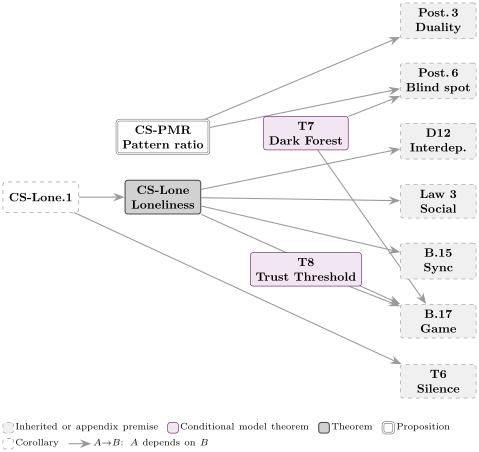
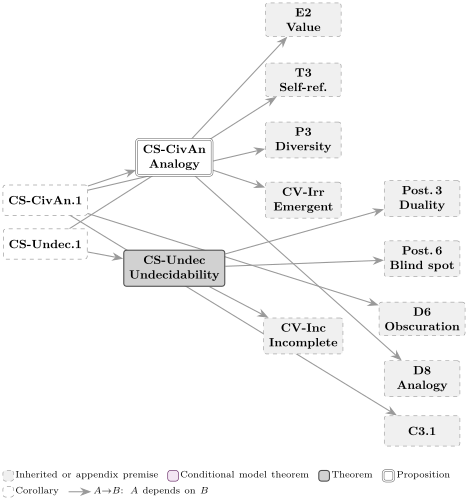
Formal Structure Dependency Diagram
The two diagrams below map the cosmic-scale formal dependencies. Arrow \(A \to B\) means “\(A\) depends on \(B\)”; in each panel the corollaries stand at the left, with their parent structures and premises ranged to the right. Grey nodes are inherited structures or appendix-level models; purple nodes mark the conditional game-theoretic theorems of Section §XVI.3.
XVI.7 · Beyond Dual Silence: Five Extensions of the Framework
A natural question arises: if Dual Silence is the cosmic-scale endpoint, can Lucidosophy be extended further? The question has five mutually compatible answers, each revealing a different dimension of what “beyond” means.
Do not read the five as a checklist to master; read them as five honest answers to one question a reader is right to ask, “is that all?” The Return says where to go next (back to the personal); Meta-lucidity asks whether we can go deeper (awareness of the limit itself); the Living Paradox notes that stating a limit already steps past it; Silence-as-extension suggests the extension may be learning to stay quiet; and Temporal Openness says “beyond” is a time, not a place, the genuinely new the future will bring.
The first extension: The Return (circle). Dual Silence is a turning point. When the framework meets the cosmic boundary (as inter-civilizational coupling approaches zero, the collective lucidity of Appendix B.16 degenerates into unrelated single points, so no inter-civilizational gradient is left to take, while the single-agent gradient \(\nabla\mathcal{M} = (\xi, \lambda)\) stays well defined throughout), it naturally curves back. The rational response is redirection: the field on which a gradient could be taken vanishes at cosmic scale and stays intact at the personal scale. Dual Silence shows that the personal scale is irreplaceable: it is the scale the cosmic boundary cannot take away, and so the place where lucidity can always happen.
The book thus forms a circle, not an arrow: Chapter §XVI curves back to Chapter §I. One who has grasped cosmic silence returns to the everyday (meditation, practice, relationships) with changed understanding.
The second extension: Meta-lucidity (recursion). Dual Silence demonstrates the framework’s limits. But recognizing limits is itself a form of lucidity, lucidity about lucidity. This generates recursive levels: first-order lucidity is lucidity about Reality (pattern-awareness \(\times\) mystery-awareness); second-order lucidity is awareness of first-order lucidity’s limits, or lucidity about the framework; third-order lucidity is awareness of second-order lucidity’s limits, and so on.
Each meta-level adds diminishing but nonzero insight. The levels do not terminate: after any finite number of them, another thin layer of understanding remains available. Whether those increments sum to a finite total the framework does not claim, since diminishing nonzero terms may converge and may not. Chapter §XVII (Philosophical Genealogy and Position) is one exercise of this second order: it sets the framework back among the traditions and reads off, against them, where it stands and where its reach ends.
The third extension: The living paradox. Dual Silence contains a generative paradox: the proof that certain truths are inaccessible is itself an accessible truth; marking the place of silence is itself a form of speech (T4); and the framework’s marking of its own limits is still work done inside the framework.
Each time you articulate a limit, you slightly transcend it, creating a new limit requiring further articulation. The boundary between the expressible and the inexpressible is itself expressible, which shifts the boundary, which demands new expression…
Lucidosophy is therefore inherently open-ended, because the relationship between speech and silence is generatively unstable. The framework will never be “finished”, just as Reality never stops unfolding.
The fourth extension: Silence is the extension. Perhaps the very assumption of “extension” is a projection of Pattern-domain habits: more propositions, more theorems, more speech. But at cosmic scale, T4 teaches that the most honest response to the inexpressible is to mark the place of silence.
The “extension beyond Dual Silence” may be learning to dwell in silence without rushing to fill it. The book’s structure here embodies its own teaching: after the dense formal apparatus of the preceding chapters, that apparatus leaves the stage entirely in Chapter §XVIII. Fewer words, more space. The extension is less propositional than performative: the book itself becomes what it describes.
The fifth extension: Temporal openness. Dual Silence is a spatial cosmic endpoint. But Reality also unfolds temporally. Postulate 2 asserts that Reality necessarily unfolds into infinite diversity. Future epochs will produce entirely new forms of being with no analogy in current experience, genuinely novel unfolding modes.
“Beyond” is a time, not a place: the future as genuine novelty. T2 (Emergence Theorem) at the cosmic-temporal scale guarantees that new levels of reality will emerge, irreducible to current levels. Lucidosophy as a living framework must remain open to revision by future unfolding, a feature that mirrors Reality’s own inexhaustibility. Here the Intergenerational Legitimacy proposition (CV-IG) acquires cosmic force: if present civilizations shape the unfolding conditions of future ones, then temporal openness becomes a binding ethical constraint across deep time.
Grand Reflection: The Interweaving of Five Extensions
The five extensions are not mutually exclusive. They are five dimensions of a single answer:
The Return provides the structural answer: after cosmic silence, return to the personal. Meta-lucidity provides the logical answer: reflection on limits generates new levels. The living paradox provides the philosophical answer: the boundary between speech and silence is generatively unstable. provides the aesthetic answer: the book itself tends toward silence. Temporal openness provides the ontological answer: Reality’s unfolding guarantees future novelty.
The complete answer may be to weave all five together: what comes “after” Dual Silence is simultaneously a return, a meta-reflection, a paradox, a silence, and an openness to the genuinely new. This is Reality’s way: the answer to a question is a living structure, resonating across multiple dimensions at once.
The Dark Universe and the Dark Forest are theoretical constructs for cosmological speculation, and they are also mirrors held up to individual existence. If 95% of cosmic reality is invisible to current instruments, how much of your own inner reality remains unseen? Faced with a universe that is mostly dark, cultivating \(\xi\) (Mystery-awareness) is the honest response. Daily practice (Chapter §VIII) is where this cosmic insight touches ground: each morning calibration, each moment of wu wei awareness, each act of letting go is a finite agent’s way of honoring the inexhaustible depth in which it is embedded. The cosmos whispers the same lesson at every scale: what you cannot see is vaster than what you can, and the appropriate response is attentiveness.
What This Chapter Cannot Decide
Whether the Dark Forest model actually describes the strategic landscape of our universe is an empirical question the framework cannot settle; the theorems (T6, T7, T8) establish structural possibilities, not observed facts. Whether any civilization has crossed the Trust Threshold (T8) or achieved inter-civilizational cooperation remains beyond the reach of any purely philosophical framework; the Cosmic Undecidability Theorem (CS-Undec) is the framework’s own admission of this limit.
The chapter’s central metaphor (95% of cosmic reality as dark matter and dark energy mirroring Mystery’s dominance) is an analogy, not a derivation; the framework does not claim that physical darkness is ontological Mystery, only that the structural parallel is illuminating. Whether pre-political conditions (no shared institutions, no communication, no trust) actually obtain between civilizations in our universe is an astronomical question that no amount of axiomatic reasoning can answer.
Summary
Dual Silence is one of the book’s most expansive philosophical images: fear and wisdom produce the same observable phenomenon (no signal). This is Postulate 3 enacted at cosmic scale: the same Pattern-domain surface can map to radically different Mystery-domain realities. The framework dissolves in the pre-political cosmos, which shows that it knows where its map ends. The deepest question is not how many civilizations exist, but which kind of silence you yourself are practicing. The next chapter returns from the cosmos to the self: the framework sets itself back into the history of philosophy, asking what it inherits, where it parts from which traditions, and what position it occupies among them.
Inquiries
T7 (the Dark Forest Theorem) is the limiting case where \(\xi=0\) (mystery-awareness is zero, no perception of the other’s inner life): with the theorem’s other two restrictions also in force, namely no communication between civilizations and survival-dominated payoffs, the unique pure-strategy equilibrium is silence and armament. In interpersonal relationships, when you cannot perceive another person’s inner life at all, does a similar “chain of suspicion” arise?
The silence of fear (closure for self-protection) and the silence of wisdom (restraint born of maturity) are observationally indistinguishable: both appear simply as “no broadcast.” In your own life, has there been a moment when you could not tell which kind of silence you were practicing?
The framework acknowledges its own dissolution in the pre-political cosmos (the region where communicative coupling \(\beta\to 0\), so that D12 (interdependence) loses its grip): the series of political conclusions from P12 to P18 has nothing left in this domain to apply to. Does this self-admitted limitation strengthen or weaken your trust in the framework? Why?
“Which kind of silence are you practicing?” This is the chapter’s final question. Do not rush to answer. Pause first. Then face it honestly.
T8 (the Trust Threshold Theorem) says that coupling strength above a trust threshold is enough for cooperation to emerge, and the threshold is inversely proportional to minimum mystery-awareness: the better agents perceive one another’s inner life, the less “physical closeness” is required for cooperation. In your life, what increases your trust in others: more information, or deeper relationship?
Dark matter is “structural Mystery”: it shapes galactic structure through gravity (a Pattern effect) yet is invisible to electromagnetic observation (Pattern’s tool). What forces in your life are shaping you yet cannot be directly observed?
The framework acknowledges its own dissolution in the pre-political cosmos. A good philosophical framework should know where it fails. Do the other belief systems you hold (religious, political, scientific) also know where they fail?
Emmy Noether (1882–1935), German mathematician. Her 1918 theorem states that every continuous symmetry of a physical system corresponds to a conserved quantity: symmetry under translation in time yields conservation of energy, symmetry under translation in space yields conservation of momentum. The theorem is named here to mark a boundary. That the three components of lucidity sum to one is a normalization identity in the bookkeeping, with no symmetry standing behind it, and so it is not a conservation law in Noether’s sense. The physics audit of Appendix B makes the same distinction separately.↩︎
The existence of dark matter was first inferred by Fritz Zwicky in 1933 from mass discrepancies in galaxy clusters, and later confirmed by Vera Rubin in the 1970s through galaxy rotation curves. Dark energy was discovered in 1998 through Type Ia supernova observations showing that the expansion of the universe is accelerating. The physical nature of both remains unknown.↩︎
Liu Cixin, The Three-Body Problem trilogy (2006–2010), one of the most important works of Chinese science fiction. The “Dark Forest” theory appears in the second volume, The Dark Forest (2008). The series won the Hugo Award and has been translated into dozens of languages.↩︎
The Chain of Suspicion is a central concept in The Dark Forest: because communication delays are immense and intentions cannot be verified, rational inference leads both parties to assume hostility even if both are benevolent. The horror of the idea is that it needs no villains: two entirely peaceful civilizations, each merely unable to confirm the other’s peacefulness, are driven by sound logic to strike.↩︎
Coupling strength \(\beta\) measures the real channel between two agents: how much one can communicate with, observe, or affect the other. High \(\beta\) means a thick, fast connection (neighbors sharing a star); \(\beta \to 0\) means an effectively severed one (worlds tens of thousands of light-years apart, where a message may take longer to arrive than its sender survives). The notation \(\beta_{ij}\) is simply the coupling between civilizations \(i\) and \(j\); “\(\beta_{ij}=0\) for all \(i \neq j\)” is the formal way of saying that no two distinct civilizations can reach each other at all. Coupling is a structural quantity here, not a measured physical constant; Appendix B.17 gives the light-cone form.↩︎
The light-cone coupling function is simply \(\beta\) made honest about physics: because no signal outruns light, two civilizations’ ability to affect each other falls off with distance and time-lag, the closer they are the higher their coupling, until at cosmic separations it falls effectively to zero. It is the physical reason cosmic \(\beta\) is almost always near zero.↩︎
Was this chapter helpful?