Part I · The Scale of Reality · What is real?
III · The Inner Face of Mystery
~20 min left · 4,922 words
III · The Inner Face of Mystery
§II unfolded Reality’s intelligible aspect. But Postulate 3 says Reality also has another face, the ineffable Mystery. If Lucidosophy spoke only of Pattern and not of Mystery, it would collapse into scientism, pretending that the intelligible is all there is. Why devote an entire chapter to the “unspeakable”? Because the deepest experiences of your life often live beyond the boundary of language: the moment beauty leaves you speechless, the unnameable presence touched in deep meditation, the bottomless feeling before death. To ignore these is not rationality, but obscuration. This chapter does not “describe” Mystery. That is impossible. It points toward Mystery from four directions. As T4 (the Silence Theorem) says: for the domain of Mystery, the most honest form of speech is to mark the location of silence.
III.1 · The Other Half of Reality
Here is a reading many careful thinkers favor, and for good reason: Mystery = “what we don’t know yet.” On this view Mystery shrinks to temporary ignorance, or at the outer limit to some stubborn ceiling on what minds can reach; science chips away at it century by century, and whatever survives marks the rim of our knowledge rather than any contour of the world. The appeal is real. It travels light, postulating nothing extra. It bows to a long ledger of riddles, comets and fevers and lightning, that science once filed under the inexplicable and later explained. And it spares us a second ontological category looming behind Pattern.
Lucidosophy hears this reading out, weighs it, and declines it. Read ontologically, Mystery is a genuine seam in reality, not a placeholder we paste over our ignorance. Call that a wager. No proof underwrites it; what follows are the reasons one might take the wager anyway.
Mystery (D4) is not Pattern’s (D3) “unexplored zone.” It is a domain different in kind: certain dimensions of reality lie outside the jurisdiction of knowledge as such, however much knowledge we gather. You cannot measure the beauty of music with a ruler, however fine the ruler. Beauty simply does not belong to the dimension of length.
The further science advances, the clearer this becomes. Physics can describe the wavelength of light to the nanometer, but about “what it feels like to see red” it has nothing whatever to say. Neuroscience maps brain activity with ever sharper precision, yet the question “why do these neural activities arrive accompanied by subjective experience at all?” stays structurally different from any neural map. None of this counts as a failure of science. It marks a boundary in the very kind of question being asked. Certain dimensions never fall within Pattern’s jurisdiction.
Mystery is Reality’s other half, as real, as rich, and as fundamental as Pattern, and no deficiency of it.
A deeper point waits underneath. Mystery is not merely other than Pattern in kind; it is inexhaustible in principle. Gödel’s incompleteness theorems, the mathematical forerunner of T3, proved that even on Pattern’s home ground, any consistent formal system strong enough for arithmetic holds truths it cannot prove from within: Pattern runs short even of itself. Mystery presses past that. It is a region where the whole machinery of proving never gets a grip, lying deeper than Pattern’s own unprovable remainder. If Pattern cannot close over its own house, its purchase on Mystery is fainter still. The inexhaustibility is one of category, not quantity: the word “exhaustion” finds nothing in Mystery to fasten onto.
III.2 · The Four Depths of Mystery
Mystery has internal strata (Figure 16); it is no single, undifferentiated “unspeakable.”
An extension of Theorem T4 (the Silence Theorem): Mystery cannot be defined, but it can be indicated. The following four experiences are fingers pointing toward Mystery. They are not Mystery itself, only the four directions in which people most often touch it in everyday life.
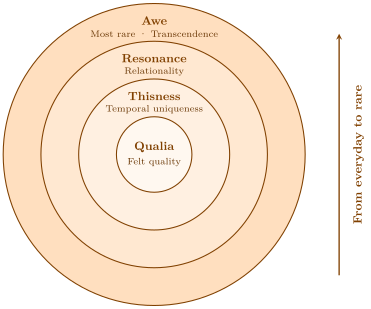
The first depth is qualia, the felt grain of things: the stubborn “what it is like” of experience, the redness of red, the ache inside pain, the lift inside joy. You could hold every physical fact about red, its band of 615 to 700 nanometers, the cone cells it trips, the flare in cortical area V4, and yet, if you had never once seen it, you would not know how red feels. Frank Jackson’s “Mary’s Room”1 brings this to a fine edge. Mary lives out her years in a room drained to black and white, having memorized every physical truth about color vision; the morning she steps into the open and meets red, she learns something fresh. That something is qualia. Pattern can narrate the light; it cannot stand in for the seeing. This is Mystery in its most everyday dress, awake in every flicker of sensation, and the taproot of Law 2 (Experience Is Irreplaceable). The lived texture of reading these very words is qualia. The formal model appears in Appendix B.7, Eqs. (eq:experience-map)–(eq:dignity-formal).
Qualia answers to dissipation on Pattern’s side of the ledger. Dissipation names a direction: order sliding toward disorder, heat draining toward cold. Qualia is that same arrow, but lived from the inside. A cup of coffee cools, and that is physics. The warmth leaving your cupped hands, that is qualia. The arrow of time is not only a lawlike scaffolding; it is also the felt grain of being alive.
(responding to counterarguments from consciousness science): Dennett’s “Quining Qualia,”2 Frankish’s illusionism,3 and higher-order theories all press a serious objection: perhaps qualia are cognitive artifacts rather than irreducible realities. Lucidosophy grants their force against naive introspection. Its reply is narrower: these theories relocate the explanatory gap rather than close it. A model may explain the architecture of consciousness-reports, but why those reports feel like anything remains unanswered. The physicalist may say Mary gains acquaintance or ability rather than a new ontological ingredient; Lucidosophy treats that as coherent but insufficient, because acquaintance itself has a qualitative character that resists third-person replacement. See §XIX.2 for the fuller objection-response treatment.
Lucidosophy does not pretend to have buried physicalism. Fifty years of professional philosophy have left the qualia debate open, its verdict still pending. The claim Lucidosophy does press is narrower and steadier: that the explanatory gap keeps reopening under every reductive strategy yet tried, and that ontological irreducibility accounts for this stubbornness better than mere complexity ever has. That is a judgment, not a demonstration. Readers who keep the physicalist reading will find much of Lucidosophy’s working framework still standing (see §XIX.1 for the explicit ledger of what holds and what frays under each reading). One corollary follows straight from the irreducibility wager: to simulate an experience and to undergo one are events of different ontological categories (E-Gap.1).
The second depth is thisness, or haecceity: the absolute uniqueness of each moment of experience. This moment, as you read these words, is a one-time event. Seeing the same painting twice gives two different experiences that happen to concern the same object. Medieval philosopher Duns Scotus called this haecceitas (“thisness,” from Latin haec, “this”): the irreplaceable “this-one-ness.”
Pattern can analyze causal structure, probability distribution, and statistical regularity, yet it cannot capture the uniqueness of this once. A model can say “70% chance of rain,” but never this rain on this window, this sound of drops on glass, this light, this mood. Gradient is Pattern’s account of measurable difference; thisness is difference shoved past the breaking point of measurement. The gap between this moment and every other is no magnitude you could plot on a graph: it is absolute, incomparable, singular. Pattern measures how much things differ; thisness marks that they differ at all, a fact no instrument was ever built to record. The formal model appears in Appendix B.8, Eqs. (eq:cumulative-value)–(eq:irreplaceability).
The third depth is resonance. Late at night, alone, you sit with a cello piece playing. At first the roles are clean: you are the listener, the music the thing listened to, subject here and object there. Then, at a moment no clock could have foretold, the seam gives way. You are no longer merely “listening to” the music; it has crossed into you, and your whole frame hums with the sound. The movement closes, silence comes down, and for those few minutes you cannot quite say where “you” had gone. The same shape recurs in other rooms of a life: staring up at the stars and feeling abruptly stitched into everything; loving someone until the border between “you” and “I” goes soft; talking so far down that the words seem to rise from the air between two people rather than from inside either skull. Zen’s “unity of subject and object” and Buber’s I-Thou relation both gesture toward this country, where the subject/object divide no longer rules over experience.
What dissolves here is a boundary in experience, not a distinction in concepts; this is no argument for monism. Pattern distinguishes parts; resonance lets the continuity beneath distinctions rise to the surface. If selection is Pattern’s mode of differentiation, resonance is its experiential reverse. Selection creates boundaries; resonance encounters what those boundaries never fully divide. The formal model appears in Appendix B.10, Eqs. (eq:weak-emergence)–(eq:info-emergence).
The fourth depth is awe: the trembling before what exceeds understanding. Fear makes you flee; awe holds you still, and you feel at once small and complete: at the Grand Canyon, before a newborn child, or under the thought that the universe has existed for 13.8 billion years. Rudolf Otto called this the numinous (from Latin numen, divine power); Kant called it the “Sublime,” the mixed pleasure and humility before what exceeds comprehension.
Awe is not the child of ignorance: for anyone who keeps looking at the boundary, the more they understand, the deeper the awe. The astronomer feels the universe’s depth more sharply than most, precisely because she knows more clearly how vast, how ancient, how improbable it is. This is the complementarity of Pattern and Mystery: the farther Logonaut sails, the more deeply he touches the depths that Mystient guards (both archetypes make their formal entrance in §IV). Feedback is Pattern’s account of return, output folding back as input; awe is that return raised to another level. You turn toward what exceeds understanding, and something turns back. Not information: a trembling that answers your gaze. Of the four depths, awe carries the complementarity most completely, for every step deeper into understanding deepens the tremor. The formal model appears in Appendix B.9, Eqs. (eq:godel-sentence)–(eq:self-reference-limit).
Why exactly four? The four depths mirror Pattern’s four modes (§II.3): dissipation appears inwardly as qualia, gradient as thisness, selection as resonance, and feedback as awe.4 They move from the most everyday to the rarest and cover felt quality, temporal uniqueness, relationality, and transcendence. Other candidates, including beauty, free will, death-awareness, and silence, either combine these four or belong to Mystery itself rather than to a particular depth.
The four depths above describe Mystery as encountered outward: in sunsets, in music, at the edge of the Grand Canyon. But Mystery also manifests reflexively, within cognition itself. §II.3 showed that mathematics, logic, and reasoning are Pattern’s four modes turned inward. Symmetrically, the four depths of Mystery turn inward too: they infiltrate the very act of knowing. Mystery is present every time you think.
The hard problem is reflexive qualia. Outward qualia asks what red feels like; reflexive qualia asks why anything feels like anything whatsoever. When you catch understanding in the act, not what you understand but the bare fact that understanding carries a felt character, you have met qualia at its deepest stratum. The hard problem of consciousness5 is Mystery’s most intimate reflexive showing, alive in every instant of cognition. You cannot think about thinking without bumping into it: the thinker is itself a quale.
Creative insight is reflexive thisness. Outward thisness is this rain, this moment; reflexive thisness is the unrepeatable eureka struck in idea-space. Poincaré setting his foot on a bus step and abruptly seeing Fuchsian functions whole6, Ramanujan taking formulas down from dreams, Kekulé watching the benzene ring close in sleep: one structure runs through all three. That is why mathematical biographies grip us so: the theorems belong to everyone, but their births belong only to the instant they broke. Intuition is Pattern arriving by Mystery’s channel: the cargo is Pattern, the manner of arrival is Mystery.
Understanding is reflexive resonance. When a proof finally clicks, you have stopped watching it from the bleachers; you are thinking with it. The line between “you” and “the structure” folds shut for a breath, and the proof seems to run itself through you. This is the wall named by P-Share (§II.3): Pattern’s content travels, understanding will not, because understanding is a resonance event. A teacher can lay down every step of a proof in order; the student’s “aha!” still has to surface from within. No tonnage of information stands in for resonance. Socrates’ image of the midwife is exact here: he could not deliver understanding, only crouch beside its birth.
Mathematical beauty is reflexive awe. Euler’s identity (\(e^{i\pi} + 1 = 0\)) knots five fundamental constants into a single line; it earns no more practical work than a hundred duller formulas, and still mathematicians call it beautiful. Hardy wrote that “there is no permanent place in the world for ugly mathematics.”7 Why should Pattern’s most exacting province throw off an aesthetic shiver at all? Because even at Pattern’s summit, Mystery refuses to be left at base camp. Mathematical beauty is awe turned inward: no longer the tremor before what exceeds understanding, but the tremor before the inexplicable elegance lodged within understanding itself. The proof is finished, each step warranted, nothing left dangling, and still you stand in awe. That “and still” is Mystery’s signature.
(reflexivity and AI): Pattern’s reflexive modes, logic, reasoning, and proof, can be implemented in silicon. AI already demonstrates this. Mystery’s reflexive depths, however, cannot be inferred from performance alone within Lucidosophy’s ontological reading. An AI can verify a proof, but does it experience the “aha!”? It can generate novel conjectures, but does it feel the haecceity of insight? It can rank a proof “elegant” by the statistics of human judgment, but does it tremble before beauty? These questions are not settled by better benchmarks; they follow from Postulate 3: if Mystery differs in kind from Pattern, then a system built wholly from Pattern may simulate Mystery’s outputs without thereby proving that it instantiates Mystery’s depths. See §XIV for the full development.
So the four depths mirror Pattern’s four modes, each wearing two faces: an outward face, Mystery met in the world, and an inward face, Mystery met inside the act of knowing. Set this beside §II.3’s reflexive reading of Pattern and the conclusion follows: even within the mind, Pattern and Mystery cannot be prised apart. You cannot think a single thought without dragging both along.
Pattern’s coverage of Mystery is strictly zero: the fraction of Mystery that Pattern’s operations can capture is zero. Mystery differs from Pattern in kind.
Postulate 3 establishes Pattern and Mystery as two aspects Reality necessarily possesses together. That step secures Mystery’s non-emptiness: were Mystery empty, “coverage is zero” would be satisfied trivially and the proposition would say nothing. D4 fixes Mystery as the dimension beyond all concepts and language; D3 fixes Pattern as the order through which all things can be known, analyzed, and expressed.
Suppose Pattern had positive coverage of some part of Mystery. By D3, whatever falls under Pattern’s coverage can be known, analyzed, and expressed, hence captured in concepts and language. By D4, whatever is captured in concepts and language is by definition no longer Mystery. That part would then belong to Mystery and not belong to it. Contradiction. No positively covered part exists, and coverage is strictly zero.
T4 agrees with this conclusion without independently supporting it: if some part of Mystery were sayable, marking the location of silence would no longer be the most honest speech about Mystery, and the Silence Theorem would fail. The Silence Theorem is the same fact seen from the other side, rather than a second premise.
Zero coverage is not absence. Pattern can be intertwined with Mystery everywhere without exhausting any fraction of it.
“Coverage” here names that fraction only; it is neither the sum of Lucidity’s components in Appendix B nor the coverage measure \(\mu_E\) that Appendix B supplies for D11. Were Mystery Pattern’s unexplored zone, it could be exhausted.
Note (reconciliation with intertwining): “Coverage strictly zero” and “intertwined everywhere” (Appendix B, Eq. eq:intertwining) are compatible. Appendix B formalizes Pattern as the \(\sigma\)-algebra \(\mathcal{F}\) and Mystery as the non-measurable remainder lying outside \(\mathcal{F}\) (Eq. eq:mystery-formal). Precisely because Mystery is not in \(\mathcal{F}\), Pattern’s operations have no way to assign it any positive captured fraction, and that is what zero coverage means. Eq. eq:intertwining then guarantees that both aspects are present within every non-empty open region. Zero coverage and universal co-presence therefore stand together, and they are the formal signature of the Pattern-Mystery relationship. One distinction is worth drawing: zero coverage is not measure zero. A set of measure zero is still measurable and so falls, by Eq. eq:li-formal, on Pattern’s side; Mystery’s zero coverage has another source, namely that Mystery lies outside \(\mathcal{F}\) altogether.
No advance of Pattern diminishes Mystery; on the reading that the boundary where Pattern meets Mystery lengthens with each advance, every advance also reveals more of Mystery’s depth.
By P-Mys Pattern’s coverage of Mystery is strictly zero, so no advance in Pattern can reduce Mystery: there is no quantity there to subtract from. That gives the first half of the corollary. The second half, that each advance reveals more depth, needs a further premise, which the statement names: every advance in Pattern lengthens the boundary at which Pattern meets what it cannot capture, and Mystery shows itself on that boundary. This is a hermeneutic reading of the interweaving in Postulate 3, which the postulate does not itself supply. The corollary is therefore stronger than non-reduction, and that reading is the extra step.
Every new theorem, every new model confirms this. Scientific progress does not shrink Mystery’s territory; the growth of AI intelligence does not eliminate Mystery’s dimensions; for one who stays open at the boundary, deeper understanding opens more room for awe. Newton’s late theological meditations, Einstein’s repeated invocations of “cosmic religious feeling,” Wittgenstein’s silence before the unspeakable: these are the responses of Pattern’s most accomplished practitioners on reaching the boundary. When AI surpasses humans in the domain of Pattern, humanity’s relationship with Mystery, the texture of experience, the uniqueness of the present moment, the depth of resonance, and the reality of awe do not become less important. They become more precious, because they mark the domain AI cannot simply replace.
(on anthropocentric bias): The four depths of Mystery are heuristic categories derived from human phenomenological experience; they are not claimed to be exhaustive or universal. Other modes of being (non-human organisms, potential artificial agents, or modes of unfolding we cannot yet imagine) may encounter mystery through dimensions that do not map cleanly to qualia, thisness, resonance, or awe. The framework offers these four as navigational landmarks rather than an ontological census, and remains open to revision as understanding deepens (consistent with EP6 and T3).
III.3 · Probability: The Meeting Point Seen from Mystery’s Side
Probability sits at the border crossing between Pattern and Mystery. Its structure (distributions, the laws of large numbers, the patient Bayesian update) belongs squarely to Pattern. Where its concrete realizations belong (why this outcome surfaced rather than another) depends on the case, and drawing that line precisely is the work of this section. Chapter §II already grants that the framework survives under merely ineliminable epistemic uncertainty. The question here is where more can be said, and where it cannot. The reasons for the commitment itself were given in §III.1, and its epistemic status is itemized in §XIX.1; neither is repeated here.
Take first the case where nothing stronger can be said. A radioactive atom has a 50% probability of decaying within an hour. One hour later, it has decayed, or it has not. Pattern can only say “50%,” and which side this particular outcome falls on it cannot settle in advance. But unpredictability in advance is not yet enough to assign the outcome to Mystery. By D4, Mystery is the dimension beyond all concepts and language, and the result of this decay is perfectly sayable afterwards: “it decayed” says the whole of it. Unpredictable and unsayable are two different things. A physicalist can consistently regard this decay as a Pattern-governed event that merely exceeds finite prediction, and Lucidosophy does not contest that ground. For realizations with no agent present, the framework claims only the weaker and steadier thing: the uncertainty here is ineliminable.
The stronger case needs someone present. Each of your decisions is such a case. Pattern can analyze the probabilistic structure of your decision: what factors are influencing you, and what consequences various choices are likely to bring. But after Pattern’s analysis is exhausted, the choice you actually make still leaves an irreducible remainder. That remainder goes beyond randomness8 (randomness remains Pattern’s concept); it is the experience of freedom: a special form of qualia. Here §III.2’s account of qualia takes over: whatever is undergone carries a core Pattern cannot reach, and by D9 no third-person description exhausts it. So for realizations an agent lives through, that remainder does belong to Mystery, and the step turns on its being lived rather than on its being unpredictable.
The probability distribution is the map Pattern draws. Where someone has walked, each realization presses a fresh footprint of Mystery into that map; where no one has, the map is still the map, with no one to tread it.
Push the horizon to its maximum scale: contemporary physics tells us that roughly 95% of the universe’s mass-energy is dark matter and dark energy, literally invisible to our instruments. Dark matter serves here only as an analogy: it shows how the unknown can be structurally present, but it is itself a scientific puzzle awaiting empirical resolution, outside Mystery in Lucidosophy’s technical sense. Mystery refers to what is structurally inaccessible to finite cognition (Postulate 6), while dark matter is merely not yet understood, and conflating the two is a category error. As an analogy, dark matter reminds us that what we can describe through Pattern (visible matter, measurable radiation, calculable orbits) is only a small fraction of Reality’s unfolding. The universe itself is a macroscopic illustration of Postulate 3. When we enter the cosmological scale in §XVI, this intuition will be developed further: the doubly silent cosmos is Mystery made manifest at the largest scale.
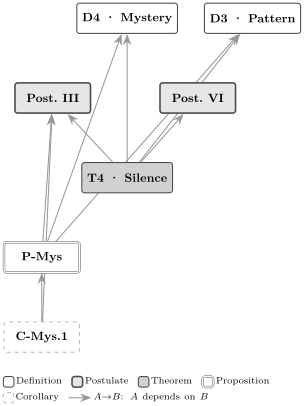
Formal Structure Dependency Diagram
The diagram below (Figure 17) shows the logical dependencies among this chapter’s formal structures. An arrow \(A \to B\) means “\(A\) depends on \(B\)” (\(B\) is a premise of \(A\)). Structures at the same logical depth are arranged horizontally.
Summary
Mystery is what explanation, by its nature, cannot touch. It manifests through four depths (qualia, thisness, resonance, awe), each with an outward face (Mystery in the world) and an inward face (Mystery in the act of knowing). Together with Pattern, Mystery completes Reality’s dual nature (Postulate 3): two faces of one reality, neither reducible nor separable. The next chapter gives this ontology a human face: three archetypes who embody different relationships to the boundary between Pattern and Mystery.
Inquiries
Mystery (Reality’s unspeakable-depth face) manifests through four depths: qualia (the inner texture of experience), thisness (the unrepeatability of the present), resonance (dissolution of the subject/object boundary), and awe (humility before depth). Which do you most often overlook in daily life? Why?
Mary’s Room: knowing all the physics of color is not the same as knowing the feel of red. In your own life, what analogous experiences of “knowing everything yet still not knowing” have you had?
Mystery is not “what we don’t yet know” (Pattern’s temporary blind spot) but “what is in principle inexhaustible” (a face of reality alongside Pattern, not behind it). What does this distinction mean to you? Can you give an example of something that resists full articulation not because we lack cleverness, but because of its very nature?
This chapter claims that deeper understanding can deepen awe: the more Pattern (intelligible order) is exhausted, the more Mystery (unspeakable depth) reveals its inexhaustibility. Have you experienced this counter-intuitive deepening? In what situation did knowing more make you more humble?
Resonance (the third depth of Mystery) describes the dissolution of the boundary between subject and object: in deep listening to music, the listener becomes indistinguishable from the sound. When did you last experience such boundary dissolution?
Gödel’s incompleteness theorems prove that even within Pattern’s own domain, any consistent formal system strong enough for arithmetic contains truths it cannot prove from within: an internal limit already lives inside intelligible order. How does this affect your understanding of “the limits of knowledge”?
If AI could perfectly simulate the outward signs of awe (tone, pauses, facial expressions) but lacked inner experience (D9: the first-person “what-it-is-like”), would that constitute awe? Why does this question matter?
Frank Jackson (b. 1943), Australian philosopher. “Mary’s Room” appears in “Epiphenomenal Qualia” (1982) and is developed further in “What Mary Didn’t Know” (1986). The argument runs: if physicalism is true, someone holding every physical fact should have no new fact left to learn; Mary plainly learns one; so physical facts do not exhaust the facts. Jackson himself later converted to physicalism, holding instead that Mary gains a mode of representation rather than a new fact, and that the argument has kept its currency among others after its author abandoned it.↩︎
Daniel Dennett (1942–2024), American philosopher. “Quining Qualia” (1988) runs fifteen intuition pumps to argue that the properties qualia are supposed to have (ineffable, intrinsic, private, directly apprehensible) cannot hold together, so the concept should be retired. He uses “quine” as a verb, meaning to deny the existence of something.↩︎
Keith Frankish (b. 1962), English philosopher. “Illusionism as a Theory of Consciousness” (2016) argues that the hard problem should be replaced by the “illusion problem”: what needs explaining is not why phenomenal consciousness exists but why we are so stubbornly convinced that it does.↩︎
Source map, consolidated for readability: qualia draws on Jackson’s “Mary’s Room” and Nagel’s bat essay; thisness on Duns Scotus’s haecceitas; resonance on Buber’s I-Thou relation and Zen subject-object unity; awe on Otto’s numinous and Kant’s sublime. Appendix A gives the longer intellectual-source account.↩︎
David Chalmers (b. 1966), Australian philosopher, formulated the “hard problem of consciousness” in The Conscious Mind (1996): why and how do physical processes give rise to subjective experience? The “easy problems” (explaining behavior, neural correlates, information integration) are tractable by standard scientific methods. The hard problem resists this approach because the explanatory gap between objective description and subjective experience appears structural rather than merely technical.↩︎
Henri Poincaré (1854–1912) described in his essay “Mathematical Creation” (1908) how the key insight about Fuchsian functions came to him unbidden as he stepped onto an omnibus in Coutances: “At the moment when I put my foot on the step the idea came to me, without anything in my former thoughts seeming to have paved the way for it.” He had been working on the problem intensely, then stopped. The insight arrived during a period of apparent idleness. This is one of the most cited examples of mathematical intuition operating outside conscious logical effort.↩︎
G. H. Hardy (1877–1947), English mathematician. In A Mathematician’s Apology (1940), he argued that beauty is the first test of mathematics: “The mathematician’s patterns, like the painter’s or the poet’s, must be beautiful; the ideas, like the colours or the words, must fit together in a harmonious way.” Hardy’s conviction that mathematical beauty is objective (not merely a subjective preference) finds a natural home in Lucidosophy’s framework: if beauty is Mystery’s fingerprint within Pattern’s domain, then its objectivity reflects the ontological reality of Mystery.↩︎
Even “randomness” itself resists capture by a single definition. In the second half of the twentieth century, three independent formalization paths were proposed: Martin-Löf typicality (indistinguishability relative to a measure), Kolmogorov incompressibility (algorithmic randomness), and martingale-based unpredictability. The three partially converge yet partially diverge; moreover, Gregory Chaitin proved that any given formal system can certify the randomness of only finitely many individual sequences, so for almost every sequence its randomness cannot be proved within that system. Randomness itself resists unified formalization: yet another manifestation of Mystery within Pattern’s conceptual toolkit. More precisely, each existing formalization of randomness belongs to Pattern; Mystery shows itself in the boundary fact that no unified formalization is available. When the main text keeps randomness under Pattern’s name, it means the former.↩︎
Was this chapter helpful?